essay
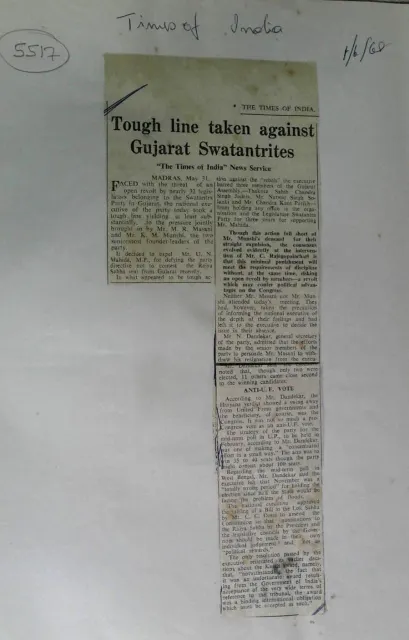
Tough line taken against Gujarat Swatantrites
THE TIMES OF INDIA · Madras · 1968
1 pages
Summary
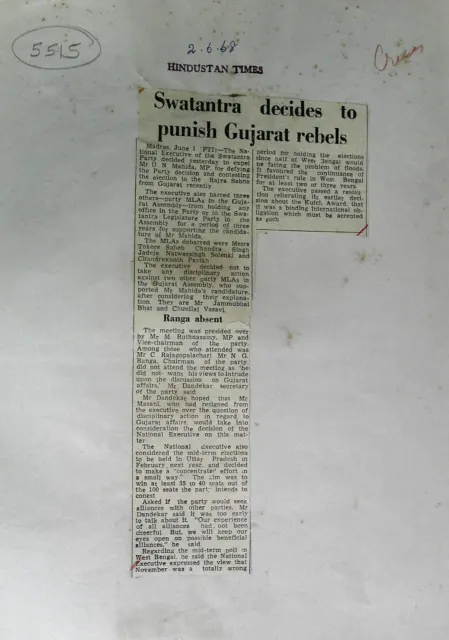
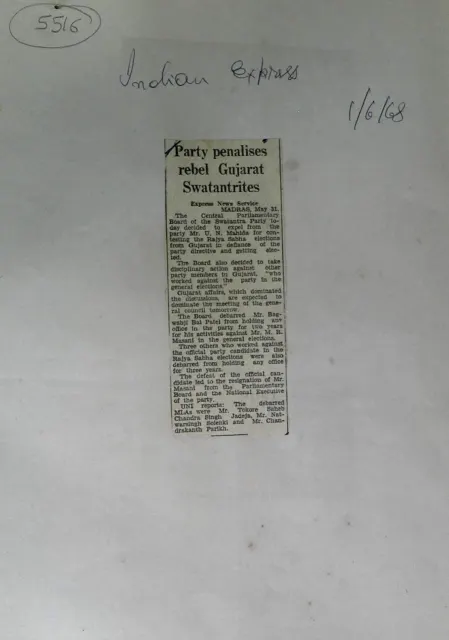
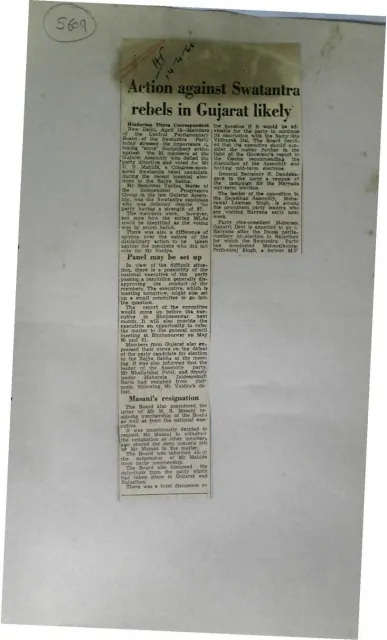
This Times of India News Service report, dated Madras, May 31, describes disciplinary action by the national executive of the Swatantra Party against its Gujarat unit. In response to an open revolt by 32 Gujarat legislators, the executive adopts a “tough line,” expelling U. N. Midhia, M.P., for defying the party directive not to contest the Rajya Sabha seat from Gujarat. The report also says that three Gujarat Assembly members—Sahib Chandra Singh Jadeja, Narwar Singh Solanki and M. Chandra Kant Parikh—were barred from holding party or legislative-organisation office for supporting Midhia.
The article presents the action as an attempt to balance discipline with the avoidance of a wider revolt. Minoo Masani and K. M. Munshi attend the meeting but leave the final decision to the executive, while N. Dandekar is reported to have acknowledged unsuccessful efforts to persuade Masani to withdraw his resignation. The latter part of the clipping turns to party and parliamentary matters, including an anti-United Front vote in Haryana, the proposed strategy for the mid-term poll in Uttar Pradesh, and the executive’s resolution on the Lok Sabha’s constitutional power to amend Fundamental Rights.
Key points
- The Swatantra Party’s national executive responds to an open revolt by 32 Gujarat legislators.
- U. N. Midhia, M.P., is expelled for defying a directive concerning the Gujarat Rajya Sabha contest.
- Three Gujarat Assembly members are barred from party and legislative-organisation offices for supporting Midhia.
- Minoo Masani and K. M. Munshi attend the meeting but leave the disciplinary decision to the executive.
- N. Dandekar reports that efforts to persuade Masani to withdraw his resignation have failed.
- The report links the party dispute to broader electoral questions in Haryana and Uttar Pradesh.
- The executive resolution supports the Lok Sabha’s power to amend Fundamental Rights, while acknowledging limits concerning the Constitution’s basic structure.
Metadata and summary are AI-extracted from the source PDF and reviewed for editorial accuracy. The original work is available via the Read PDF tab above (where present); paragraph-level citation inside the PDF is deferred to a future engagement.