essay
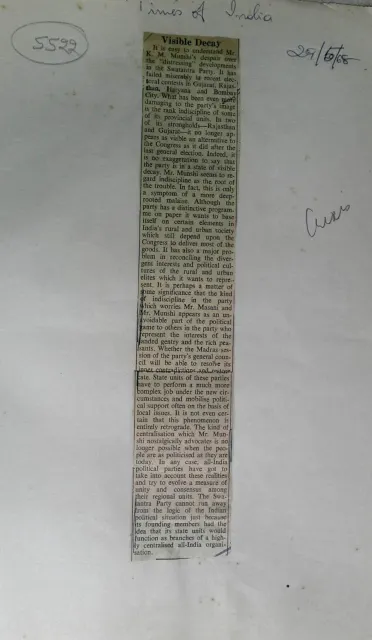
Visible Decay
1968
2 pages
Summary
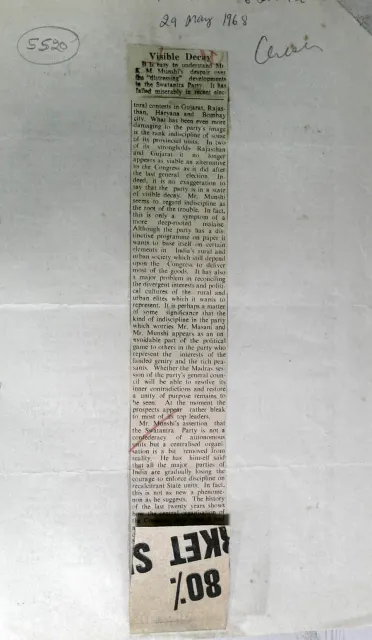
“Visible Decay” criticizes the Swatantra Party’s condition after poor performances in electoral contests in Gujarat, Rajasthan, Haryana, Bombay, and Bombay city. The clipping argues that the party’s visible indiscipline is a symptom of a deeper malaise: it must reconcile the interests of rural and urban elites while preserving a coherent alternative to the Congress. It questions whether the party’s general council can resolve these internal contradictions and restore unity of purpose. The visible passage ends before the argument is complete.
The second rendered page is a typed discussion of the performance of the H.S.L., apparently Hindustan Steel Limited, and rebuts a ministerial explanation that newer public-sector plants are inefficient because depreciation and interest charges are higher. It argues that modern plants should generate compensating economies through greater efficiency, especially reduced manpower requirements. The page cites alleged excess staffing and substantial overtime payments at Durgapur and Rourkela as evidence of operational inefficiency. The relationship between this fragment and the newspaper clipping is not established by the pages supplied.
Key points
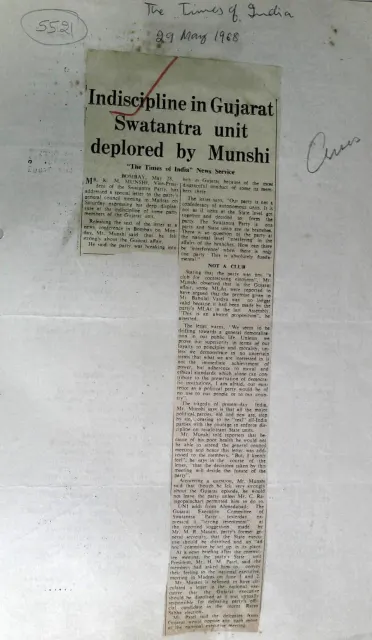
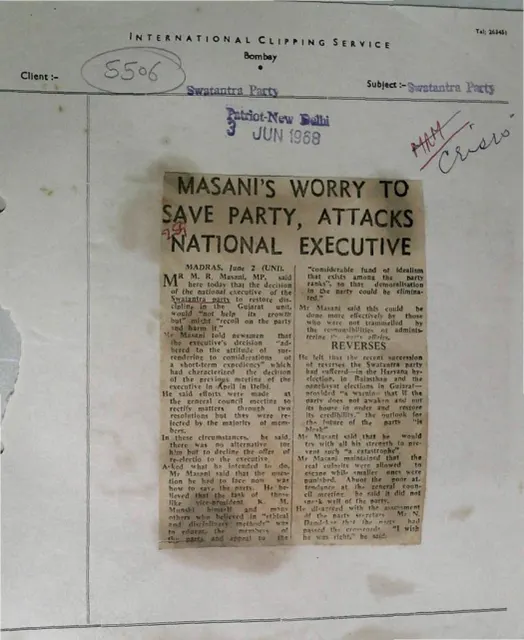
- The Swatantra Party is portrayed as suffering from electoral setbacks and serious internal indiscipline.
- The clipping treats indiscipline as a symptom of a deeper organizational and political malaise.
- The party’s difficulty is linked to the divergent interests of rural and urban elites whom it seeks to represent.
- The text questions whether the party’s general council can restore unity of purpose.
- The H.S.L. passage challenges the claim that depreciation and interest charges explain public-sector inefficiency.
- Modern plant economics are presented as capable of offsetting higher capital costs through greater productivity.
- Excess manpower and overtime payments at Durgapur and Rourkela are cited as evidence of inefficiency.
Metadata and summary are AI-extracted from the source PDF and reviewed for editorial accuracy. The original work is available via the Read PDF tab above (where present); paragraph-level citation inside the PDF is deferred to a future engagement.