
essay
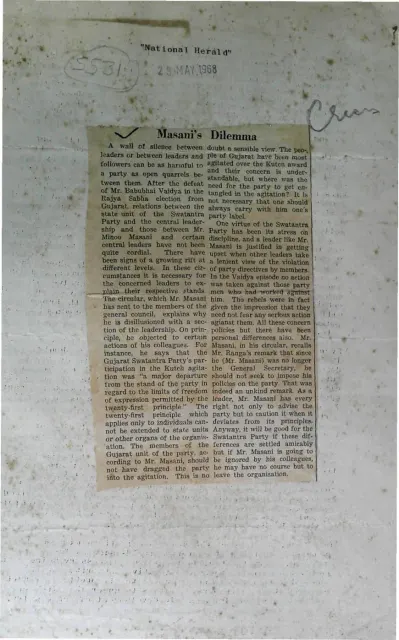
Masani's Dilemma
"National Herald" · 1968
4 pages
Summary
“Masani’s Dilemma,” published in the “National Herald” on 25 May 1968, examines tensions within the Swatantra Party after Minoo Masani’s defeat in the Rajya Sabha election from Gujarat. The article attributes the dispute to disagreements over party discipline, the limits of permissible dissent, the Kutch agitation, and the relationship between the Gujarat unit and the central leadership. It argues that Masani’s colleagues should address the disagreement openly rather than allow personal differences to weaken the organisation, while also recognising that many state units do not share the central leadership’s positions on planning, Kashmir, Kutch, language, nuclear deterrence, or Vietnam.
The accompanying typed draft letter to the Prime Minister sets out the Swatantra Party’s objections to the government’s approach to the Fourth Five-Year Plan. It distinguishes planning from the extensive system of controls, licences, permits, food zones, sugar controls, import substitution, and industrial licensing that the letter associates with corruption, patronage, and restricted production. The proposed alternative is a substantial reduction of controls, with any necessary licensing administered by an independent quasi-judicial body, alongside freer foreign exchange and export policies. The pages also cite Ireland, Taiwan, Pakistan, the World Bank, and Rafi Ahmed Kidwai in support of arguments about exports, economic growth, and the removal of food controls.
Key points
- The article presents Swatantra Party disputes as a conflict between Minoo Masani and elements of the central leadership.
- It defends Masani’s concern that party members should not be punished for dissent or for defending the party’s stated principles.
- It identifies unresolved differences among Swatantra units over planning, Kashmir, Kutch, language, nuclear deterrence, and U.S. policy in Vietnam.
- The draft letter argues that planning should not become an instrument for pervasive controls, licences, and permits.
- It calls for the abolition or sharp reduction of food, sugar, industrial, import, and export controls.
- It proposes that unavoidable licensing be handled by an independent quasi-judicial authority rather than ordinary government departments.
- It advocates freer foreign exchange and export policies, and urges national consensus rather than party politics on economic development.
Metadata and summary are AI-extracted from the source PDF and reviewed for editorial accuracy. The original work is available via the Read PDF tab above (where present); paragraph-level citation inside the PDF is deferred to a future engagement.
Related across the archive
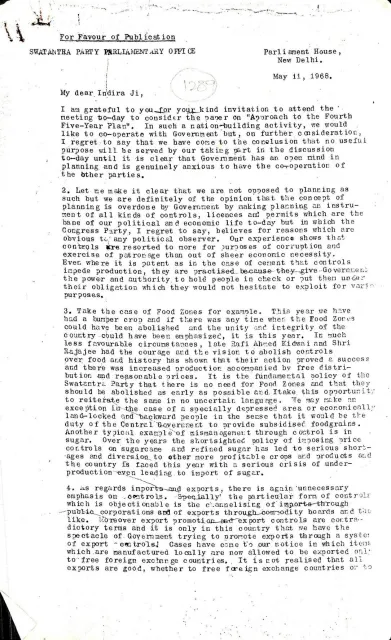 Primary workFor Favour of Publication
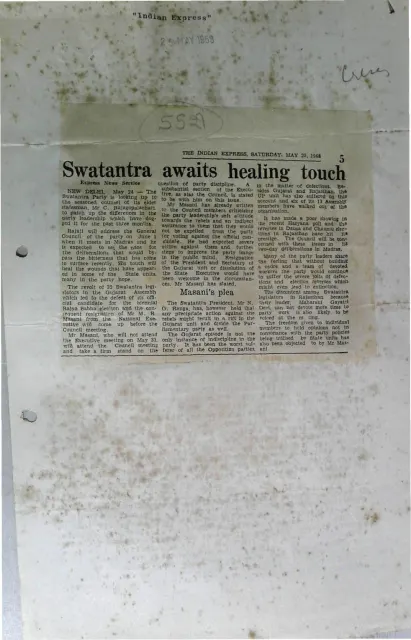 Primary workDraft letter to the Prime Minister regarding the Swatantra Party’s reactions to the approach to the Fourth Five-Year Plan.
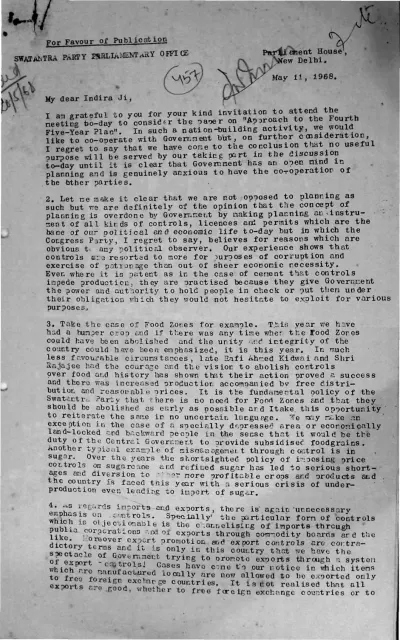 Primary workSwatantra Party Minutes of Meeting
 ExcerptOBSTACLES TO LIBERALISATION AND MARKET ECONOMY
 OpinionThe Aborted Promise of Economic Liberalisation in Mid-1960s