essay
Swatantra in the doldrums
1968
2 pages
Summary
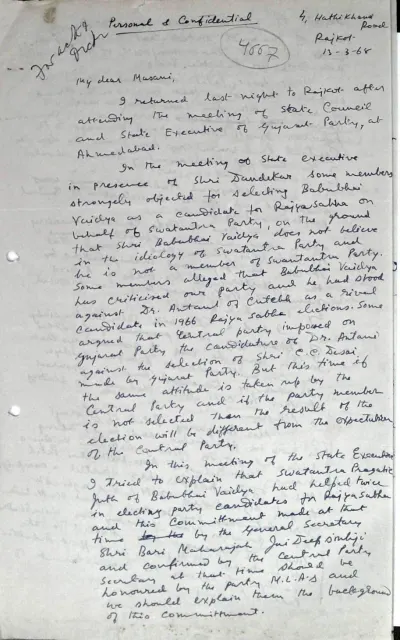
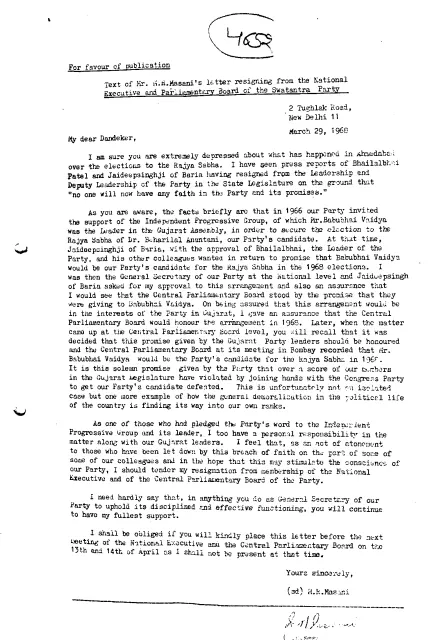
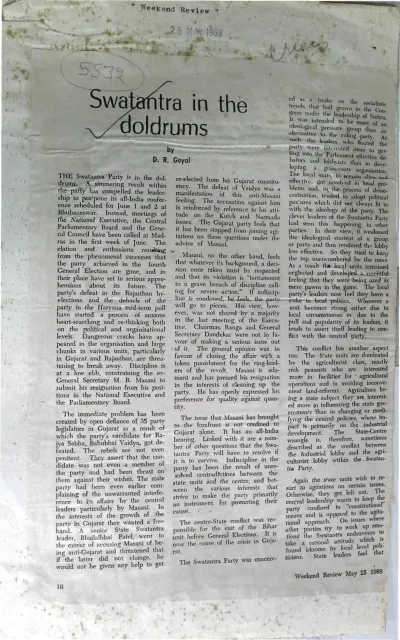
In the rendered article page, D. R. Goyal describes the Swatantra Party as being in organisational and political decline after its disappointing electoral performance. The postponement of its all-India conference reflects disputes within the leadership, especially over M. R. Masani’s position as general secretary, the revolt of Gujarat legislators over the Rajya Sabha candidacy of Babubhai Vaidya, and tensions between the party’s central leadership and its state units. The article argues that these disputes arise from weakened discipline, divergent regional interests, and the party’s failure to maintain a clear ideological centre.
The article also presents the conflict as a substantive disagreement over political method and economic policy. State units seek greater freedom to agitate on local issues, while the central leadership prefers constitutional methods and cooperation only where it serves the national interest. Its economic position is presented as a critique of indiscriminate public-sector expansion and centralised planning: public enterprises are described as loss-making, while private enterprise is defended where it can advance development. The rendered scan also includes a separate typescript letter signed by N. G. Ranga and addressed to Indira Gandhi; it is not a continuation of Goyal’s article, and its relationship to the clipping is unclear.
Key points
- The Swatantra Party’s postponed all-India conference is presented as evidence of internal crisis.
- Electoral reverses in Rajasthan and Haryana, alongside factional disputes in Gujarat, have intensified doubts about the party’s future.
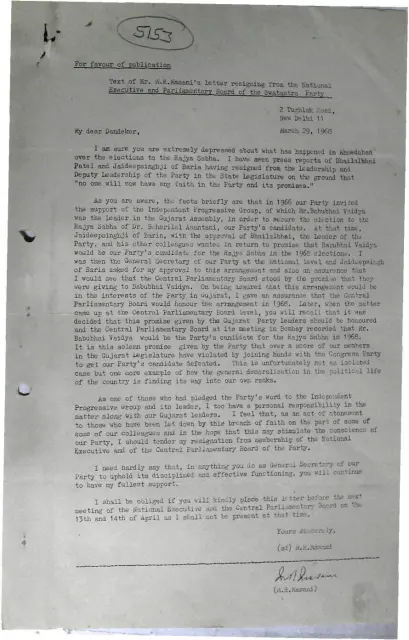
- The Gujarat dispute centres on legislators’ opposition to the party’s Rajya Sabha candidate, Babubhai Vaidya, and their resistance to central intervention.
- Minoo Masani defends party discipline and resigns as general secretary in the interest of organisational renewal.
- The article links the party’s survival to resolving tensions between the centre and state units and between competing regional interests.
- Swatantra’s ideological identity is weakened when local units focus on constituency demands rather than a common party programme.
- The economic argument criticises indiscriminate public-sector expansion and supports private enterprise where it can contribute to development.
- The article favours constitutional politics but rejects cooperation with government unless it is genuinely directed toward national consensus.
Metadata and summary are AI-extracted from the source PDF and reviewed for editorial accuracy. The original work is available via the Read PDF tab above (where present); paragraph-level citation inside the PDF is deferred to a future engagement.