
essay
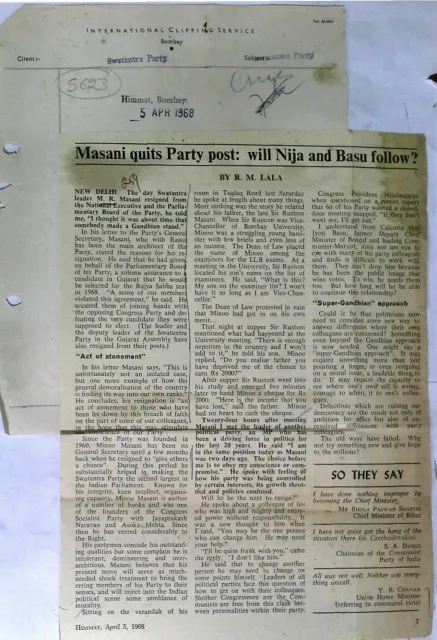
Masani quits Party post: will Nija and Basu follow?
Himmat · Bombay · 1968
2 pages
Summary
R. M. Lala reports on Minoo Masani’s resignation from the Swatantra Party’s National Executive and Parliamentary Board. Masani explains that he had given a candidate in Gujarat a solemn assurance of selection for the Rajya Sabha, but the party’s decision to nominate another candidate violated that commitment. He describes his resignation as an “act of atonement” and as a protest against what he sees as a breach of faith by colleagues. The article recalls Masani’s role as the party’s General Secretary since its founding in 1960 and notes both his organisational contribution and his critics’ complaints that he is intolerant, domineering, and overambitious.
The article then considers whether other party leaders, especially Rajaji and Minoo Masani’s colleagues, might follow his example. Through an anecdote involving Sir Rustam Minook, it presents Masani as a figure guided by conscience and personal integrity. It also reports criticism from Congress President S. Nijalingappa and Jyoti Basu, who argue that party colleagues and Communists have difficulty working with one another because of conflicting personalities and public images. The closing discussion urges a “Super-Gandhian” approach to political disagreement, arguing that democracy is damaged by unresolved personal and organisational conflicts and that politicians must learn to admit when they are wrong.
Key points
- Minoo Masani resigns from the Swatantra Party’s National Executive and Parliamentary Board.
- Masani says the party breached a solemn assurance concerning selection of a Rajya Sabha candidate in Gujarat.
- He characterises his resignation as an “act of atonement” and a protest against declining party integrity.
- The article reviews Masani’s contribution as Swatantra Party General Secretary since 1960, alongside criticisms of his leadership style.
- It speculates about whether Rajaji and other leaders may also resign.
- The article links political dysfunction to personal conflict, unresolved differences, and failures of conscience.
- It advocates a “Super-Gandhian” approach based on moral courage, self-criticism, and reconciliation.
Metadata and summary are AI-extracted from the source PDF and reviewed for editorial accuracy. The original work is available via the Read PDF tab above (where present); paragraph-level citation inside the PDF is deferred to a future engagement.
Related across the archive
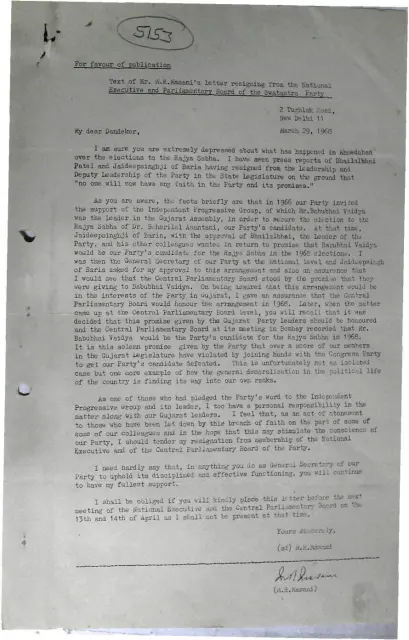 Primary workText of Mr. M.R. Masani's letter resigning from the National Executive and Parliamentary Board of the Swatantra Party
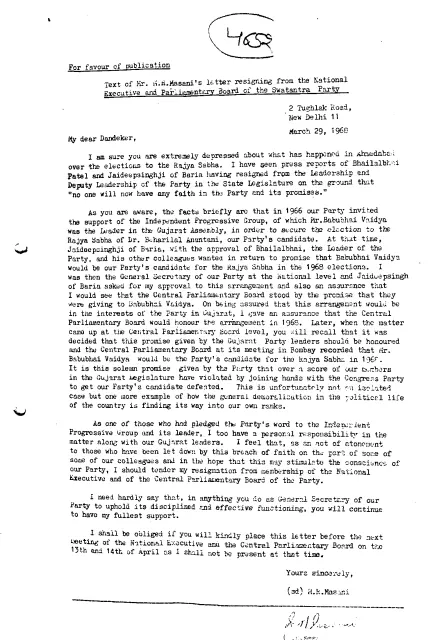 Primary workFor favour of publication
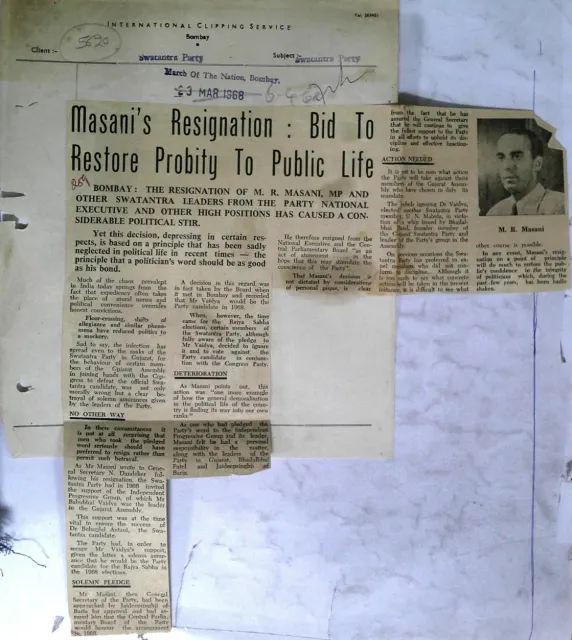 Primary workMasani’s Resignation : Bid To Restore Probity To Public Life
 OpinionHomi Mody’s Liberalism: From Pro-Business to Pro-Market
 ExcerptRajaji- Man with a Mission