essay
US House of representative
1976
15 pages
Summary
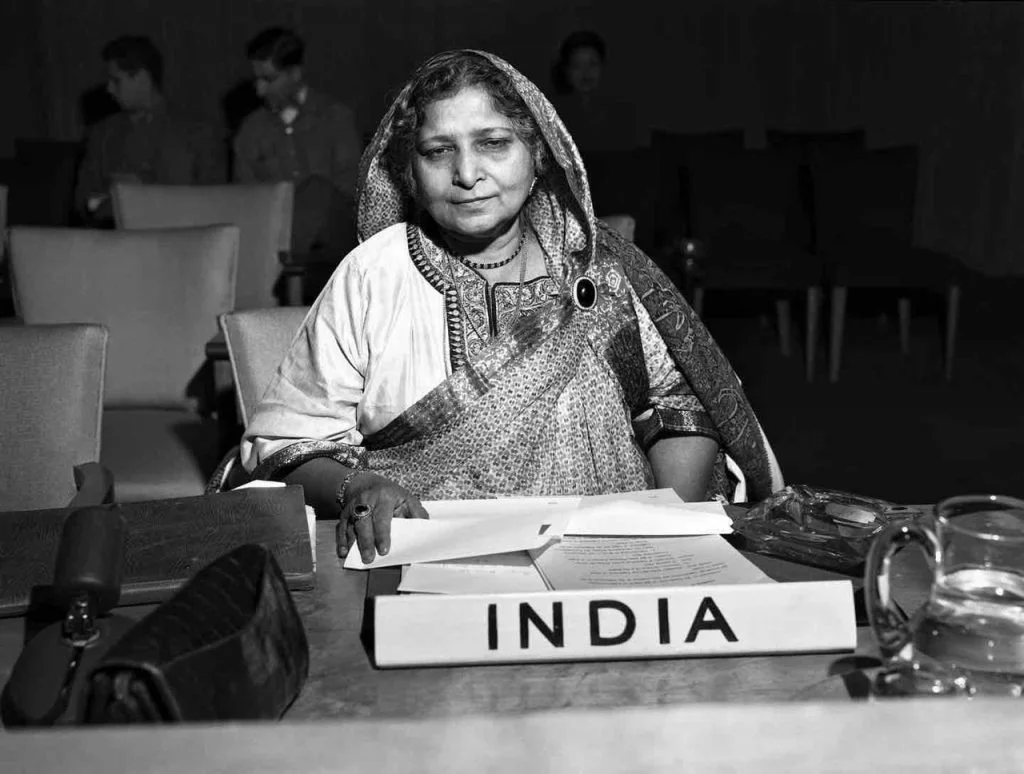
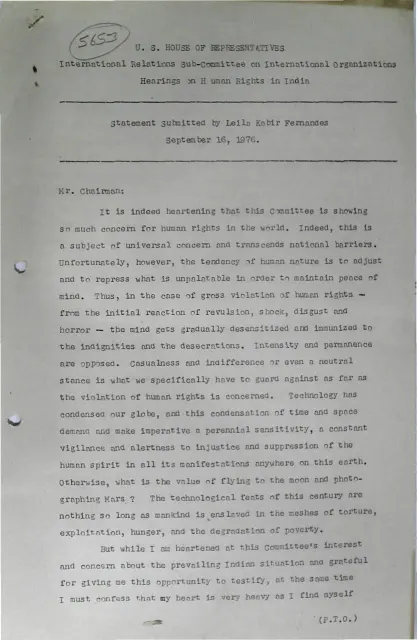
This 15-page statement, submitted by Leila Kabir Fernandes to the U.S. House of Representatives International Relations Sub-Committee on International Organizations on September 16, 1976, presents a personal and political account of human-rights violations during India’s Emergency. Fernandes begins by arguing that technological progress is morally meaningless when people are subjected to torture, exploitation, hunger, and poverty. She describes her inability to obtain information about her detained husband, George Fernandes, or to return to India and see her elderly mother, and explains that she has come before the committee because Indian citizens have no domestic forum of redress against the suppression of personal and civil liberties under Indira Gandhi’s government.
The statement combines family biography with an indictment of the Emergency’s political repression. Fernandes recounts the public and trade-union careers of her husband, his leadership of railway workers, the crushing of the 1974 railway strike, and his decision to go underground after the Emergency was declared. She describes censorship, the closure and confiscation of publications, arrests under the Defence of India Rules and MISA, alleged torture of relatives, the denial of family access to detainees, and the absence of open legal process. She also challenges the government’s economic justification for suspending freedoms, questions constitutional changes that place executive leaders beyond judicial scrutiny, and invokes the Allahabad High Court judgment, Jayaprakash Narayan’s detention, and the cases of Ram Jethmalani and Subramaniam Swamy. The statement concludes by urging the United States and the wider international community to speak out against India’s violations of the principles of the International Declaration of Human Rights.
Key points
- Fernandes frames human-rights violations as a universal concern and warns against public desensitization to injustice.
- She presents her personal separation from George Fernandes and her lack of information about his detention as evidence of the Emergency’s denial of due process.
- The statement links George Fernandes’s trade-union leadership and opposition to the government to his underground political activity and arrest.
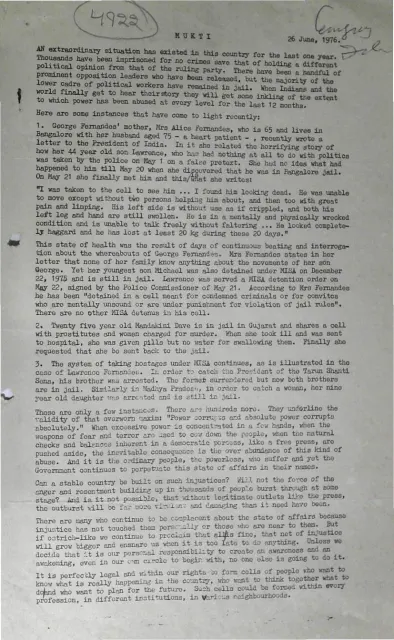
- Fernandes describes press censorship, confiscation of publications, surveillance, intimidation, political detention, and alleged torture.
- She rejects the claim that repression can solve India’s economic problems, citing unemployment, poverty, hunger, and population pressures.
- She argues that the Emergency undermines equality before the law, judicial independence, public trials, and constitutional government.
- The testimony asks the United States and the international community to condemn the suppression of civil and human rights in India.
Metadata and summary are AI-extracted from the source PDF and reviewed for editorial accuracy. The original work is available via the Read PDF tab above (where present); paragraph-level citation inside the PDF is deferred to a future engagement.