letter
Hindustani Movement Indians in Service of India
BOMBAY-6 · 1976
2 pages
Summary
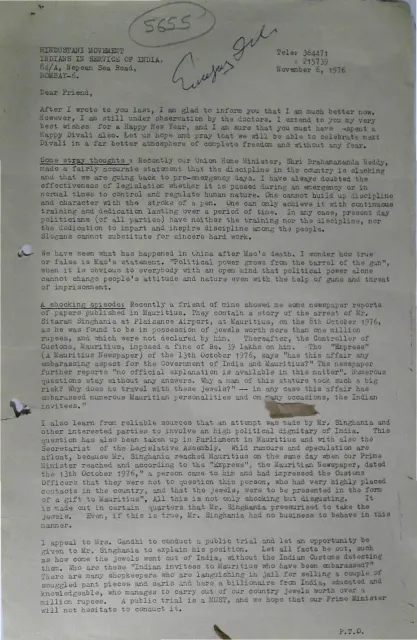
This two-page letter, dated November 6, 1976, is signed by Madhu Mehta as National Convenor of the Hindustani Movement. Writing from Bombay, Mehta reports recovering while remaining under medical observation, then turns to political conditions during the Emergency. He questions whether discipline can be created through legislation or coercion, arguing instead for sustained training, education, and moral example, and rejects Mao Zedong’s maxim that political power grows from the barrel of a gun as an adequate explanation of political authority.
The letter also raises allegations reported in Mauritian newspapers concerning Mr. Singhania’s alleged possession of jewels worth more than one million rupees, the imposition of a Rs. 39 lakh fine, and possible efforts to involve a senior Indian political figure. Mehta calls for a public trial and asks Mrs. Gandhi to explain how the jewels left India. In the second page, he argues that fundamental duties must not override conscience, criticises the indefinite postponement of elections and the continuing Emergency, and urges Indira Gandhi to open a dialogue with her opponents. The letter closes with an appeal for financial support for the Hindustani Movement.
Key points
- The letter links genuine political discipline to continuous training, education, and character formation rather than legislation alone.
- It questions the effectiveness of coercion, imprisonment, and the use of force as foundations for political authority.
- It reports Mauritian newspaper allegations about jewels allegedly taken from India by Mr. Singhania and calls for a public trial and official explanation.
- It argues that following conscience is an important fundamental duty and distinguishes it from simply obeying the government of the day.
- It criticises the Emergency’s indefinite continuation, the postponement of elections, and the resulting frustration and public unrest.
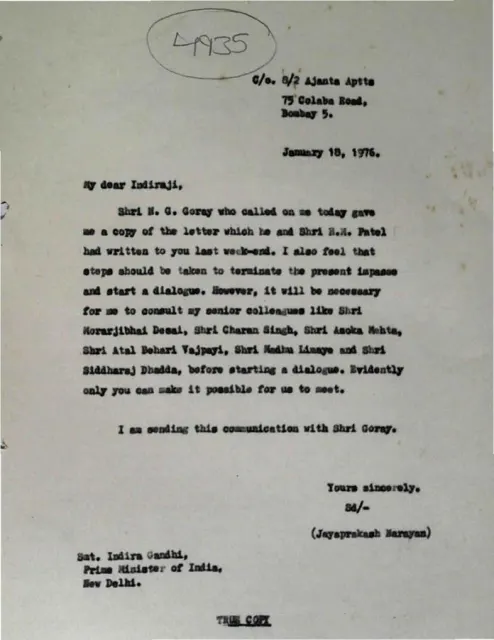
- It proposes dialogue between Mrs. Gandhi and opposition figures, including Jayaprakash Narayan, Morarji Desai, Atal Bihari Vajpayee, and Piloo Mody.
- It ends by seeking information about the recipient’s activities and requesting financial contributions to the Hindustani Movement.
Metadata and summary are AI-extracted from the source PDF and reviewed for editorial accuracy. The original work is available via the Read PDF tab above (where present); paragraph-level citation inside the PDF is deferred to a future engagement.