occasional paper · position paper
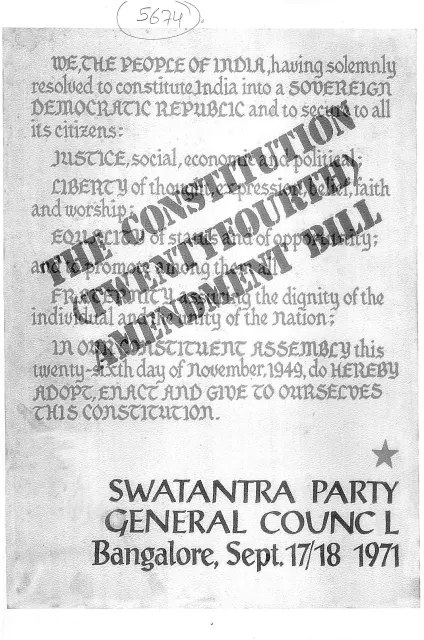
The Constitution (Twentyfourth) Amendment Bill
PUBLISHED & PRINTED BY S. V. RAJU EXECUTIVE SECY. SWATANTRA PARTY-NATIONAL HEAD QUARTERS. · Bombay
16 pages
Summary
This Swatantra Party occasional paper presents a constitutional and electoral critique from the period surrounding the party’s September 1971 General Council meeting. Its opening section argues that the 1971 elections marked a dangerous turning point for Indian democracy, attributing the party’s defeat less to rejection of its policies than to the Grand Alliance’s lack of a distinct programme. It urges the party to preserve its principles rather than compete solely through numbers, money, patronage, and electoral arithmetic, and warns that the weakening of democratic institutions could lead toward dictatorship.
The paper sets out the party’s economic and political identity as an “economics of freedom”: limited state authority, individual liberty of action, voluntary social service, and support for the family, farm, and artisan’s workshop. Other sections review Swatantra’s achievements in the Fourth Lok Sabha, including advocacy of an Ombudsman, administrative reform, and decontrol and delicensing. Election material records the party’s 1967 gains, including an increase from 22 to 44 Lok Sabha seats and its emergence as the largest opposition party. The illustrated pages extend the argument through attacks on planning, taxation, licensing, and the socialist state, while the final pages defend property rights and reproduce party leaders’ opposition to the Seventeenth Amendment. The paper is a complete 16-page compilation, but it has no formal author byline or clearly stated publication year.
Key points
- The paper interprets the 1971 election defeat as a consequence of the Swatantra Party’s alliance strategy and lack of a distinctive programme, rather than a rejection of its policies.
- It warns that electoral politics based on money, patronage, and numerical strength can displace principles, pragmatic policy, and public morality.
- It presents the party’s economic programme as an economics of freedom grounded in individual liberty, limited state authority, traditional occupations, and voluntary social service.
- It claims that Swatantra’s parliamentary criticism helped produce measures such as the Ombudsman proposal, administrative reform, and partial decontrol and delicensing.
- The paper highlights the party’s 1967 electoral performance, including 44 Lok Sabha seats, 8.54 percent of the popular vote, and 259 state-assembly seats.
- Its cartoons and campaign material criticize planning, excise, octroi, income, sales, entertainment, wealth, capital-gains, and estate duties as burdens on production, exchange, saving, and prosperity.
- The constitutional argument defends fundamental rights and property rights against the Seventeenth Amendment and condemns the concentration of power in the state.
Metadata and summary are AI-extracted from the source PDF and reviewed for editorial accuracy. The original work is available via the Read PDF tab above (where present); paragraph-level citation inside the PDF is deferred to a future engagement.