Summary
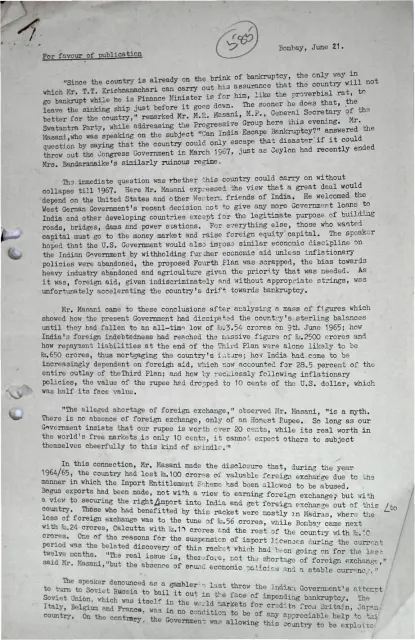
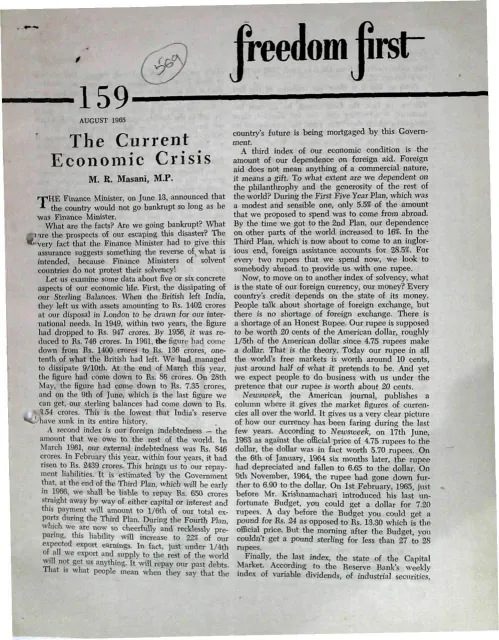
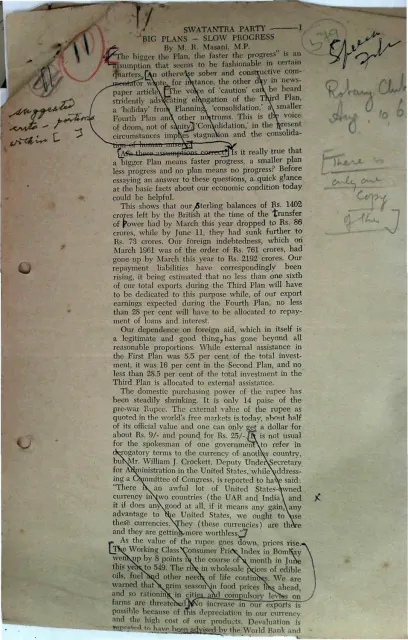
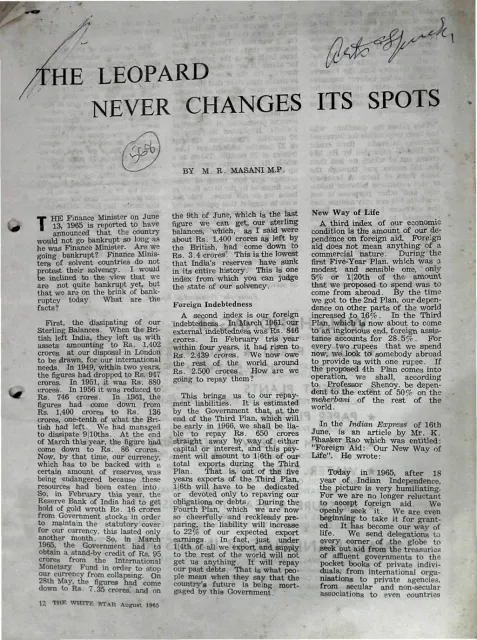
In the rendered pages, M. R. Masani argues that India in 1965 is approaching economic bankruptcy. He supports this claim with indicators including the depletion of sterling balances, rising foreign indebtedness, repayment obligations under the Five-Year Plans, dependence on foreign aid, the declining value of the rupee, and weakness in the capital market. He presents these conditions as consequences of what he calls fundamentally mistaken economic and planning policies rooted in state socialism and centralised planning.
In the rendered pages, Masani extends the critique to import controls, public-sector industry, foreign-exchange allocation, Soviet-linked trade, and government interference in private enterprise. He describes state enterprises as inefficient and argues that bureaucratic protection of them has displaced more productive activity. The essay concludes that India’s “new class” of corrupt politicians, officials, and businessmen benefits from the system while ordinary people bear its costs; Masani therefore calls for a decisive break with policies associated with Jawaharlal Nehru and urges readers to reject the Congress at the next election. A separate boxed item on page 15, attributed to The Journal of Commerce, reports Soviet discussion of profit incentives and managerial autonomy in unprofitable factories; it is editorial material rather than part of Masani’s argument.
Key points
- Masani uses falling sterling reserves, foreign debt, repayment obligations, and foreign-aid dependence as evidence that India is nearing bankruptcy.
- He attributes the crisis to state-socialist economic policies and the Second and Third Five-Year Plans.
- The essay criticises import licensing, foreign-exchange controls, and decisions that favour Soviet suppliers over allegedly cheaper or better alternatives.
- Masani presents public-sector enterprises and state-run industrial management as inefficient, politically protected, and hostile to private initiative.
- He argues that the rupee is substantially overvalued and that official claims about its value obscure the realities of Indian markets.
- The essay identifies a politically connected “new class” of corrupt officials, politicians, and businessmen as the chief beneficiary of the system.
- Masani calls for a practical break with Nehru-era policies and urges readers to vote Congress out of office.
Metadata and summary are AI-extracted from the source PDF and reviewed for editorial accuracy. The original work is available via the Read PDF tab above (where present); paragraph-level citation inside the PDF is deferred to a future engagement.