programme · manifesto
Good living, next to freedom, is our birthright
National Party of India · Bombay · 1979
4 pages
Summary
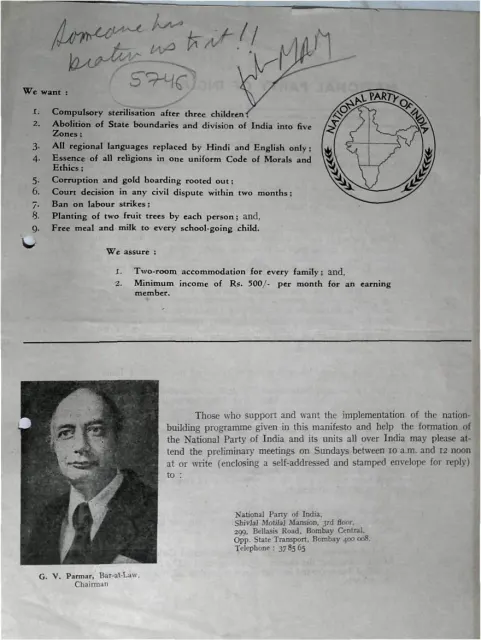
This four-page manifesto presents the National Party of India’s programme under the slogan “Good living, next to freedom, is our birthright”. It argues that India’s abundant natural resources and human capacity have not translated into adequate living standards, and proposes two-room housing for every family and a minimum monthly income of Rs. 500 for each earning member. The programme combines population control, national integration, administrative centralisation, a common moral code, and aggressive anti-corruption measures.
The manifesto calls for compulsory sterilisation of married men after three children, abolition of existing state boundaries and division of India into five zones, replacement of regional languages by Hindi and English, and a uniform code of morals and ethics. It proposes confiscating unaccounted property, limiting personal gold holdings to 100 grams, resolving civil disputes through an accelerated written procedure without oral evidence or appeal, banning strikes and other labour agitation, requiring adults to plant and maintain fruit trees, and providing every schoolchild with a free meal and a quarter litre of milk. The final page is a membership declaration, including a Rs. 24 annual subscription for the year ending 31 December 1979.
Key points
- The manifesto links political freedom to material security, especially housing and minimum income.
- It treats population control as an urgent welfare measure and proposes compulsory sterilisation after three children.
- It advocates abolishing state boundaries, reorganising India into five zones, and shifting major administrative and judicial functions to zonal capitals.
- It proposes replacing regional languages with Hindi and English and creating a uniform code of morals and ethics drawing on all religions.
- It combines anti-corruption enforcement with restrictions on gold holdings and confiscation of unaccounted property.
- It seeks rapid civil justice through written pleadings, tightly prescribed timelines, and no appeal.
- It proposes banning strikes while allowing workers eventually to acquire up to a 50 per cent share in industry through wage contributions.
- It presents tree planting, school meals, milk provision, and family accommodation as practical welfare measures.
Metadata and summary are AI-extracted from the source PDF and reviewed for editorial accuracy. The original work is available via the Read PDF tab above (where present); paragraph-level citation inside the PDF is deferred to a future engagement.