Summary
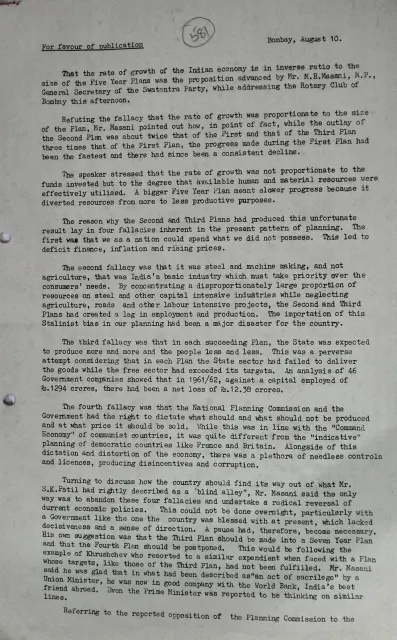
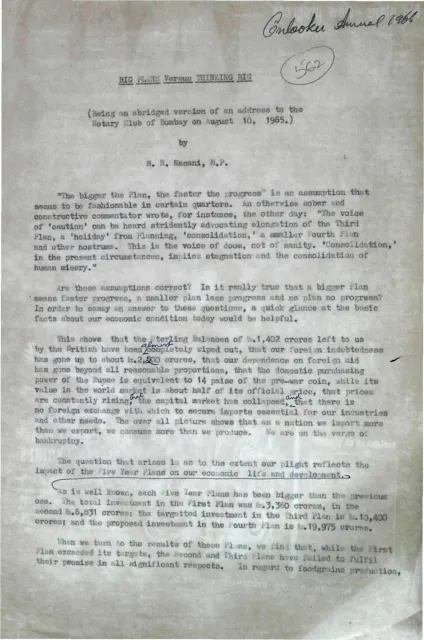
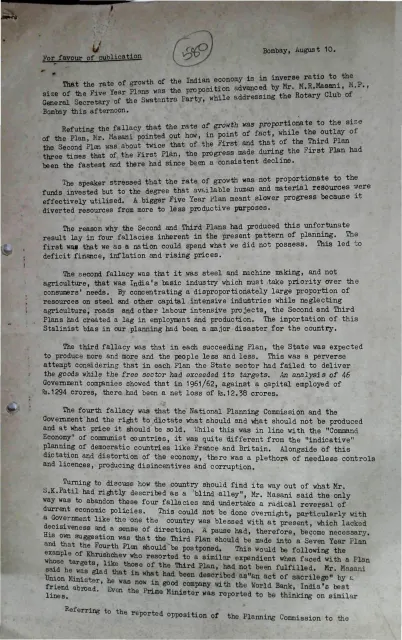
This four-page English occasional paper reports M. R. Masani’s address to the Rotary Club of Bombay on the relationship between economic growth and the size of India’s Five Year Plans. In the rendered pages, Masani argues that the Second and Third Plans produced slower growth despite their larger scale because resources were poorly used and diverted toward less productive purposes. He identifies four planning fallacies: spending resources the country did not possess, prioritising steel and machine-making over agriculture and labour-intensive projects, expanding an inefficient state sector, and allowing the Planning Commission and government to dictate production and prices through controls and licences. The paper links these policies to deficit finance, inflation, unemployment, production losses, disincentives, and corruption.
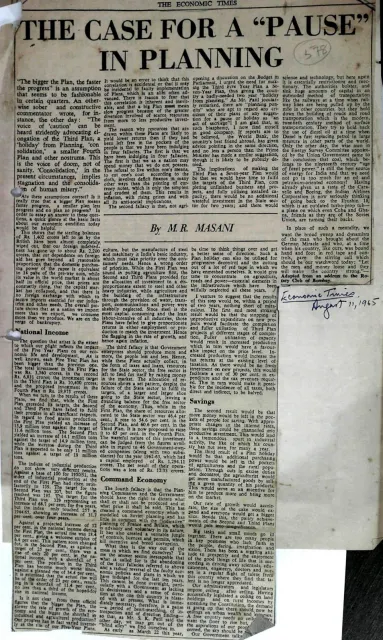
In the rendered pages, Masani proposes a two-year “Plan holiday,” postponement of the Fourth Plan, fuller use of existing capacity, and a shift toward private savings, industrial investment, agricultural production, and lower taxation. He presents this as a route to faster growth and wider prosperity, while criticising what he describes as restrictive and technologically backward official attitudes. The pages also include a newspaper clipping presenting related Swatantra Party proposals, including reduced deficit financing, curtailed non-essential public expenditure and foreign borrowing, consolidation of existing projects, and opposition to further expansion of the public sector. The visible material does not print a title, publisher, issuer, or year; the dateline reads “Bombay, August 10.”
Key points
- Masani disputes the assumption that larger Five Year Plans automatically generate faster economic growth.
- He attributes disappointing results to poor resource utilisation and four planning fallacies.
- The paper criticises steel-centred industrialisation, neglect of agriculture, and insufficient attention to labour-intensive projects.
- It uses state-enterprise losses and the growth of controls and licences as evidence against an enlarged directive public sector.
- Masani proposes a two-year Plan holiday, postponement of the Fourth Plan, and more intensive use of existing capacity.
- The proposed policy shift is intended to reduce taxation, increase private savings and investment, and improve agricultural incentives.
- The accompanying clipping presents Swatantra proposals for fiscal restraint, reduced non-essential spending, restricted foreign borrowing, and consolidation of existing projects.
Metadata and summary are AI-extracted from the source PDF and reviewed for editorial accuracy. The original work is available via the Read PDF tab above (where present); paragraph-level citation inside the PDF is deferred to a future engagement.