
speech
Mr. M. R. Masani's speech during the consideration of the Taxation Laws (Amendment) Bill in the Lok Sabha on August 11, 1960, in so far as it relates to the development rebate on road transport vehicles.
By Minoo Masani
1960
2 pages
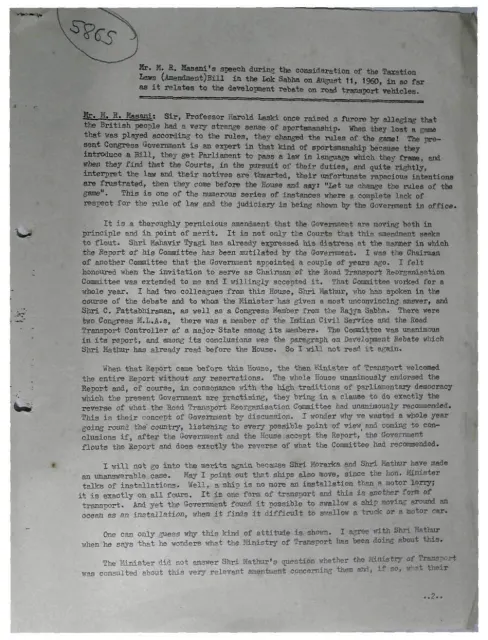
Summary
In this two-page Lok Sabha speech delivered on August 11, 1960, M. R. Masani opposes the development-rebate provision for road transport vehicles in the Taxation Laws (Amendment) Bill. He argues that the Government has disregarded the unanimous recommendations of the Road Transport Reorganisation Committee and has shown disrespect for law, the courts, and parliamentary procedure. Masani presents the amendment as “pernicious” both in principle and in its practical effect, noting that the committee’s report had previously been accepted by the House and welcomed by the then Minister of Transport.
Masani’s central economic argument is that the Railway Board, benefiting from a state-backed monopoly, obstructs the growth of road transport and prevents fair competition. He challenges the Government’s distinction between ships and road vehicles, and disputes the Third Five Year Plan’s claim that road transport will expand according to automobile-manufacturing capacity rather than according to whether railway monopoly is restrained. He concludes that the amendment would reinforce an inefficient public monopoly and states his vigorous opposition to it.
Key points
- Masani criticises the Government for altering the rules of law when courts interpret legislation against its preferred position.
- He argues that the development-rebate amendment reverses the unanimous recommendation of the Road Transport Reorganisation Committee.
- He maintains that the Ministry of Transport has failed to defend road transport against the Railway Board.
- He presents the Railway Board as a state-backed monopoly that obstructs fair competition and road-transport development.
- He challenges the Third Five Year Plan’s account of the conditions required for expanding commercial road transport.
- He opposes the Bill’s clause as pernicious, anti-social, and contrary to the interests of both the public and the State.
Metadata and summary are AI-extracted from the source PDF and reviewed for editorial accuracy. The original work is available via the Read PDF tab above (where present); paragraph-level citation inside the PDF is deferred to a future engagement.
People in this work
Related across the archive
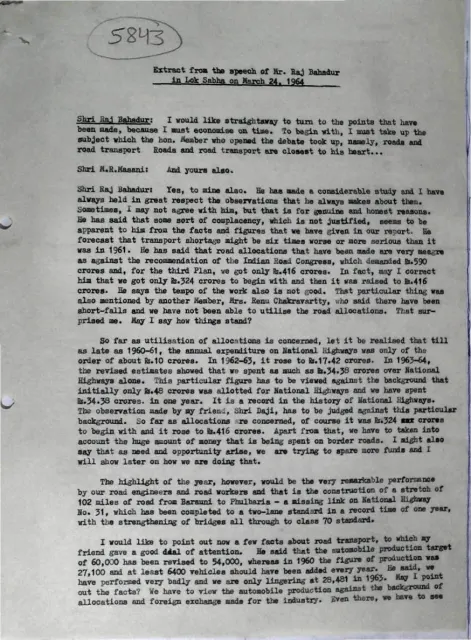 Primary workExtract from the speech of Mr. Raj Bahadur in Lok Sabha on March 24, 1964
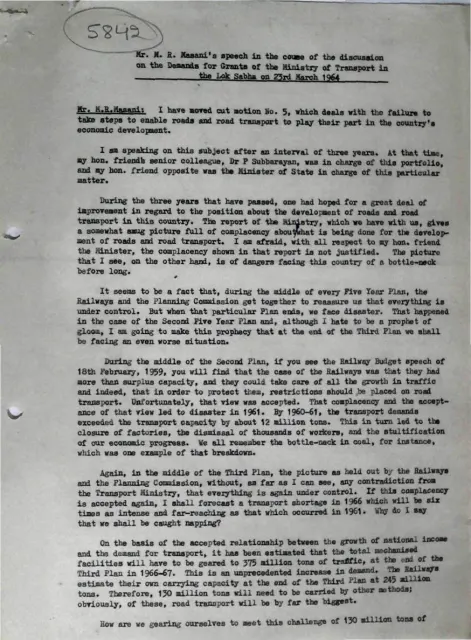 Primary workMr. M. R. Masani's speech in the course of the discussion on the Demands for Grants of the Ministry of Transport in the Lok Sabha on 23rd March 1964
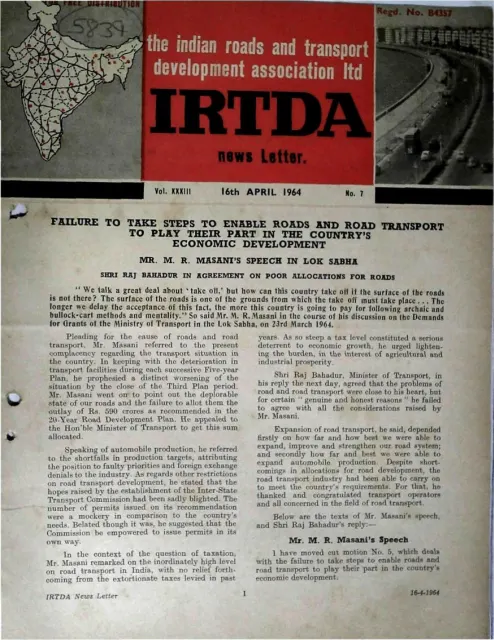 Primary workIRTDA News Letter.
 ExcerptSTATE MONOPOLIES AND THE CITIZEN IN A DEMOCRACY
 ExcerptDemocracy in India