Summary
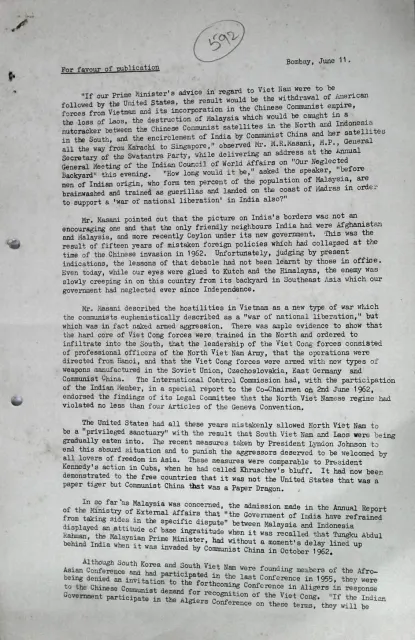
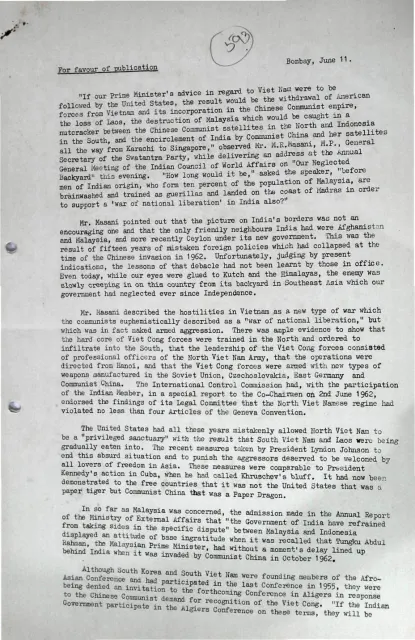
This two-page press statement reports M. R. Masani’s address to the Annual General Meeting of the Indian Council of World Affairs on the dangers posed by communist expansion in Southeast Asia. Masani argues that accepting the withdrawal of American forces from Vietnam would expose Vietnam, Laos, and Malaysia to Chinese communist domination and leave India encircled by communist states. He describes the Vietnam conflict as externally directed armed aggression rather than a genuine “war of national liberation,” citing North Vietnamese infiltration, professional military leadership, foreign-supplied weapons, and alleged violations of the Geneva Convention.
Masani criticizes India’s foreign policy since Independence, particularly its neglect of Southeast Asia, its position on Malaysia and Indonesia, and its handling of non-alignment. He maintains that non-alignment need not mean neutrality or refusal of assistance, noting Jawaharlal Nehru’s acceptance of American and British aid during the 1962 Chinese invasion. The statement attributes New Delhi’s policies partly to dependence on the Soviet veto over Kashmir and partly to appeasement of communist expansion. Masani concludes by advocating a regional security arrangement involving the free countries of Asia, supported by Western democracies, with India and Japan as its principal anchors.
Key points
- Masani warns that an American withdrawal from Vietnam would enable Chinese communist expansion across Vietnam, Laos, Malaysia, and potentially toward India.
- He presents the Vietnam conflict as armed aggression directed by North Vietnam rather than an authentic national-liberation movement.
- The statement cites North Vietnamese infiltration, professional officers, foreign weapons, and alleged Geneva Convention violations as evidence for this interpretation.
- India’s foreign-policy record since Independence is criticized for neglecting Southeast Asia and mishandling the Malaysia–Indonesia dispute.
- Masani argues that non-alignment is compatible with accepting military assistance from friendly powers and defending oneself against aggression.
- He attributes India’s policy to dependence on Soviet support over Kashmir and to appeasement of communist expansion.
- The proposed alternative is a regional Asian security arrangement underwritten by Western democracies, with India and Japan as its principal defensive positions.
Metadata and summary are AI-extracted from the source PDF and reviewed for editorial accuracy. The original work is available via the Read PDF tab above (where present); paragraph-level citation inside the PDF is deferred to a future engagement.