speech · convention address
Our Duty in the Present Crisis
Bombay · 1962
4 pages
Summary
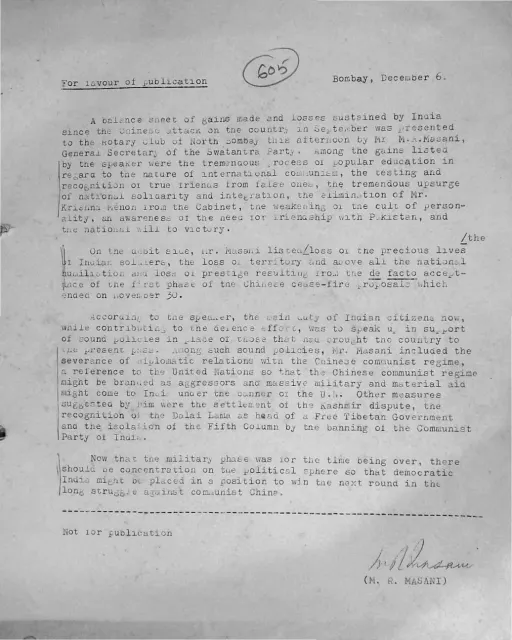
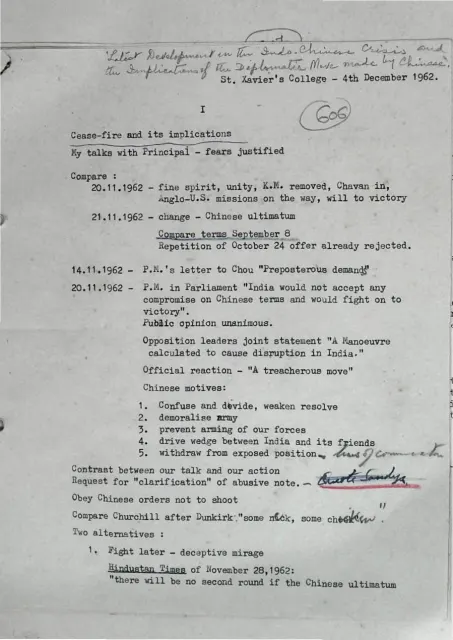
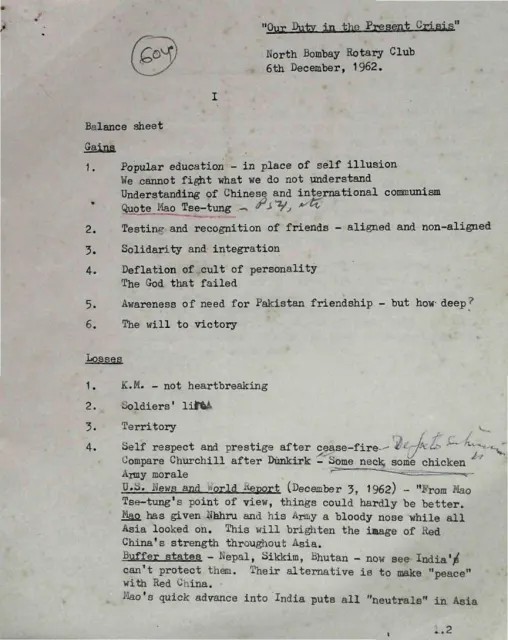
These typed speech notes, prepared for delivery at the North Bombay Rotary Club on 6 December 1962, assess India’s position during the Sino-Indian crisis. The opening “balance sheet” lists perceived gains from public education about Chinese and international communism, the testing of aligned and non-aligned friends, national solidarity, a reduced cult of personality, a possible need for friendship with Pakistan, and the will to win. The losses include military casualties, territory, and damage to national self-respect and prestige after the cease-fire. The notes argue that Chinese advances have exposed the limits of non-alignment as a security policy and present Mao’s truce offer as strategically advantageous to China rather than as evidence of genuine conciliation.
Key points
- The speech frames the 1962 crisis as a balance sheet of political gains and military, territorial, and psychological losses.
- It calls for public education about Chinese and international communism in place of self-illusion.
- It treats the crisis as a test of India’s friends, including aligned and non-aligned states, and stresses solidarity and integration.
- It argues that Mao’s truce offer eased China’s supply problem while allowing Mao to pose as a peace-maker.
- It recommends severing diplomatic relations with China and appealing to the United Nations to declare China the aggressor.
- It calls for preparation for a second round of fighting, including a two-million-man army and fifteen new divisions.
- It advocates settling the Kashmir dispute, recognising the Dalai Lama, liberating Tibet, isolating the Communist Party of India, and changing national leadership if necessary.
- It distinguishes national unity during the war from unquestioning support for existing government policies.
Metadata and summary are AI-extracted from the source PDF and reviewed for editorial accuracy. The original work is available via the Read PDF tab above (where present); paragraph-level citation inside the PDF is deferred to a future engagement.