correspondence
Letter to Jayaprakash Naryan
Muzaffarpur · 1971
8 pages
Summary
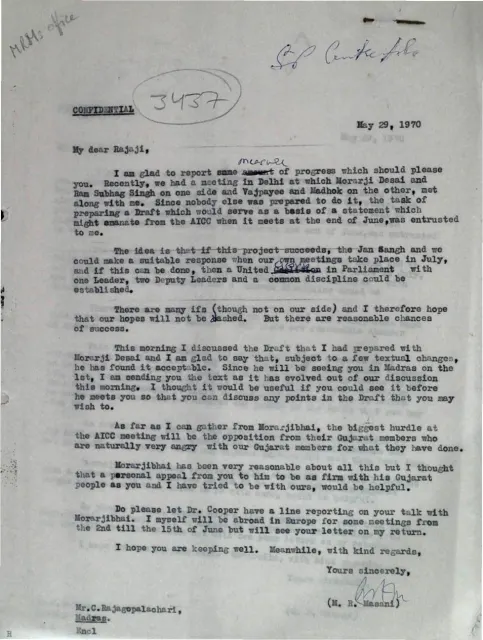
This eight-page archival correspondence packet contains letters exchanged between Jayaprakash Narayan and M. R. Masani in January 1971, together with handwritten routing and translation notes. In his letters of January 16 and January 29, Narayan discusses the political situation in Bihar, the stability of Karpoori Thakur’s coalition government, land-ceiling policy, and the proposed autonomous statutory board for Chhotanagpur. He argues that the coalition partners should adjust their positions rather than threaten to withdraw support, and that resistance to Adivasi demands could encourage demands for a separate Jharkhand state.
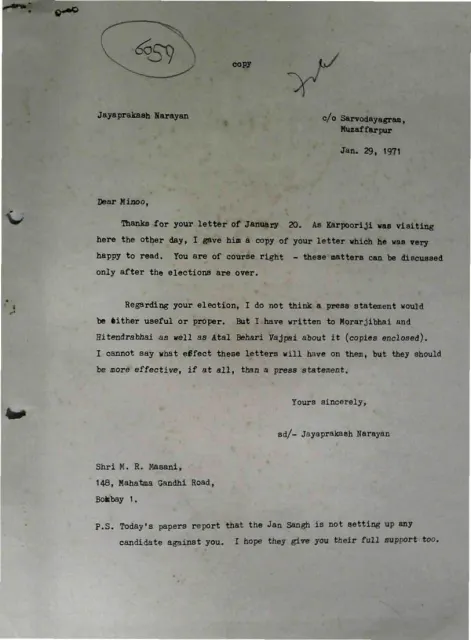
The January 29 letter addresses Masani’s election directly. Narayan discourages a public press statement before the elections, saying that private letters to Morarji Desai, Hitendra Desai, and Atal Bihari Vajpayee may be more effective. A postscript notes press reports that the Jan Sangh would not field a candidate against Masani and expresses hope that it would give him its full support. The packet also includes Masani’s January 20 reply, which discusses the land ceiling and Chhotanagpur questions and indicates that he had already consulted Karpoori Thakur.
Key points
- Narayan criticizes the instability of Bihar’s coalition governments since 1967.
- He identifies land-ceiling policy and an autonomous statutory board for Chhotanagpur as major coalition disputes.
- He argues that Bihar’s land-ceiling limits are too high and that surplus land had not been distributed to landless people.
- He supports considering an autonomous statutory board for Chhotanagpur and warns that opposition to Adivasi demands could strengthen separatist sentiment.
- Narayan advises Masani against issuing a press statement about his election before the elections conclude.
- Narayan says he has written privately to Morarji Desai, Hitendra Desai, and Atal Bihari Vajpayee regarding Masani’s election.
- The letters refer to cooperation or tension among the Swatantra Party, Bharatiya Jana Sangh, and other coalition partners in Bihar.
Metadata and summary are AI-extracted from the source PDF and reviewed for editorial accuracy. The original work is available via the Read PDF tab above (where present); paragraph-level citation inside the PDF is deferred to a future engagement.