office record
Notes and Extracts From Keesings Contemporary Archives
Swatantra Party · 1962
7 pages
Summary
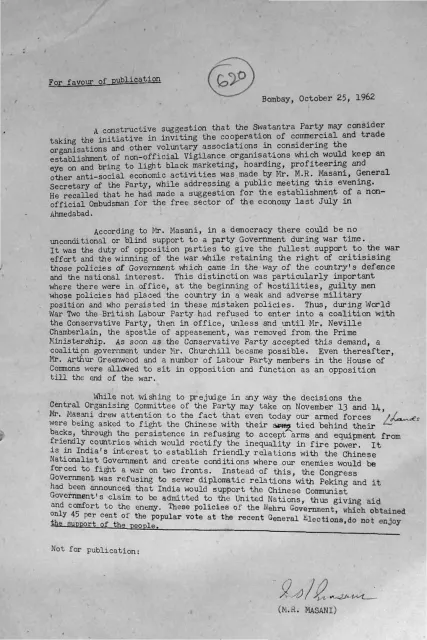
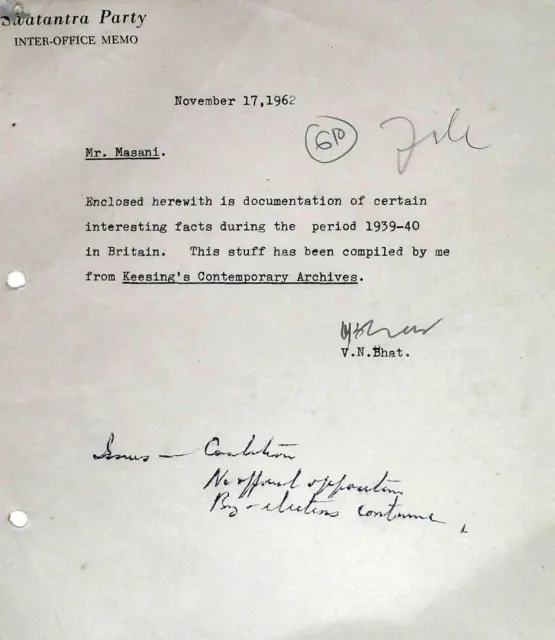
This English-language Swatantra Party inter-office memo, dated November 17, 1962, transmits material compiled by V. N. Bhat from Keesing’s Contemporary Archives. The enclosed notes focus chiefly on the British parliamentary crisis of May 1940, when the failures of the Norway campaign prompted demands for a reorganised wartime government. Extracts from debates record Labour, Liberal, Conservative, and independent criticism of Neville Chamberlain’s administration, especially its inadequate preparation, intelligence failures, ineffective war cabinet, and repeated diplomatic and military setbacks.
The notes follow the political consequences of the debate: Chamberlain’s resignation, Winston Churchill’s accession, the formation of a coalition government involving Conservative, Labour, and Liberal figures, and the subsequent confidence vote. They also include shorter 1939 items on party liaison with government departments, a wartime agreement not to contest by-elections, and parliamentary opposition to Hitler’s peace proposals. The document is primarily a documentary compilation rather than a sustained argument by Bhat; its evident concerns are party politics, wartime governance, leadership accountability, and the case for reconstructing government in a national emergency.
Key points
- V. N. Bhat’s memo forwards extracts compiled from Keesing’s Contemporary Archives.
- The central material concerns the British Parliament debates of May 7–8, 1940, after the Norway campaign.
- Clement Attlee and other critics condemn inadequate planning, intelligence failures, and the ineffective wartime cabinet.
- The extracts present demands for a smaller war cabinet, a supreme war directorate, and a real national government.
- Neville Chamberlain accepts responsibility but argues that a government needs parliamentary and public support to prosecute the war.
- The debate is followed by Chamberlain’s resignation on May 10 and Churchill’s formation of a coalition government.
- The notes record Labour’s decision to participate in a new government under a prime minister able to command national confidence.
- Additional 1939 material covers party liaison arrangements, a wartime by-election agreement, and rejection of Hitler’s peace proposals.
Metadata and summary are AI-extracted from the source PDF and reviewed for editorial accuracy. The original work is available via the Read PDF tab above (where present); paragraph-level citation inside the PDF is deferred to a future engagement.