
letter
Letter from Jayaprakash
1975
11 pages
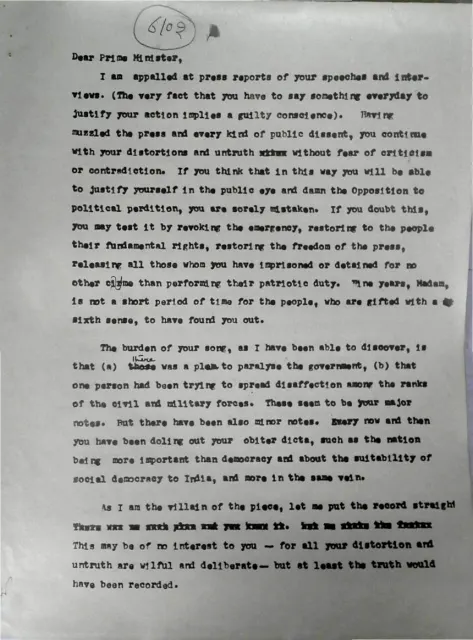
Summary
This ten-page English letter, signed “Jayaprakash” and addressed to the Prime Minister, is a forceful critique of the Emergency and of the government’s public justification for it. The writer rejects the claim that the Opposition had devised a plan to paralyse the government, arguing that the Bihar movement was largely constructive and that popular demands concerned corruption, administration, land reform, public distribution, and accountable government. He presents the protests, student mobilisation, satyagraha, and calls for resignation as democratic responses to governmental misrule rather than subversion.
The letter defends civil disobedience as a legitimate democratic right when ordinary channels of reform have failed, while stressing that the campaign was intended to remain non-violent and limited. It condemns arrests, restrictions on the press, and the suppression of criticism, and argues that corruption—not an organised conspiracy—was the central cause of unrest. The writer also challenges the Prime Minister’s opposition between the nation and democracy, insists that the Constitution cannot be converted into a totalitarian instrument by executive action, and warns that repression cannot remedy the failures of governance. He closes with a personal appeal not to destroy India’s democratic inheritance and bids the Prime Minister farewell.
Key points
- The letter rejects the alleged Opposition plan to paralyse the Bihar government as an invention used to justify Emergency measures.
- It describes the Bihar movement as addressing corruption, public distribution, land reform, local administration, and social injustice.
- It defends the people’s right to seek the resignation of a corrupt or misruling elected government through democratic mobilisation.
- It presents satyagraha and civil disobedience as lawful, non-violent democratic action rather than insurrection.
- It identifies corruption within government and administration, especially at senior levels, as the movement’s central issue.
- It condemns press censorship, arrests, and the curtailment of fundamental rights as attacks on democracy.
- It rejects the claim that national interest can be set against democracy and warns against authoritarian constitutional change.
- It urges the Prime Minister to abandon repression, heed the Opposition, and preserve India’s democratic inheritance.
Metadata and summary are AI-extracted from the source PDF and reviewed for editorial accuracy. The original work is available via the Read PDF tab above (where present); paragraph-level citation inside the PDF is deferred to a future engagement.
Related across the archive
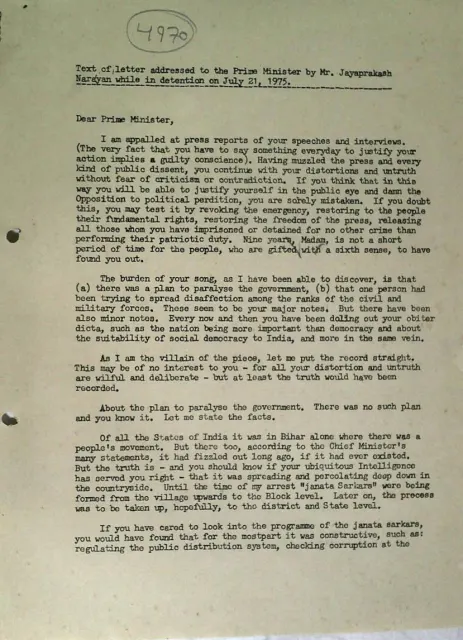 Primary workText of letter addressed to the Prime Minister by Mr. Jayaprakash Narayan while in detention on July 21, 1975.
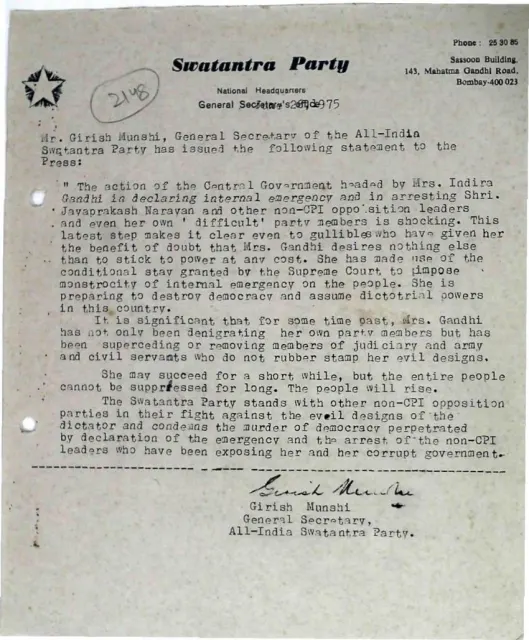 Primary workStatement Given by Girish Munshi
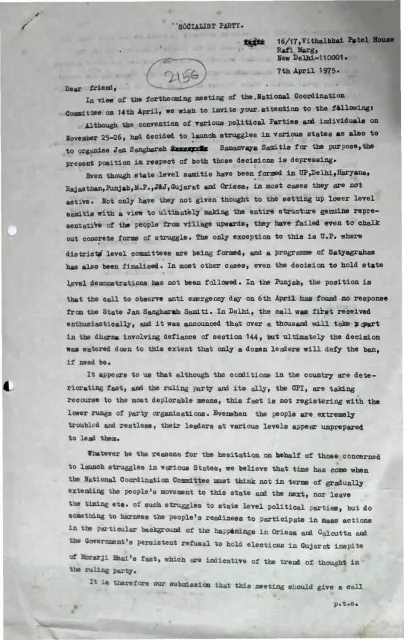 Primary workLetter to Radhakrishna
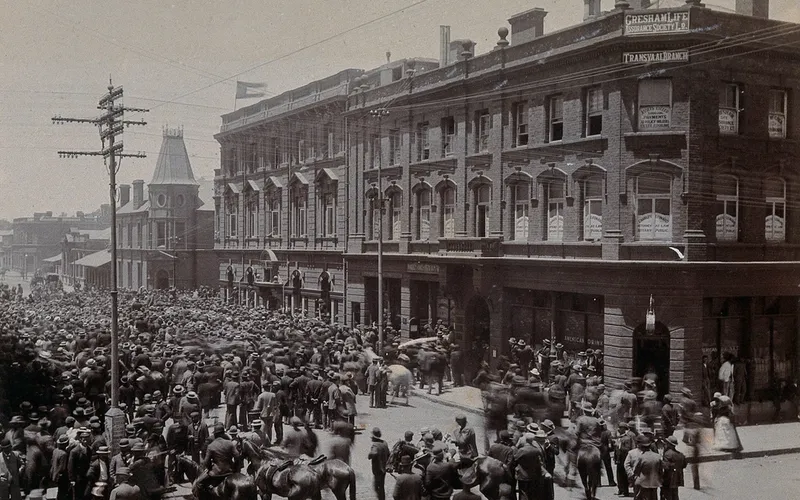 ExcerptSatyagraha and the Political System
 OpinionIndian Liberals, Quest Magazine and India's First Dictatorship