lecture
Lecture Notes
FFE · 1962
2 pages
Summary
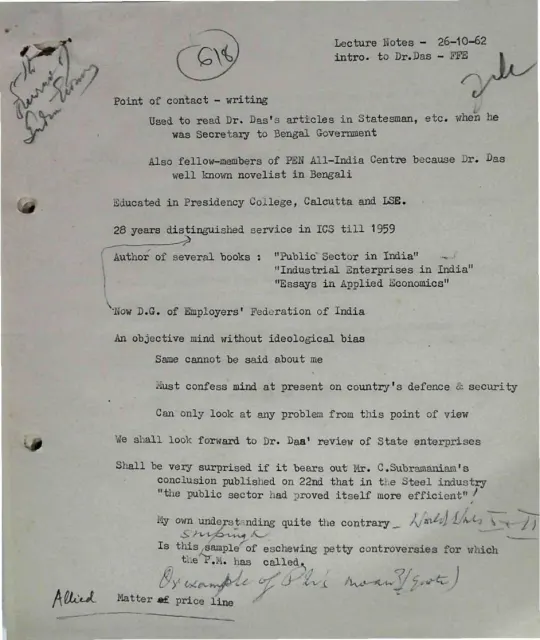
These two pages are typed lecture notes dated 26 October 1962 for an introduction to “Dr. Das” at the Forum of Free Enterprise. They sketch Dr. Das’s background as a Bengali novelist, journalist, former Secretary to the Bengal Government, Presidency College and LSE alumnus, and former Indian Civil Service officer who later became Director-General of the Employers’ Federation of India. The notes also list his books, including “Public Sector in India,” “Industrial Enterprises in India,” and “Essays in Applied Economics.”
The substantive discussion focuses on state enterprises, inflation, prices, and business responsibility. The notes anticipate Dr. Das’s review of state enterprises while questioning the efficiency of public-sector steel production and linking price rises to wasteful investment in low-return state enterprises and to basic government policies. They reject the idea that controls alone can stop inflation, while also assigning businessmen and traders responsibility for avoiding anti-social practices. The notes propose that commercial and trade associations establish vigilance organisations for voluntary discipline, potentially led by an industrialist such as J. R. D. Tata. Handwritten annotations are present throughout, including comments on security, controversy, and the “price line.”
Transcript
Summary
These two pages are typed lecture notes dated 26 October 1962 for an introduction to “Dr. Das” at the Forum of Free Enterprise. They sketch Dr. Das’s background as a Bengali novelist, journalist, former Secretary to the Bengal Government, Presidency College and LSE alumnus, and former Indian Civil Service officer who later became Director-General of the Employers’ Federation of India. The notes also list his books, including “Public Sector in India,” “Industrial Enterprises in India,” and “Essays in Applied Economics.”
The substantive discussion focuses on state enterprises, inflation, prices, and business responsibility. The notes anticipate Dr. Das’s review of state enterprises while questioning the efficiency of public-sector steel production and linking price rises to wasteful investment in low-return state enterprises and to basic government policies. They reject the idea that controls alone can stop inflation, while also assigning businessmen and traders responsibility for avoiding anti-social practices. The notes propose that commercial and trade associations establish vigilance organisations for voluntary discipline, potentially led by an industrialist such as J. R. D. Tata. Handwritten annotations are present throughout, including comments on security, controversy, and the “price line.”
Key points
- The document is dated 26 October 1962 and introduces an unidentified “Dr. Das” under the auspices of the Forum of Free Enterprise.
- Dr. Das is described as a Bengali novelist, former Secretary to the Bengal Government, former Indian Civil Service officer, and Director-General of the Employers’ Federation of India.
- The notes list Dr. Das’s books on public-sector enterprises and applied economics.
- The notes question claims that India’s public-sector steel industry was more efficient than the private sector.
- Inflation is attributed to basic government policies and wasteful state-enterprise investment, rather than being treatable through controls alone.
- Businessmen and traders are held responsible for anti-social practices, but are also encouraged to develop voluntary self-discipline.
- Commercial and trade associations are urged to create vigilance organisations, with J. R. D. Tata suggested as a possible leader.
Metadata and summary are AI-extracted from the source PDF and reviewed for editorial accuracy. The original work is available via the Read PDF tab above (where present); paragraph-level citation inside the PDF is deferred to a future engagement.