pamphlet
My Apology to Rajaji
Victoria Press, Vellore. · Vellore · 1971
10 pages
Summary
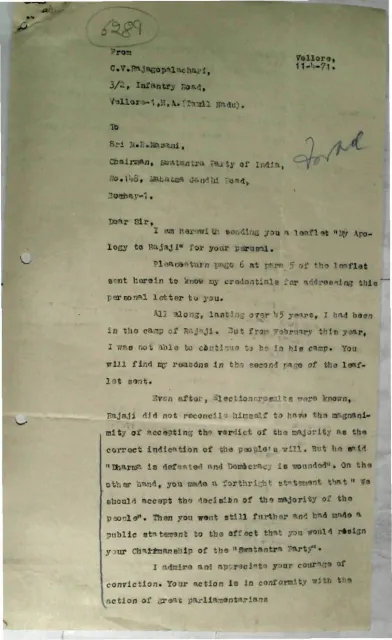
My Apology to Rajaji is a 1971 political pamphlet in which C. V. Rajagopalachari explains his decision to oppose Rajaji’s position and support the Dravida Munnetra Kazhagam (D.M.K.) in Tamil Nadu. In the covering letter to Minoo Masani, Rajagopalachari praises Masani’s willingness to accept the majority’s verdict and criticises Rajaji’s refusal to reconcile himself to the people’s decision. He presents his own intervention as a matter of public duty rather than personal hostility, while acknowledging Rajaji’s courage and conviction.
The reproduced correspondence revisits earlier disagreements between Rajagopalachari and Rajaji, including disputes over Congress’s relationship with ordinary people, political toleration, religion in public judgment, and the proper standards by which the political left and right should be assessed. The pamphlet then turns to a direct electoral appeal: it credits the D.M.K. government with addressing rice shortages, the language question, and prosecutions arising from religious disputes, and urges Tamil Nadu voters to support D.M.K.-backed candidates and its “Rising Sun” symbol. Rajagopalachari closes by arguing that democratic leadership requires detecting political dangers early and warning the public before they threaten the people.
Key points
- Rajagopalachari apologises to Rajaji while defending his decision to support the D.M.K. against Congress.
- The covering letter to Minoo Masani frames majority rule as the correct indication of the people’s will.
- The reproduced 1948 correspondence debates popular judgment, religious authority, political toleration, and Congress’s alleged deterioration.
- Rajagopalachari rejects judging political action solely through competing claims about the voice of God.
- The pamphlet presents the D.M.K. government’s record on rice distribution, the English-language question, and religiously sensitive prosecutions as grounds for electoral support.
- It invokes Rajagopalachari’s long association with Congress and the freedom movement while arguing that Congress should not survive merely as a historical inheritance.
- The closing quotation defines leadership as recognising a dangerous tendency at its birth and warning workers about its consequences.
Metadata and summary are AI-extracted from the source PDF and reviewed for editorial accuracy. The original work is available via the Read PDF tab above (where present); paragraph-level citation inside the PDF is deferred to a future engagement.