Summary
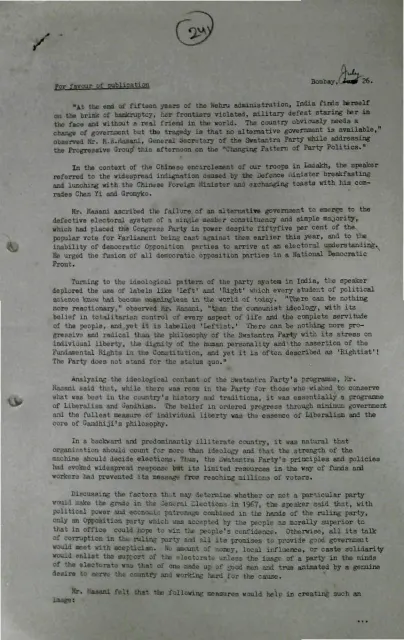
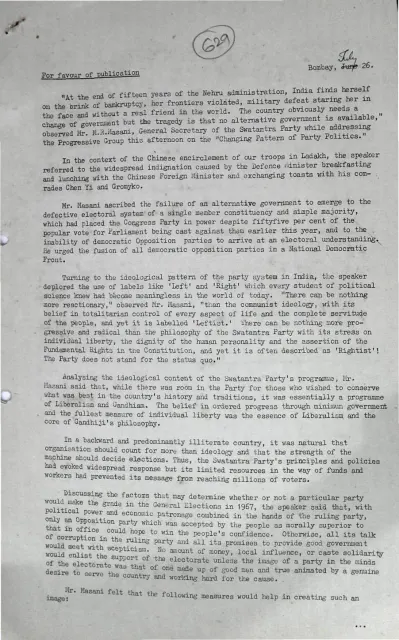
This two-page press statement reports M. R. Masani’s address to the Progressive Group on the “Changing Pattern of Party Politics.” Masani presents India, after fifteen years of Jawaharlal Nehru’s administration, as facing economic crisis, violated frontiers, military defeat, and diplomatic isolation. He criticizes the Congress government’s handling of the Chinese encirclement of Indian troops in Ladakh and argues that the single-member-constituency system and simple-majority voting have allowed Congress to retain power despite receiving only about fifty-five per cent of the popular parliamentary vote. He calls for the fusion of democratic opposition parties into a National Democratic Front.
The statement also defines the Swatantra Party’s ideological and organisational position. Masani rejects the conventional “Left” and “Right” labels, portraying communism as reactionary because of its totalitarianism and Swatantra as progressive because of its commitment to individual liberty, human dignity, Fundamental Rights, limited government, and ordered progress. He identifies the party’s programme as combining liberalism with Gandhism. The proposed organisational measures include early selection of candidates, strict standards of competence and integrity, grassroots cadre-building, a broad social base, internal discipline, and funding through many small contributions rather than a few large donors. The document concludes that political parties are means rather than ends and should not be treated as objects of unquestioning loyalty.
Key points
- Masani describes India as facing economic, military, territorial, and diplomatic difficulties after fifteen years of Nehru’s administration.
- He criticizes the electoral system of single-member constituencies and simple majorities for enabling Congress to remain in power despite substantial opposition votes.
- He urges the democratic opposition parties to unite in a National Democratic Front.
- He rejects the conventional Left–Right classification of political ideologies and presents Swatantra as a liberal and Gandhian alternative to communism.
- The statement identifies individual liberty, human dignity, Fundamental Rights, limited government, and ordered progress as central to the party’s programme.
- Masani proposes organisational reforms focused on candidate quality, grassroots workers, social breadth, discipline, and small-donor financing.
- He argues that a political party is an instrument for public purposes, not an end in itself.
Metadata and summary are AI-extracted from the source PDF and reviewed for editorial accuracy. The original work is available via the Read PDF tab above (where present); paragraph-level citation inside the PDF is deferred to a future engagement.