speech
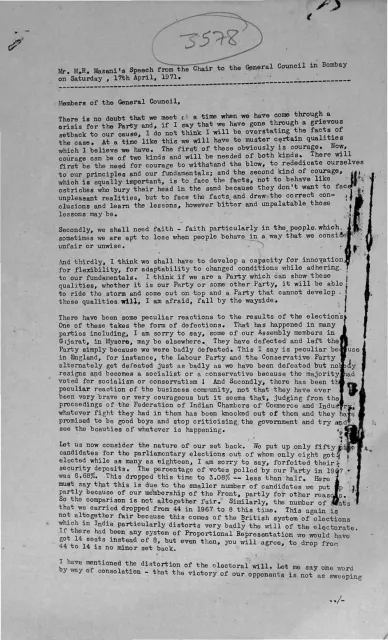
Mr. M.R. Masani's Speech from the Chair to the General Council in Bombay on Saturday, 17th April, 1971.
By Minoo Masani
Bombay · 1971
13 pages
Summary
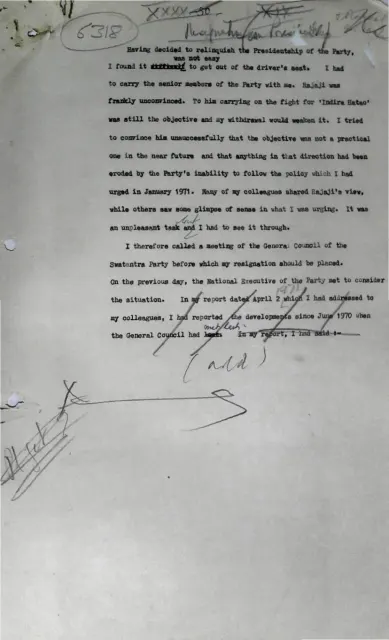
In this speech to the Swatantra Party General Council on 17 April 1971, Minoo Masani explains his decision to resign as party president after the party’s severe electoral setback. He rejects the view that the party has merely lost a battle, arguing instead that it has lost the war and must adopt a post-war posture. He attributes the defeat not simply to the decision to join the opposition Front, but to inadequate preparation, weak organisation, insufficient finance, and failures of leadership. He also criticises the Front’s January 1971 breakdown and the subsequent compromises that, in his account, weakened the party’s electoral position.
Masani insists that the party’s principles remain sound, while its performance and methods require fundamental change. He calls for courage to face unpleasant facts, faith in the people, organisational innovation, outreach to younger voters, concern for disadvantaged communities, agricultural priority, attention to consumers, and cultivation of minorities. The speech closes with his argument that leadership must change after defeat, his defence of resignation as a public act of renewal, and a call for a rapid internal election process. He warns that future political success will depend on a quick reappraisal, new tactics and strategy, and renewed dedication to the party’s objectives.
Key points
- Masani presents his resignation as a necessary response to the Swatantra Party’s 1971 defeat and the loss of credibility of its existing leadership.
- He rejects the claim that the party has merely lost a battle, arguing that it has lost the war and needs a post-war organisational posture.
- He attributes the setback to inadequate preparation, weak organisation, insufficient money, delayed decisions, and failures of collective leadership.
- He criticises the opposition Front’s conduct, including the January 1971 breakdown of negotiations and the Front’s failure to function effectively in all constituencies.
- He argues that the party’s principles remain valid, but that its performance, tactics, public communication, and organisational methods must change.
- He identifies courage, faith, innovation, flexibility, concern for disadvantaged groups, youth outreach, agriculture, consumers, and minorities as essential priorities.
- He urges the General Council to conduct a rapid reappraisal, adopt new tactics and strategy, and organise early internal elections.
- He warns that public disappointment could produce a future turn toward the Naxalites or Mao Tse-tung unless the party renews itself and educates the public.
Metadata and summary are AI-extracted from the source PDF and reviewed for editorial accuracy. The original work is available via the Read PDF tab above (where present); paragraph-level citation inside the PDF is deferred to a future engagement.