essay
No room for Right Wing Party
Free Press Journal · 1971
1 pages
Summary
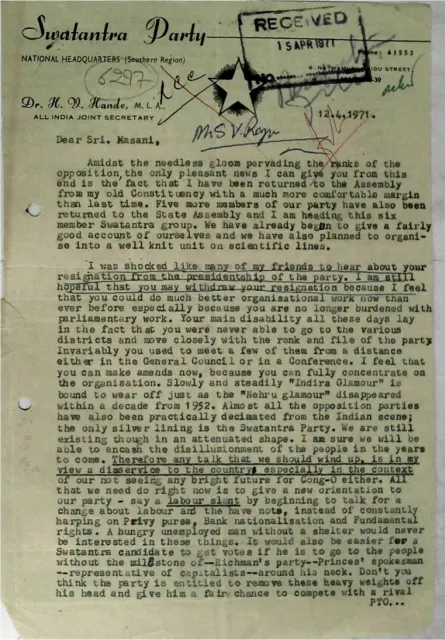
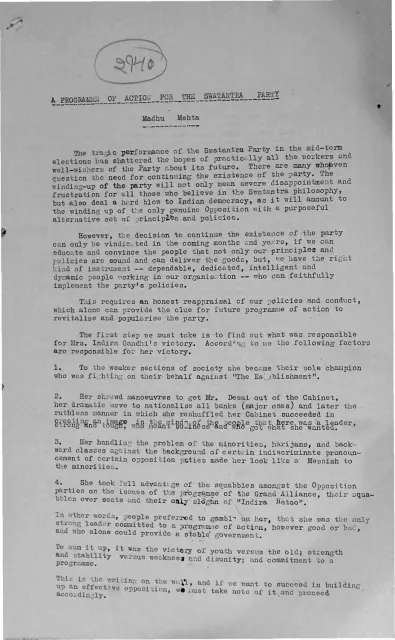
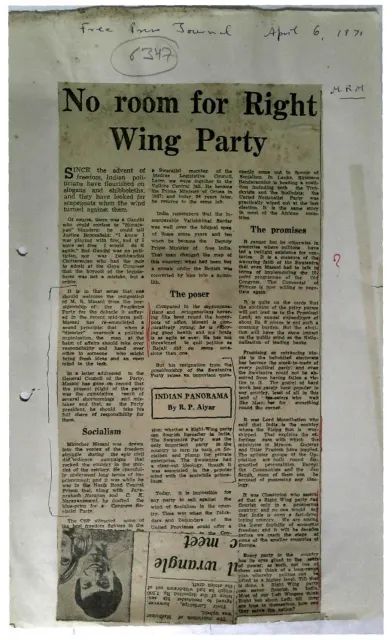
This newspaper article argues that post-independence Indian politics has been dominated by slogans, scapegoating, and an expanding commitment to socialism, leaving little room for a coherent right-wing or free-enterprise party. It opens with Minoo Masani’s resignation from the Swatantra Party, presenting the resignation as a response to the party’s electoral debacle and to its failure to confront responsibility for its own decline. The article recalls Masani’s anti-socialist credentials and his imprisonment during the freedom struggle, while suggesting that the party’s leadership must rethink its organisation and political direction.
The article contrasts the Swatantra Party’s stated commitment to private enterprise with the appeal of socialism across the political spectrum. It discusses the Congress’s promises concerning bank nationalisation and the abolition of privy purses, warning that such measures will not automatically produce prosperity or social justice. The closing argument is that Indian voters have been offered little meaningful ideological choice: parties compete for power while avoiding a clear defence of economic freedom, and a genuine right-wing party cannot succeed without a more persuasive programme and political strategy.
Key points
- The article attributes the weakness of Indian politics to slogans, shibboleths, and the search for scapegoats.
- Minoo Masani’s resignation from the Swatantra Party is treated as a sign of the party’s organisational and political crisis.
- The Swatantra Party is presented as a party associated with private enterprise and opposition to socialism.
- The article argues that socialism has become politically dominant, including within the Congress.
- It questions whether nationalisation and the abolition of privy purses will deliver the promised social and economic benefits.
- The conclusion calls attention to the absence of a credible political alternative defending economic freedom.
Metadata and summary are AI-extracted from the source PDF and reviewed for editorial accuracy. The original work is available via the Read PDF tab above (where present); paragraph-level citation inside the PDF is deferred to a future engagement.