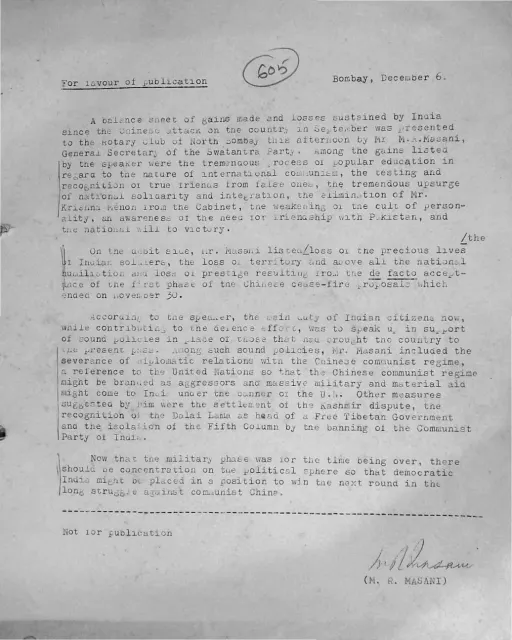
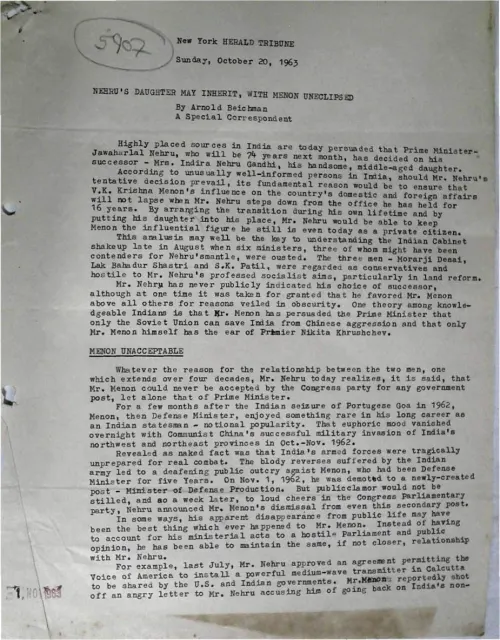
press note
For Favour of Publication
Bombay · 1960
2 pages
Summary
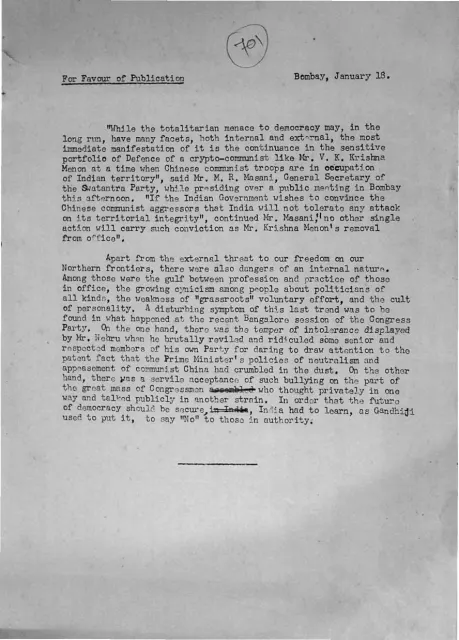
This two-page typed press-publication sheet, dated “Bombay, January 18,” reports remarks by M. R. Masani, General Secretary of the Swatantra Party. It presents the continued inclusion of V. K. Krishna Menon in the Defence portfolio, during the occupation of Indian territory by Chinese communist troops, as the immediate manifestation of a broader totalitarian threat to democracy. Masani argues that removing Krishna Menon would be the clearest way for the Indian Government to demonstrate that it would not tolerate attacks on India’s territorial integrity.
The statement also identifies internal dangers to Indian democracy: the gap between the professions and conduct of office-holders, public cynicism about politicians, weak grassroots voluntary activity, and the cult of personality. Referring to the recent Bangalore session of the Congress Party, it criticizes Jawaharlal Nehru’s intolerance toward party critics as well as the Congress rank and file’s passive acceptance of bullying. The sheet concludes by invoking Gandhi’s maxim that democracy requires the ability to say “No” to those in authority. No authorial byline, publisher, issuing organisation, year, or printed page foliation is visible.
Key points
- M. R. Masani’s statement links the Krishna Menon controversy to the wider threat posed by totalitarianism.
- The document treats Chinese communist occupation of Indian territory as a serious challenge to national security and territorial integrity.
- It argues that Krishna Menon’s removal from the Defence portfolio would send the strongest signal to Chinese aggressors.
- It identifies internal democratic weaknesses, including cynicism about politicians, weak grassroots voluntary effort, and personality cults.
- The recent Bangalore session of the Congress Party is presented as evidence of intolerance and passive party discipline.
- Jawaharlal Nehru is criticized for ridiculing senior party members who drew attention to the collapse of his policies of neutralism and appeasement toward communist China.
- The statement concludes that democracy depends on citizens learning to say “No” to those in authority.
Metadata and summary are AI-extracted from the source PDF and reviewed for editorial accuracy. The original work is available via the Read PDF tab above (where present); paragraph-level citation inside the PDF is deferred to a future engagement.