report · report
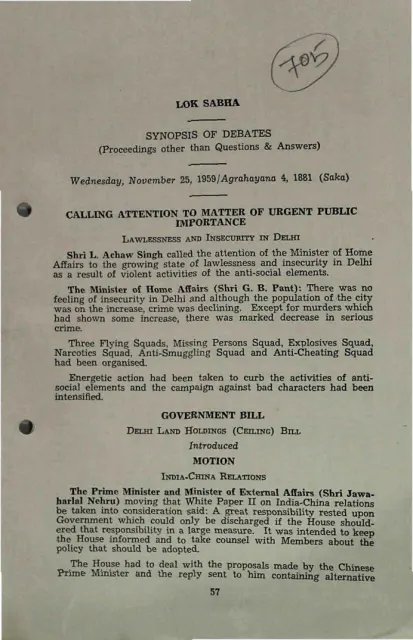
CALLING ATTENTION TO MATTER OF URGENT PUBLIC IMPORTANCE
LAWLESSNESS AND INSECURITY IN DELHI
1959
13 pages
Summary
This Lok Sabha synopsis dated 25 November 1959 records a calling-attention discussion on lawlessness and insecurity in Delhi, a brief entry for the Delhi Land Holdings (Ceiling) Bill, and an extended motion on India-China relations. On Delhi, L. Achaw Singh raised concern about violent anti-social activity, while Home Minister G. B. Pant replied that insecurity was not widespread, crime was declining apart from murders, and several specialist squads had been organised to address crime, smuggling, explosives, missing persons, and cheating.
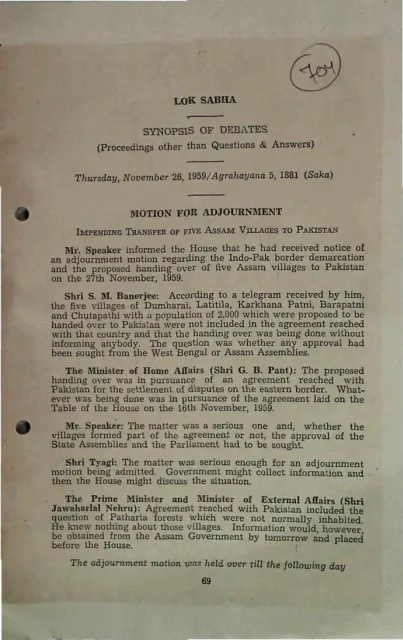
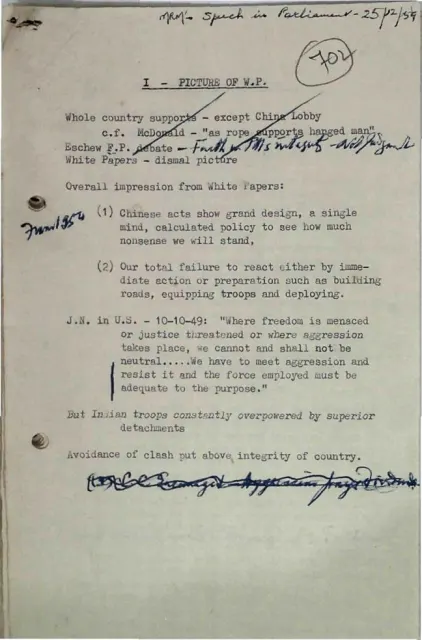
The India-China debate focuses on the Ladakh incident, the Sino-Indian boundary, Tibet, Panchsheel, non-alignment, defence preparedness, and the conduct of foreign policy. Jawaharlal Nehru defended non-alignment and argued that India should approach the dispute through its basic policies while strengthening its industrial and defensive capacity. Other members pressed for clearer information, stronger border infrastructure, possible emergency military assistance, reciprocity in diplomatic and economic relations, and the withdrawal of Chinese forces from Indian territory. The debate is explicitly marked as not concluded. The final rendered pages also contain undated handwritten notes, including references to democracy, communism, external dangers, citizenship, and a note dated 5/2/60; their context and authorship are not established.
Key points
- The document is a Lok Sabha Synopsis of Debates dated Wednesday, 25 November 1959.
- The Delhi discussion contrasts concern about lawlessness with the Home Minister’s claim that serious crime was declining.
- The synopsis records the introduction of the Delhi Land Holdings (Ceiling) Bill.
- The India-China motion addresses the Ladakh incident, the Tibetan crisis, boundary claims, and the 1954 Sino-Indian agreement.
- Nehru presents non-alignment and Panchsheel as peace-oriented policies while defending India’s right to maintain adequate defence capabilities.
- Members criticise the Government’s delayed communication, evasive answers, weak border preparedness, and conciliatory handling of Chinese actions.
- Proposed responses include improved roads and airfields, stronger military readiness, diplomatic reciprocity, and possible foreign military aid without surrendering sovereignty.
- The India-China debate was not concluded in the rendered proceedings; supplementary material is noted as being issued separately.
Metadata and summary are AI-extracted from the source PDF and reviewed for editorial accuracy. The original work is available via the Read PDF tab above (where present); paragraph-level citation inside the PDF is deferred to a future engagement.