Summary
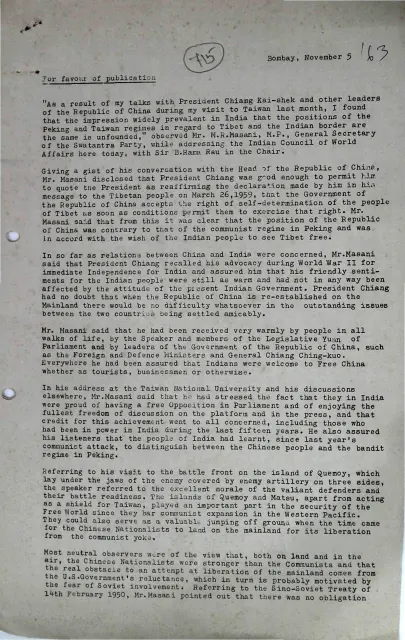
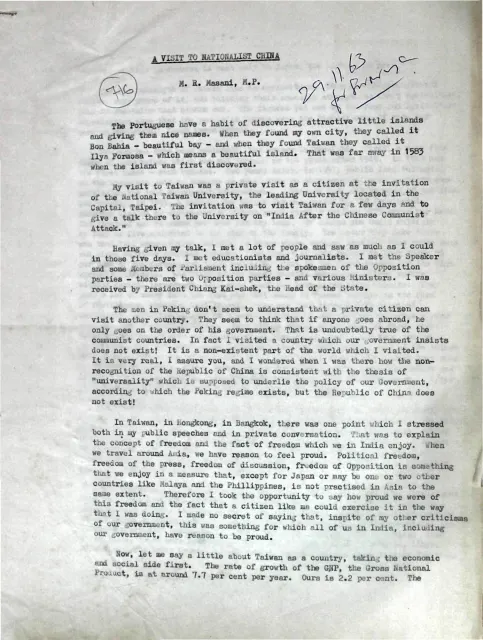
In this nine-page English essay, M. R. Masani reports on a private visit to Taiwan at the invitation of National Taiwan University, where he spoke on India after the Chinese Communist attack. He describes meetings with educators, journalists, legislators, ministers, and President Chiang Kai-shek, and contrasts the political freedoms he says Indians enjoy with conditions elsewhere in Asia. He argues that India should distinguish between the Chinese people and the Communist regime, while maintaining practical and friendly relations with the people of Free China.
Key points
- Masani presents Taiwan as a politically free and economically developing society opposed to Communist China.
- He highlights Taiwan’s agricultural performance, attributing it to land reform, compensation for dispossessed landowners, capital investment, and intensive fertiliser use.
- The essay cites Taiwan’s high rice yields, expanding export trade, improved infrastructure, rising electrification, education, and literacy.
- Masani describes Quemoy and Matsu as strategic defensive positions that contain Chinese Communist military forces and support the Nationalist claim to mainland China.
- He relays Nationalist intelligence asserting that Chinese Communist industry, agriculture, and military capacity had deteriorated after the Great Leap Backwards.
- The essay advocates Indian support for Tibetan self-determination and closer informal relations between India and Taiwan despite the absence of diplomatic recognition.
- Masani rejects a permanent Two-China settlement that would leave mainland China under Communist rule while Taiwan alone remained free.
- He recommends differentiating between friendly and hostile Chinese, breaking off diplomatic relations with Peking, and developing people-to-people, journalistic, educational, and commercial contacts with Taiwan.
Metadata and summary are AI-extracted from the source PDF and reviewed for editorial accuracy. The original work is available via the Read PDF tab above (where present); paragraph-level citation inside the PDF is deferred to a future engagement.