Summary
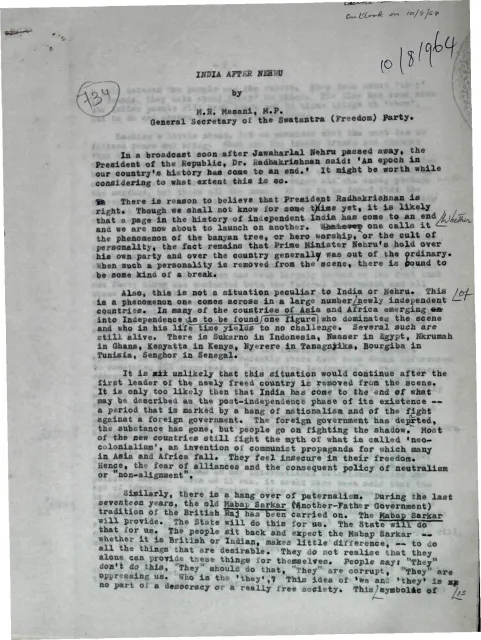
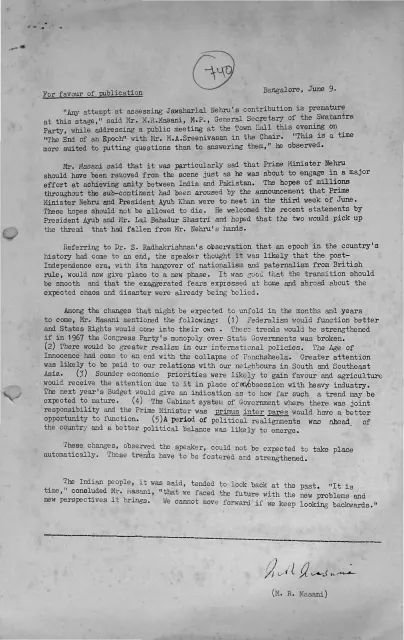
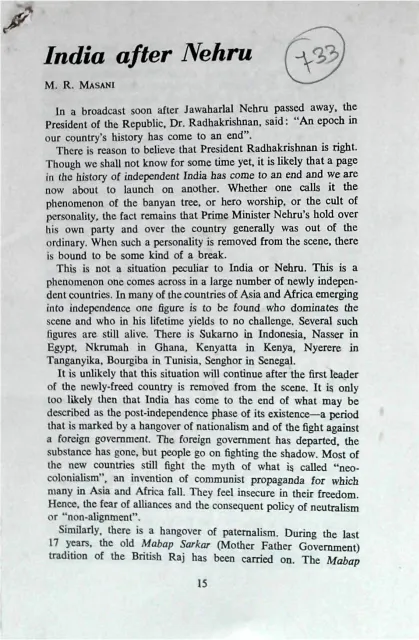
In the visible pages, M. R. Masani considers the political consequences of Jawaharlal Nehru’s death and argues that India is moving beyond the post-independence phase dominated by a single national leader. He identifies two inherited political habits as obstacles to democratic maturity: dependence on the paternal state, expressed through the “Mother-Father Government” idea, and the tendency to blame an external “They” rather than accept civic responsibility. Masani hopes that policy will increasingly be judged on its own merits and that political power will become more competitive and federal, with the states asserting greater rights against the Union government.
The essay also anticipates changes in foreign and economic policy. Masani expects India to learn from the failures of Panchsheel and an overly idealistic foreign policy, to pay closer attention to its South Asian neighbourhood, and to seek a more normal relationship with Pakistan. Economically, he calls for greater priority for agriculture, less “gigantism” and fewer costly “white elephants,” and a more welcoming attitude toward foreign capital. He predicts new political alignments and presents the Swatantra Party’s role as that of a constitutional, democratic opposition. The final pages urge Indians to face the future rather than remain absorbed in the glories of the past.
Key points
- Nehru’s death is presented as the likely end of a political era centred on one dominant leader and the beginning of a new phase in independent India.
- Masani criticises paternalism and the popular habit of attributing social and political problems to an undefined “They.”
- He anticipates stronger federalism, greater state rights, and the eventual breakdown of one-party dominance.
- The essay calls for a more realistic foreign policy, especially greater attention to Laos, Vietnam, Malaysia, China, and Pakistan.
- Masani argues that agriculture should receive higher priority than heavy industrialisation and that India should reduce wasteful large-scale projects.
- He advocates abandoning punitive treatment of Indian and foreign capital in a country short of productive tools and resources.
- The essay forecasts new party alignments and defines the Swatantra Party as a loyal constitutional opposition.
Metadata and summary are AI-extracted from the source PDF and reviewed for editorial accuracy. The original work is available via the Read PDF tab above (where present); paragraph-level citation inside the PDF is deferred to a future engagement.