minutes
For the use of General Council Members
For the use of General Council members only · Bombay · 1972
68 pages
Summary
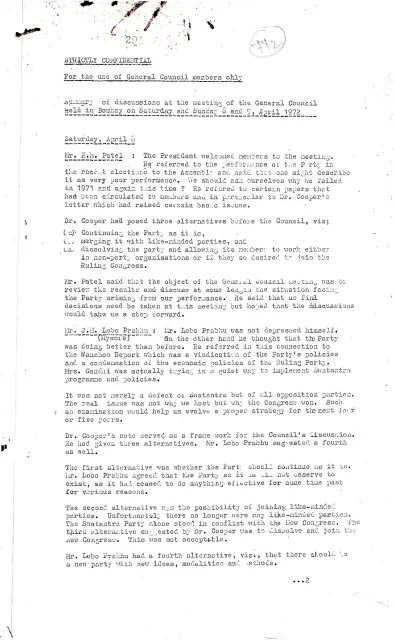
In the rendered pages, the confidential record of the Swatantra Party General Council meeting in Bombay on 8–9 April 1972 centers on whether the party should continue after its poor electoral performance, and on how it might recover. In the rendered pages, H. M. Patel, J. N. Lobo Prabhu, and other participants reject dissolution as the only response, while debating merger, alliances, organisational renewal, finance, leadership, and a possible new programme. In the rendered pages, speakers attribute the Congress victory to its ability to present nationalisation, bank policy, land reform, and welfare measures as serving ordinary voters, while criticising the Swatantra Party for failing to communicate its own commitments to private property, enterprise, lower prices, and individual freedom.
In the rendered pages, the discussion repeatedly turns from electoral diagnosis to practical political work: grievance cells, public meetings, press campaigns, district-level organisation, youth mobilisation, cadre training, and direct action on issues affecting farmers, the unemployed, and small industry. In the rendered pages, several speakers insist that the party must develop a mass base rather than remain an organisation of part-time or “arm-chair” politicians. In the rendered pages, participants also defend the party’s constitutional and liberal identity against socialism, one-party dominance, the 24th and 25th Constitutional Amendments, and possible alliances with the Jan Sangh, while disagreeing over how much emphasis to place on agitation and electoral tactics.
Key points
- In the rendered pages, the General Council debates whether the Swatantra Party should continue after its 1971–72 electoral defeats.
- In the rendered pages, speakers diagnose Congress’s success as a result of effective mass-oriented presentation, organisational resources, money, and control over public communication.
- In the rendered pages, proposed remedies include grievance bodies, public meetings, press outreach, district work, youth mobilisation, and trained full-time cadres.
- In the rendered pages, participants defend private property, enterprise, constitutional rights, and democratic pluralism against socialism and one-party politics.
- In the rendered pages, land reform, agricultural prices, tenancy, ceilings, unemployment, small industry, and the cost of living are presented as issues the party must take up directly.
- In the rendered pages, speakers criticise internal indiscipline, weak leadership, manipulated party elections, inadequate public contact, and dependence on wealthy supporters.
- In the rendered pages, electoral reforms proposed include controlling campaign expenditure, preventing ballot manipulation, holding elections on one day, and improving voter and candidate procedures.
Metadata and summary are AI-extracted from the source PDF and reviewed for editorial accuracy. The original work is available via the Read PDF tab above (where present); paragraph-level citation inside the PDF is deferred to a future engagement.