letter
Letter to Piloo Mody
POONA · 1974
2 pages
Summary
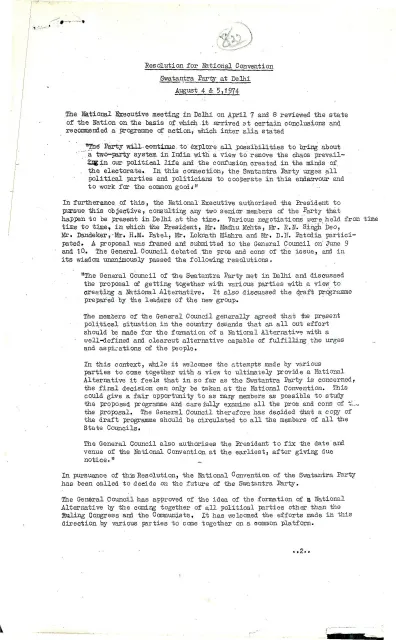
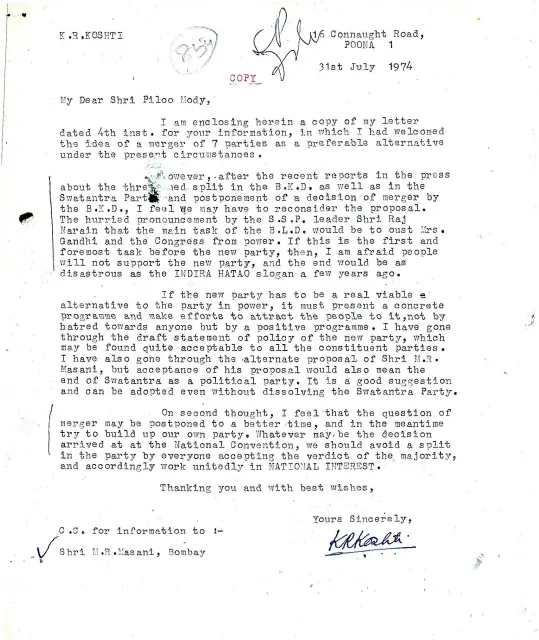
This two-page English correspondence from K. R. Koshti, dated 4 and 31 July 1974, addresses the future of the Swatantra Party and proposals to merge it with other opposition parties. In the enclosed letter to the President of the Swatantra Party (Maharashtra), Koshti argues that the party faces declining prospects and must choose between continuing separately and joining a broader opposition formation. He favors merger as a practical response to the political situation, while acknowledging that it would end Swatantra’s separate existence.
In the covering letter to Piloo Mody, Koshti qualifies his earlier support for an immediate seven-party merger after reports of divisions within the Bharatiya Kranti Dal and Swatantra Party. He warns that defining the new party chiefly as an instrument to remove Indira Gandhi and the Congress would produce a negative and ultimately disastrous political appeal. Instead, he calls for a concrete, positive programme, suggests that merger might be postponed, and urges party members to accept the National Convention’s majority decision and work together in the national interest.
Key points
- Koshti presents the Swatantra Party with a choice between maintaining separate existence and merging into a new opposition party.
- He considers merger preferable in light of the party’s political condition and the likelihood of elections.
- He argues that a new opposition party needs a concrete and positive programme rather than hostility toward Indira Gandhi and the Congress.
- Koshti regards M. R. Masani’s alternative proposal as potentially usable without dissolving the Swatantra Party.
- He later suggests postponing merger while building Swatantra’s own organization and avoiding an internal split.
- The letters emphasize cooperation among opposition parties, including possible participation by Congress (O), the Jana Sangh, and the Republican Party.
Metadata and summary are AI-extracted from the source PDF and reviewed for editorial accuracy. The original work is available via the Read PDF tab above (where present); paragraph-level citation inside the PDF is deferred to a future engagement.