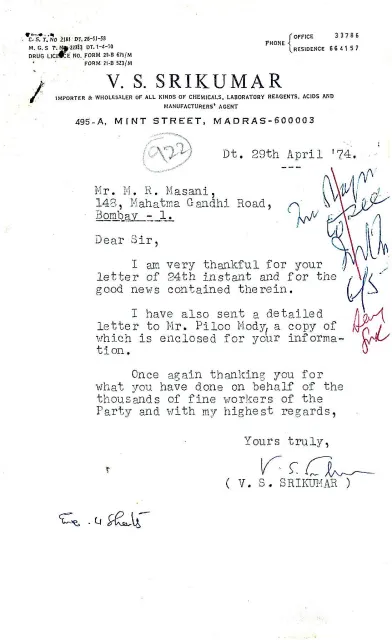
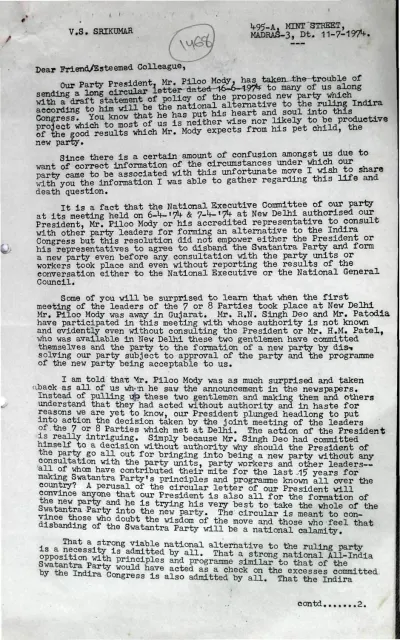
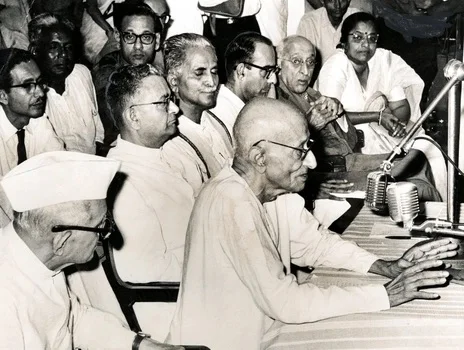
letter
Letter to Piloo Mody
Madras · 1974
7 pages
Summary
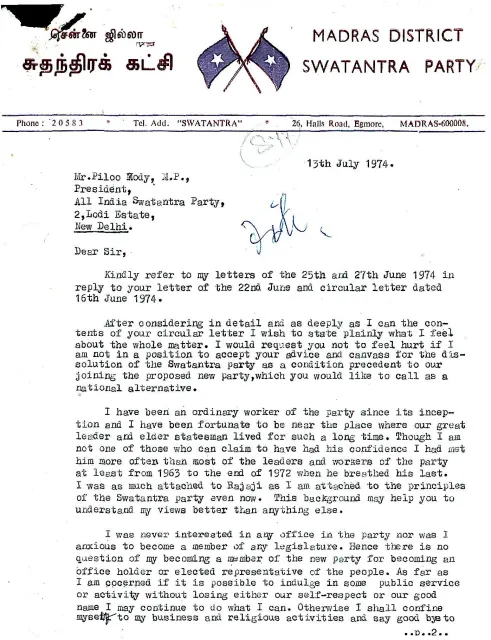
This 13 July 1974 letter from V. S. Srinivasan of the Madras District Swatantra Party to Piloo Mody rejects the proposed dissolution of the Swatantra Party as a precondition for forming a new national alternative. Srinivasan grounds his position in his long association with C. Rajagopalachari (“Rajaji”) and in his continued commitment to the party’s principles, while explaining that he has no personal ambition for office and may otherwise withdraw into business and religious activity.
The letter argues for a principled anti-socialist coalition rather than an expedient merger of groups with conflicting ideologies. Srinivasan proposes bringing together citizens and parties that support individual freedom, initiative, democratic government, and a state that serves rather than exploits the people. He criticizes the idea that parties should have no ideology, warns against alliances with unreliable politicians, and advocates a gradual consolidation of anti-socialist forces. The letter concludes that the proposed new party would fail, while a non-violent democratic movement—such as the one then being attempted in Bihar—offered a more credible route to displacing the ruling Congress.
Key points
- Srinivasan opposes dissolving the Swatantra Party as a condition for creating a new national political alternative.
- He presents his argument as a matter of political principle rather than personal office-seeking or factional advantage.
- The letter divides Indian politics into socialist and anti-socialist groupings, while noting the internal diversity of the socialist camp.
- It calls for a principled coalition of citizens and parties committed to individual freedom, initiative, democracy, and social justice.
- Srinivasan rejects a purely expedient merger involving socialist groups and industrialists or traders with incompatible ideological commitments.
- He argues that political parties require shared ideals and motivations, not merely common opposition to the ruling Congress.
- The proposed new party is judged unlikely to succeed because of mutual distrust, conflicting ideologies, and the unreliability of prospective allies.
- The letter endorses sustained, non-violent political action and long-term party-building as the alternative to a hurried merger.
Metadata and summary are AI-extracted from the source PDF and reviewed for editorial accuracy. The original work is available via the Read PDF tab above (where present); paragraph-level citation inside the PDF is deferred to a future engagement.