Summary
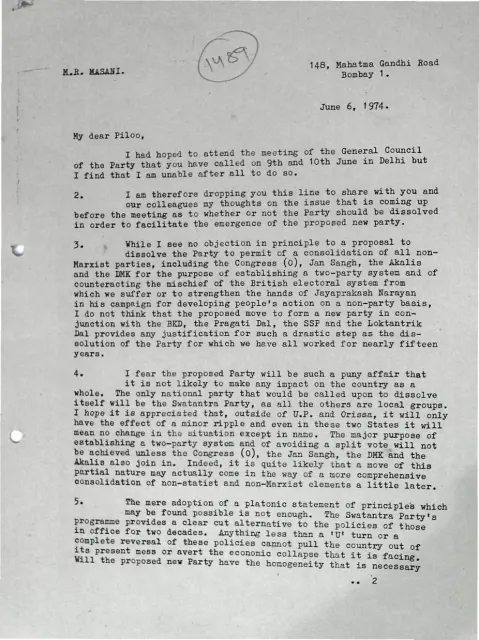
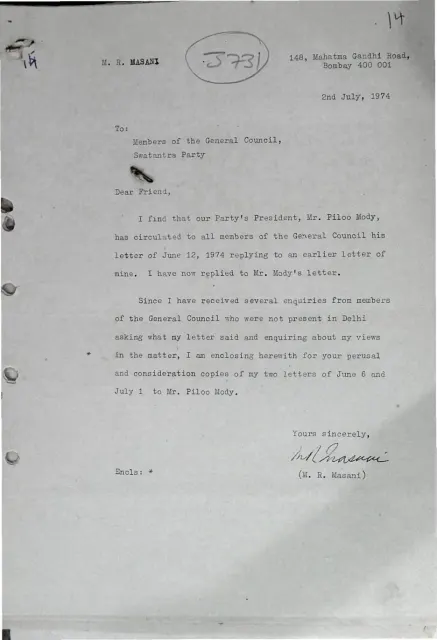
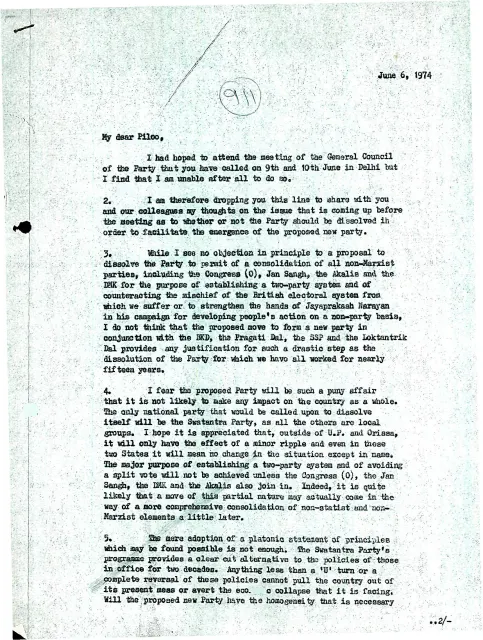
In this letter dated June 6, 1974, Minoo Masani writes to Piloo Mody about the proposed dissolution of the Swatantra Party and the formation of a broader non-Marxist political party. Masani accepts the principle of consolidation among non-Marxist parties, including Congress (O), Jan Sangh, the Akalis, and the DMK, but argues that dissolving Swatantra would not by itself create a meaningful national alternative or counter the advantages enjoyed by the ruling party under the British-derived electoral system.
Masani is particularly concerned that a hastily formed new party would be too small, politically heterogeneous, and insufficiently credible. He argues that merely adopting a declaratory statement of principles is inadequate: the new organisation would need a coherent programme and sufficient homogeneity to offer a genuine alternative to the policies of the parties that had governed for two decades. He therefore recommends a staged approach—maintaining Swatantra’s separate identity while agreeing with other parties on a common programme for “Unity in Action.” He closes by noting that the General Council can only recommend dissolution, while a National Convention has the constitutional authority to make the final decision.
Key points
- Masani supports non-Marxist political consolidation in principle but opposes dissolving Swatantra Party without a stronger organisational and programmatic basis.
- He argues that a new party comprising only a few groups would have little national impact and might merely produce a minor change in name.
- The proposed consolidation is presented as a response to the British-derived electoral system and the need to avoid splitting the opposition vote.
- Masani warns that a purely declaratory statement of principles cannot substitute for a credible alternative to the governing parties’ policies.
- He proposes a common programme for “Unity in Action” while each party retains its individual identity.
- He notes that dissolution requires a decision by a National Convention, not merely the recommendation of the General Council.
Metadata and summary are AI-extracted from the source PDF and reviewed for editorial accuracy. The original work is available via the Read PDF tab above (where present); paragraph-level citation inside the PDF is deferred to a future engagement.