
letter
Letter to Mr Minoo Masani
VIJAYAWADA-2 · 1974
3 pages
Summary
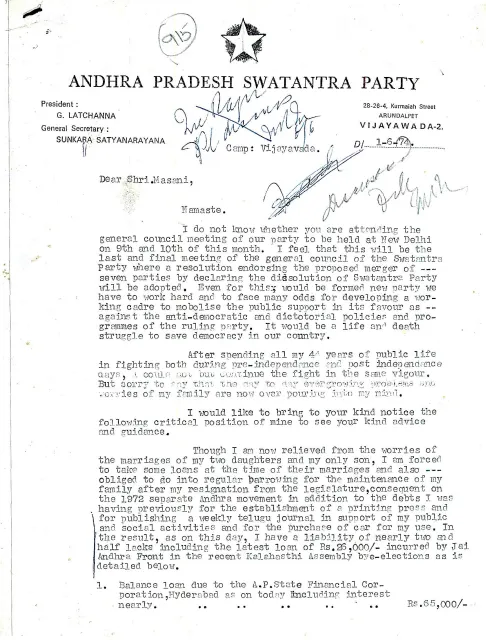
In this letter dated 1 June 1974, G. Latchanna writes from Vijayawada to Minoo Masani about the impending dissolution of the Swatantra Party and the proposed merger of seven parties. He presents the planned successor organisation as needing to oppose what he calls the ruling party’s “anti-democratic and dictatorial policies and programmes,” describing the effort as a struggle to preserve democracy. Latchanna also explains that, after 44 years in public life, family responsibilities and financial pressures prevent him from continuing political work with the same intensity.
The greater part of the letter details nearly Rs. 2.5 lakhs in liabilities, including loans connected with his printing press, the Jai Andhra Front’s Kalahasti Assembly by-election, and personal borrowing undertaken during his public career. He asks Masani to help arrange the sale of a Hyderabad building or identify wholesale and distribution opportunities for his son’s printing business in Andhra Pradesh. The letter thus combines a political appeal for democratic opposition with a personal request for financial and professional assistance.
Key points
- The letter anticipates the final general council meeting of the Swatantra Party and endorses the proposed merger of seven parties.
- Latchanna frames the new political organisation as an instrument for opposing anti-democratic and dictatorial policies.
- He says family responsibilities and accumulated financial pressures have limited his ability to continue political work.
- He itemises liabilities totalling approximately Rs. 1,90,000 in the listed categories, while describing broader obligations of nearly Rs. 2.5 lakhs.
- The debts include financing for a printing press, a car, the Jai Andhra Front’s Kalahasti by-election, and personal loans.
- He asks Masani to help find a buyer for his Hyderabad building or arrange business opportunities for his son’s printing enterprise.
- He seeks to become economically self-supporting and end his dependence on further borrowing.
Metadata and summary are AI-extracted from the source PDF and reviewed for editorial accuracy. The original work is available via the Read PDF tab above (where present); paragraph-level citation inside the PDF is deferred to a future engagement.
Related across the archive
 Primary workLetter From Mr. G. Latchanna, President-Andhra Pradesh Swatantra Party, forwarding Resolution of Andhra State Council to Mr. H. M. Patel
 Primary workGENERAL SECRETARY'S LETTER NO.111
 Primary workLetter to Mr Minoo Masani
 ExcerptSharad Joshi on The Tragedy of Being a Farmer in India
 ExcerptAgricultural Policy of Swatantra Party