Summary
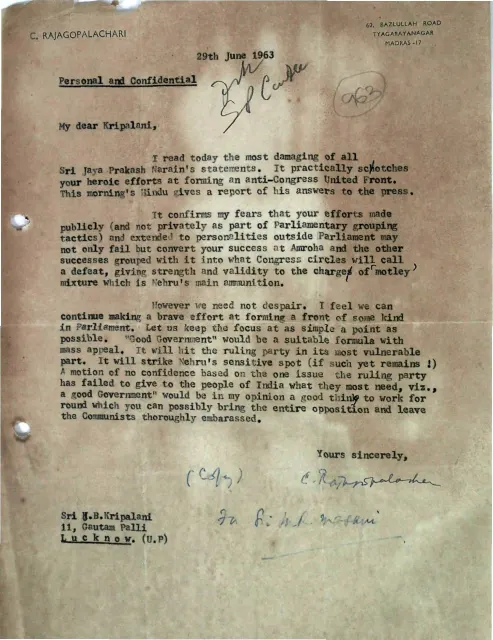
In this personal and confidential letter dated 29 June 1963, C. Rajagopalachari warns H. B. Kripalani that Jayaprakash Narayan’s recent statements could undermine efforts to build an anti-Congress United Front. Rajagopalachari argues that conducting these efforts publicly, and involving figures outside Parliament, may allow Congress to portray the opposition’s successes—including the result at Amroha—as a defeat and strengthen Jawaharlal Nehru’s criticism of the coalition as a motley mixture.
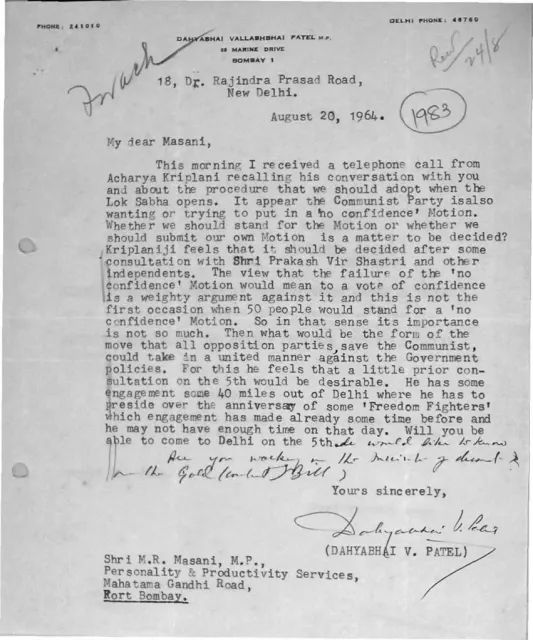
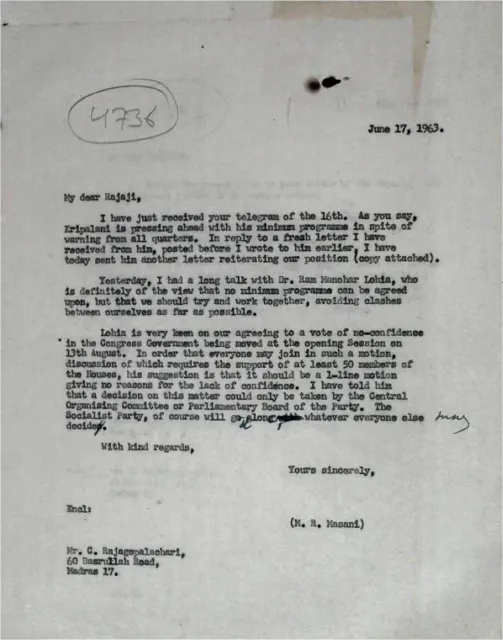
The letter nevertheless urges Kripalani not to abandon the project. Rajagopalachari proposes “Good Government” as a simple, mass-appeal issue around which the opposition could unite, including the possibility of a parliamentary no-confidence motion. He suggests that this framing would target the ruling party’s alleged failure to provide Indians with the good government they most needed while leaving the Communists politically embarrassed.
Key points
- Rajagopalachari criticizes Jayaprakash Narayan’s public statements concerning the formation of an anti-Congress United Front.
- He argues that public coalition-building and the involvement of figures outside Parliament could enable Congress to recast opposition successes as defeats.
- The letter identifies Nehru’s criticism of the opposition as a politically important concern.
- Rajagopalachari advises Kripalani not to despair or abandon the effort to form an opposition front.
- He proposes “Good Government” as a simple issue with broad popular appeal.
- He recommends using a no-confidence motion focused on the ruling party’s failure to provide good government.
- He believes this strategy could unite the opposition and embarrass the Communists.
Metadata and summary are AI-extracted from the source PDF and reviewed for editorial accuracy. The original work is available via the Read PDF tab above (where present); paragraph-level citation inside the PDF is deferred to a future engagement.