essay
A Note of Dissent on the Memorandum of the Panel of Economists
By B. R. Shenoy
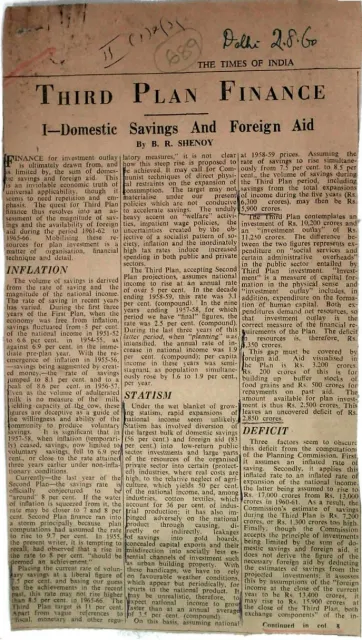
Published in The Second Five Year Plan (1956-57 to 1960-61), Basic Considerations Relating to the Plan Frame, a Memorandum prepared by the Panel of Economists, Planning Commission (April 1955). This version is scanned from the publication of Economics Research Centre, 1998. · 1955
15 pages
A Note of Dissent on the Memorandum of the Panel of Economists
By B. R. Shenoy
Summary
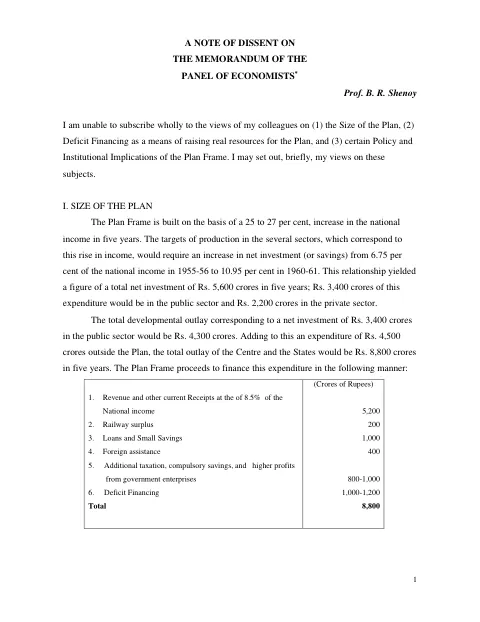
This is B.R. Shenoy’s celebrated minority “Note of Dissent” against the Memorandum of the Panel of Economists that underpinned the Plan Frame of India’s Second Five Year Plan (1956–61). Written in 1955 and originally appended to the Planning Commission’s planning documents, the note (reproduced here from a 1998 Economics Research Centre edition, with key passages highlighted in red) records Shenoy’s inability to subscribe to his colleagues’ views on three counts: the size of the Plan, deficit financing as a means of raising real resources, and certain policy and institutional implications of the Plan Frame.
On the size of the Plan, Shenoy argues that the proposed outlay — built on a 25–27 per cent rise in national income and an investment programme of the order of Rs. 8,800 crores — outruns the country’s available real resources, since total net investment cannot exceed the community’s net savings plus foreign assistance. Devices such as revenue surpluses, loans, ploughing back of profits, credit creation and deficit financing, he insists, merely appropriate existing savings: “There is no device of creating real resources which are not saved.” An over-ambitious plan, forced through against the limits of real resources, would breed uncontrolled inflation and endanger individual liberty and democratic institutions.
On deficit financing (Section II) he concedes a limited, carefully watched role but rejects the analogy between unemployment in industrial economies and underemployment in underdeveloped ones; in India the binding scarcity is savings and complementary real resources, for which created money is no substitute. In Section III he turns to policy and institutional implications, warning that legislative and administrative measures to force up the savings rate may by degrees undermine the democratic social order and infringe individual liberty. He opposes taxation that further depresses lower-income consumption, would confine nationalisation to public utilities and national security (leaving competitive enterprise to private entrepreneurs and the price system), urges the removal rather than continuance of physical controls and allocations, examines agricultural price support, and is sceptical of the proposed National Labour Force. The recurring thread is a plea for “economic rationalisation, for progress with stability” — keeping fiscal, monetary, investment, tariff and exchange-rate policy mutually consistent and within the bounds of genuinely available savings.
Key points
-
Shenoy’s 1955 minority dissent from the Panel of Economists’ Memorandum on the Plan Frame of the Second Five Year Plan; reproduced from a 1998 Economics Research Centre edition.
-
He dissents on three heads: the size of the Plan, deficit financing, and the Plan Frame’s policy/institutional implications.
-
Core economic claim: total net investment cannot exceed net savings plus foreign assistance — ‘There is no device of creating real resources which are not saved.’
-
An over-ambitious plan forced past real-resource limits would generate uncontrolled inflation and threaten individual liberty and democratic institutions.
-
On deficit financing, he allows a limited measured role but rejects equating industrial-economy unemployment with underdeveloped-economy underemployment; created money is no substitute for savings.
-
He warns that legislative/administrative drives to raise the savings rate could undermine the democratic social order.
-
He would limit nationalisation to public utilities and national security, leaving competitive enterprise to private entrepreneurs and the price system.
-
He favours decontrol over the continuance of physical controls, opposes taxing lower-income groups further, and is sceptical of the proposed National Labour Force.
Generated by the v1.5 extraction pipeline. Awaiting editorial review.
Metadata and summary are AI-extracted from the source PDF and reviewed for editorial accuracy. The original work is available via the Read PDF tab above (where present); paragraph-level citation inside the PDF is deferred to a future engagement.