book
At Liberty: Freedom to Express and Offend
Liberty Institute, C-4/8 Sahyadri, Plot 4, Sector 12, Dwarka, New Delhi 110078, India. In partnership with: Friedrich Naumann - Stiftung für die Freiheit · New Delhi · 2012
21 pages
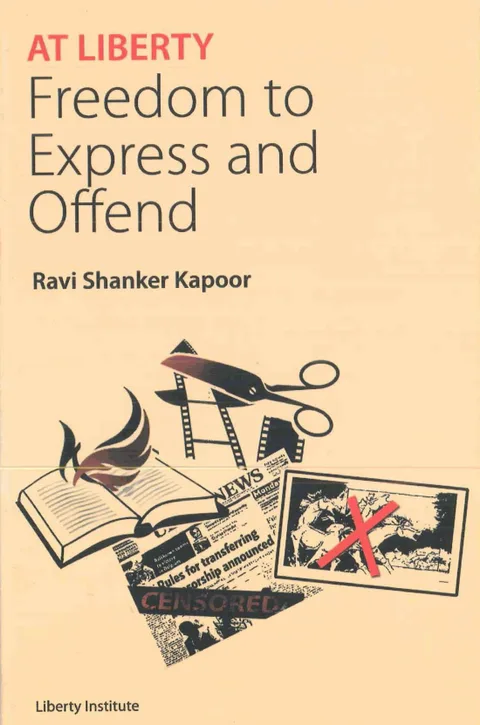
At Liberty: Freedom to Express and Offend
By Ravi Shanker Kapoor
Summary
At Liberty: Freedom to Express and Offend is a polemical booklet by journalist Ravi Shanker Kapoor, published in 2012 by the Liberty Institute (New Delhi) in partnership with the Friedrich Naumann Stiftung für die Freiheit. Across four sections it mounts an unapologetically absolutist case for free speech, opening with the claim that ‘Freedom of expression ought to be absolute—or it is no freedom at all.’ The author anticipates the standard Indian objection — that there is no point in gratuitously offending the religious or communal sentiments of groups — and argues that any ‘offence principle’ of the kind proposed by philosopher Joel Feinberg, which would go beyond John Stuart Mill’s Harm Principle, opens the door to limitless censorship.
Section I (‘For absolute freedom of expression’) develops the philosophical core, distinguishing expression from criminal incitement and answering the ‘fear of freedom’ raised by both Islamist menace and Maoist violence; Kapoor contends these problems are products of bad governance and weak rule of law rather than of unlimited speech. He treats the 1988 ban on Salman Rushdie’s Satanic Verses as a watershed that emboldened fundamentalists and demoralised writers, and notes the persecution of Taslima Nasreen.
Section II (‘Freedom of expression in Independent India’) and Section IV (‘Censorship and the Law of Inexorability’) turn to the Indian legal-institutional machinery of censorship. In the rendered pages, Section IV examines film censorship in particular, describing the Central Board of Film Certification (CBFC) — a statutory body under the Ministry of Information & Broadcasting operating under the Cinematograph Act, 1952 — its U/UA/A/S certification categories, and the broader constellation of forces that curtail filmmakers’ creative freedom. The booklet’s recurring thesis is that piecemeal, well-intentioned restrictions are inexorable: once granted, the logic of censorship expands without natural limit.
Key points
-
Single-author polemic by journalist Ravi Shanker Kapoor arguing that freedom of expression must be absolute or it is not freedom at all.
-
Published 2012 by Liberty Institute (New Delhi) in partnership with Friedrich Naumann Stiftung für die Freiheit.
-
Engages John Stuart Mill’s Harm Principle and rejects Joel Feinberg’s ‘Offence Principle’ as a license for open-ended censorship.
-
Distinguishes protected expression from criminal incitement, arguing penalising incitement is not curbing free speech.
-
Treats the 1988 ban on Salman Rushdie’s Satanic Verses as a watershed that emboldened fundamentalists; cites the persecution of Taslima Nasreen.
-
Argues that Islamist and Maoist threats stem from bad governance and weak rule of law, not from unlimited speech.
-
Section IV details India’s film-censorship apparatus: the CBFC under the Cinematograph Act, 1952, its certification categories, and pressures on filmmakers.
-
Central thesis is a ‘Law of Inexorability’ — once admitted, censorship expands without natural limit.
Generated by the v1.5 extraction pipeline. Awaiting editorial review.
Metadata and summary are AI-extracted from the source PDF and reviewed for editorial accuracy. The original work is available via the Read PDF tab above (where present); paragraph-level citation inside the PDF is deferred to a future engagement.