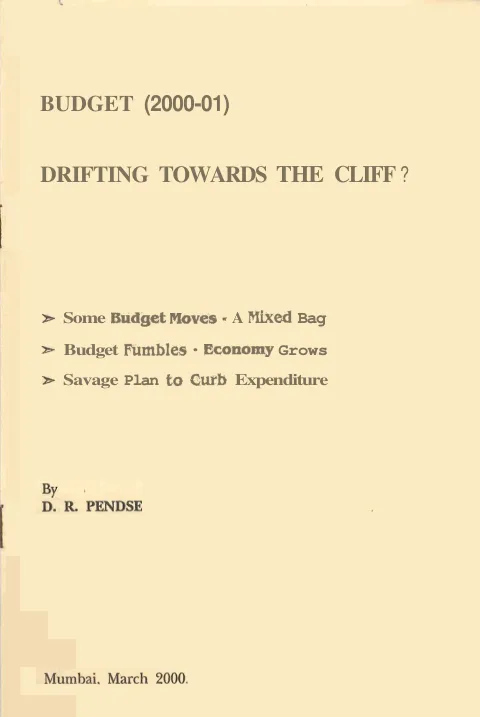
Budget (2000-01): Drifting Towards the Cliff?
By D. R. Pendse
Summary
In this 2000 Mumbai pamphlet, the economist D. R. Pendse offers a sharply critical reading of the Union Budget for 2000-01, opening with the verdict that while a few measures are deft, the budget as a whole leaves critical fiscal issues ‘needlessly brushed under the carpet’ even as ‘the fisc drifts towards the cliff.’ He organises the argument in three sections. Section I (‘Some Budget Moves: A Mixed Bag’) itemises specific proposals, grading each as creditable or not — praising the cut in the FM’s discretionary exemption powers and dividend-tax changes, while faulting deletion of Section 54EA/54EB capital-gains relief and the raising of the corporate-surcharge.
Section II (‘The Budget Fumbles, the Economy Grows’) argues the paradox at the heart of the work: although the fiscal position is deeply disturbing — Pendse marshals figures on ballooning government borrowing, interest payments and the fiscal deficit as a share of GDP — the broader economic outlook still offers scope for relief, with GDP growth recovering. He warns that runaway expenditure and rising debt-service have brought India repeatedly close to the kind of balance-of-payments crisis it narrowly escaped in 1991. Section III (‘Curbing Government Expenditure: A Seven Point Savage Plan’) sets out his prescription: a frozen total-expenditure ceiling, deep cuts to subsidies and the government wage bill, privatisation, and a freeze on fresh recruitment — measures he concedes have ‘no chance’ of being found politically acceptable, but which he insists are the only harsh options now left.
Throughout, Pendse intersperses anecdotal ‘boxes’ — a journalist friend’s quip about a ‘kite-flying’ budget, a vignette on Manmohan Singh and the 1991 reforms — to leaven what he calls an otherwise ‘dull and depressing subject.’ The pamphlet reads as a practitioner’s plea for expenditure discipline over cosmetic budgeting.
Key points
-
Pendse’s central thesis: the 2000-01 budget ducks critical fiscal issues while ‘the fisc drifts towards the cliff,’ even though the wider economy is growing.
-
Section I grades individual budget measures as ‘creditable’ or ‘not very creditable’ — e.g. welcoming reduced FM discretionary exemption power, faulting deletion of Section 54EA/54EB capital-gains relief.
-
Section II documents the fiscal danger: rising government borrowing, mounting interest payments, and the fiscal deficit as a share of GDP.
-
He repeatedly invokes 1991, when India ‘narrowly missed a brush with international default,’ as the cautionary precedent for unchecked deficits.
-
Section III proposes a ‘Seven Point Savage Plan’: freeze total expenditure, slash subsidies and the wage bill, privatise, and halt fresh recruitment.
-
Pendse concedes the plan has ‘no chance’ of being politically acceptable but argues only harsh options remain.
-
Anecdotal sidebar boxes (a ‘kite-flying’ budget joke; a Manmohan Singh/1991 vignette) are used to relieve a ‘dull and depressing subject.’
-
The work is a single-author practitioner pamphlet, priced Rs. 25, with no formal publisher imprint.
Generated by the v1.5 extraction pipeline. Awaiting editorial review.
Metadata and summary are AI-extracted from the source PDF and reviewed for editorial accuracy. The original work is available via the Read PDF tab above (where present); paragraph-level citation inside the PDF is deferred to a future engagement.