
pamphlet
I. Current Economic Environment for Business; II. The Budget We Need
By D. R. Pendse
Bombay · 1995
10 pages
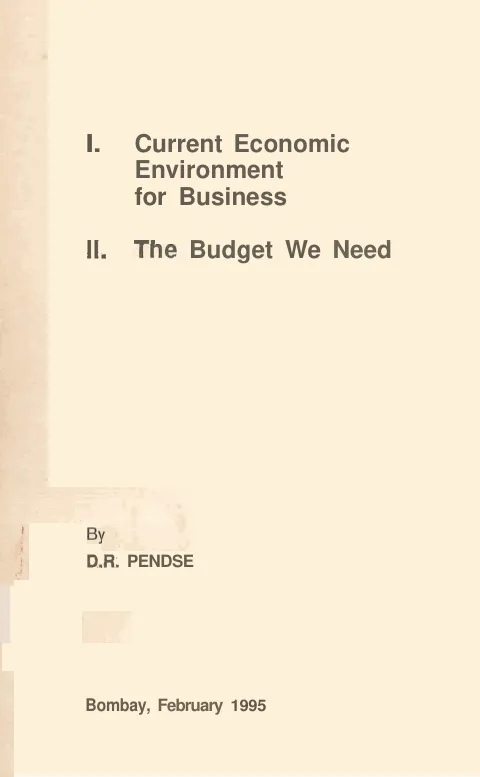
I. Current Economic Environment for Business; II. The Budget We Need
By D. R. Pendse
Summary
Written in Bombay in February 1995, this two-part pamphlet by the economist D. R. Pendse offers a practitioner’s reading of India’s economic climate on the eve of the 1995-96 Union Budget. Part I, ‘Current Economic Environment for Business,’ runs as a compact ‘executive summary’ of the parameters shaping business in post-liberalisation India: the durability of reforms, inflation, the budget, interest rates, capital-account convertibility, the rupee-dollar exchange rate, exports, and elections. Pendse’s recurring worry is fiscal: he traces the 1991 crisis to ‘huge fiscal deficits,’ notes that the deficit which was cut to 6% of GDP has ballooned back toward Rs.65,000 crore (about 7.3%) for 1994-95, and warns that any 1995-96 budget figure above 5% of GDP should be read as a reversal of reforms ‘to that extent.’ He is sceptical of populist pre-election budgeting, cautious on full capital-account convertibility, and warns that high interest rates will persist because of the government’s own market borrowing.
Part II, ‘The Budget We Need,’ turns prescriptive. Pendse argues the budget scenario is ‘once more getting out of hand’ and offers guidelines built on two mottoes he would have the Finance Minister paste on his office wall: ‘populism will never alleviate poverty’ and ‘tax rates and tax revenues are two different things.’ His concrete proposals include holding the fiscal deficit to about Rs.53,000 crore, a bolder gold and disinvestment policy, abolishing individual income tax on wages and salaries while using disinvestment proceeds to retire government debt, dismantling the ‘national disgrace’ of the Income Tax Act, and a 25% cut in ministry allocations to force a leaner government. He closes with a ‘Tailpiece’ — a serenity-prayer for India’s leaders — and the conviction that rapid growth and inflation control, not populist schemes, are the ‘best antidotes to poverty.‘
Key points
-
A two-part single-author pamphlet (Part I diagnostic, Part II prescriptive) on India’s economy ahead of the 1995-96 budget.
-
Pendse roots the 1991 crisis in ‘huge fiscal deficits’ and warns the deficit has ballooned back toward Rs.65,000 crore (~7.3% of GDP) for 1994-95.
-
He treats any 1995-96 fiscal deficit above 5% of GDP (~Rs.53,000 crore) as a measurable reversal of reforms.
-
Skeptical of populist pre-election ‘soft’ budgets and of rushing into full capital-account convertibility of the rupee.
-
Two governing mottoes: ‘populism will never alleviate poverty’ and ‘tax rates and tax revenues are two different things.’
-
Radical proposals: abolish individual income tax on wages/salaries, accelerate disinvestment (sell >50% of PSU equity), liberalise gold policy, and cut ministry allocations 25%.
-
Calls the Income Tax Act a ‘national disgrace’ and the tax department ‘in shambles.’
-
Concludes that rapid growth and inflation control with ‘a human face’ are the best antidotes to poverty.
Generated by the v1.5 extraction pipeline. Awaiting editorial review.
Metadata and summary are AI-extracted from the source PDF and reviewed for editorial accuracy. The original work is available via the Read PDF tab above (where present); paragraph-level citation inside the PDF is deferred to a future engagement.
People in this work
Related across the archive
 Primary workUnion Budget 1993-94: Laying the Foundation for an Economic Miracle
 Primary workGrowing Government Expenditure is a Cause for Concern
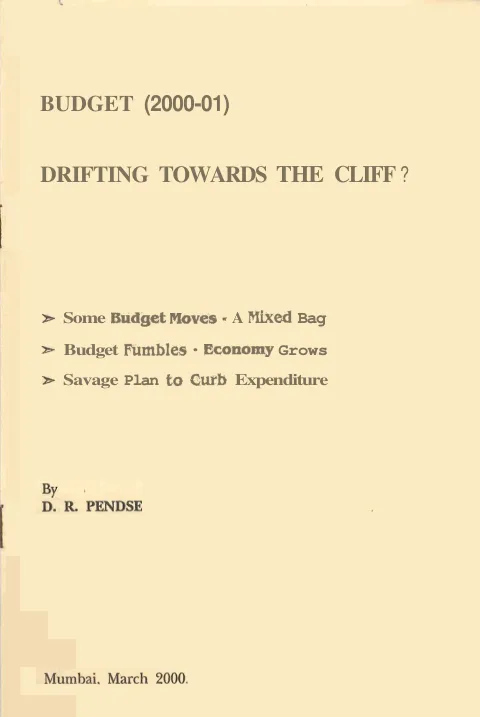 Primary workBudget (2000-01): Drifting Towards the Cliff?
 ExcerptThe Liberal Budget: Building an Equitable Society
 ThePrintEconomist DR Pendse’s 7-point plan to cut expenditure and control budget deficit