periodical issue
Freedom First
By Viswamitra
Printed & Published by Dinkar Sakrikar at the Kannada Press, Podar Chambers, 109, Parsi Bazaar St., Fort Bombay. · Bombay · 1952
8 pages
Freedom First
Summary
This is the inaugural issue (No. 1, June 1952) of Freedom First, the monthly bulletin of the Indian Committee for Cultural Freedom, affiliated with the World Movement for Cultural Freedom (later the Congress for Cultural Freedom). In the rendered pages, the issue opens with an unsigned editorial, “The Open Society,” that frames India’s long tradition of intellectual tolerance as the basis for a modern anti-totalitarian project, followed by a “Notes” section commenting on current affairs (a Hind Mazdoor Sabha trade-union delegation to Communist China, the government’s reluctance to host an international peace congress in Delhi, and a West Bengal proposal to remove British-era statues from the Calcutta Maidan). The issue also covers the Committee’s participation in the Paris “Masterpieces of the 20th Century” exposition, reports on the first Annual General Meeting and the Bombay Committee’s activities (“Our Tasks”), runs a satirical eyewitness account of a Soviet art exhibition in Bombay (“Exhibit One,” bylined Viswamitra), and closes with the reprinted “Declaration on Cultural Freedom” adopted by the Indian Congress for Cultural Freedom on 31 March 1951, plus a membership coupon. The volume’s argumentative center is a defence of the “open society” — free debate, tolerance of dissent, and resistance to totalitarian regimentation — pitched against both Communist and other authoritarian tendencies of the day.
Key points
-
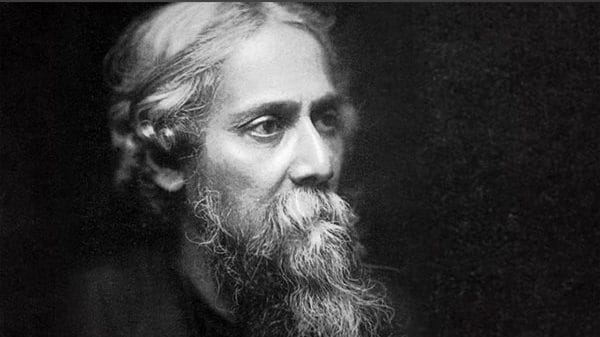
The unsigned lead editorial, “The Open Society,” argues that India’s historic tradition of intellectual tolerance, traced from Rammohun Roy through Tagore and Gandhi, grounds the newly formed Movement for Cultural Freedom’s resistance to totalitarian regimentation.
-
The “Notes” section criticises a Hind Mazdoor Sabha delegation’s attendance at Communist China’s May Day celebrations, questions the government’s excuse for postponing an international peace congress in Delhi, and condemns a West Bengal proposal to remove British-era statues from the Calcutta Maidan as “tampering with history.”
-
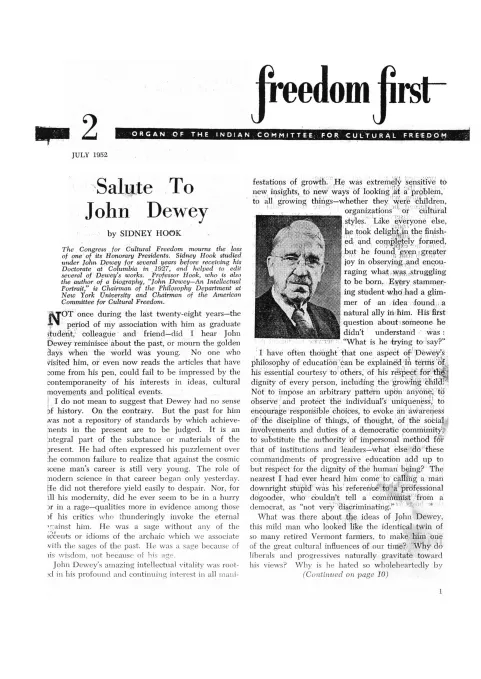
“Masterpieces of the 20th Century” reports on a five-member Indian delegation, led by Sir Rustom Masani, to the Congress for Cultural Freedom’s Paris exposition, alongside honorary presidents Croce, Dewey, Jaspers, Madariaga, Maritain, and Russell.
-
“Our Tasks” records the Committee’s first Annual General Meeting and Executive Committee, and the Bombay Committee’s syndication of Sydney Hook’s and Robert Guillain’s articles to Indian-language newspapers.
-
Viswamitra’s satirical “Exhibit One” mocks the Soviet Art Exhibition in Bombay as gaudy, Stalin-worshipping propaganda, noting a canvas that pictorially distorted Stalin’s and Mao Zedong’s relative heights.
-
The issue closes by reprinting the Indian Congress for Cultural Freedom’s “Declaration on Cultural Freedom” of 31 March 1951, which frames modern totalitarianism as uniquely dangerous for seeking to dictate truth itself, not merely its expression.
Essays
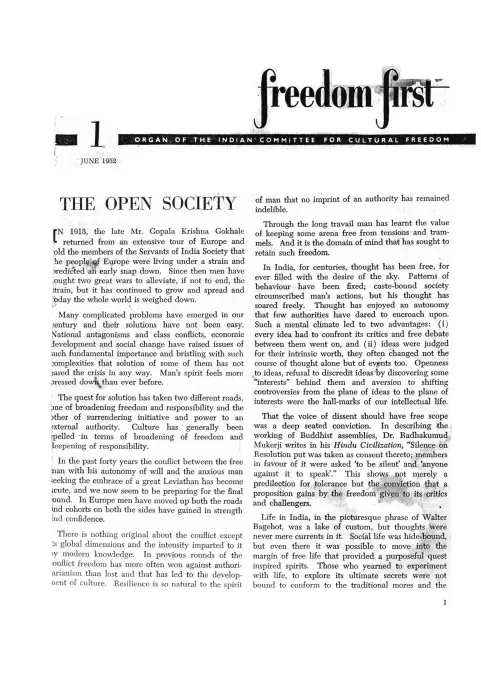
The Open Society
“The Open Society” is the unsigned lead editorial of this first issue. It opens with Gopal Krishna Gokhale’s 1913 warning, on returning from Europe, that Europeans were living under a strain that would lead to conflict, and traces the subsequent decades of war and ideological struggle between individual freedom and submission to a “great Leviathan” of state or collective authority. The piece argues that India has a distinctive heritage of intellectual tolerance — thought free even under a caste-bound, custom-heavy social order — which produced a habit of confronting every idea with its critics, quoting Radhakumud Mukerji’s account of Buddhist assemblies as an illustration. It presents the newly formed Movement for Cultural Freedom (i.e., the Indian Committee for Cultural Freedom) as continuous with this national tradition, tracing a line from Rammohun Roy through Tagore and Gandhi, and states that the Movement has no fixed programme for social ills beyond insisting that solutions be worked out within a climate of freedom and open debate, not through submission to authority.
- Opens with Gokhale’s 1913 prediction of European strain and conflict as a framing device for the essay’s argument.
- Frames the 20th-century crisis as a conflict between the free man’s autonomy and the pull toward a collectivist ‘great Leviathan’.
- Argues India has a historic ‘climate of tolerance’ in which thought remained free even though social behaviour was custom-bound.
- Cites Dr. Radhakumud Mukerji’s Hindu Civilization on Buddhist assembly practice as evidence of a deep-rooted Indian predilection for tolerance and dissent.
- Positions the Movement for Cultural Freedom as heir to the reform lineage of Rammohun Roy, Tagore, and Gandhi.
- States the Movement has no fixed programme (‘nostrums’) for society’s ills beyond preserving the framework of free debate.
- Warns against retreat into authoritarian ‘security’ as a response to modern anxiety, arguing suppression of doubt worsens underlying problems.
Notes (Trade Unionists Trip; Delhi Hospitality; Tampering with History)
The “Notes” section opens with “Trade Unionists Trip,” criticizing a Hind Mazdoor Sabha delegation’s attendance at May Day celebrations in Communist China, arguing the visit implicitly legitimized a regime that had destroyed independent Chinese trade unionism and comparing the delegation unfavourably to the Indian National Trade Union Congress, which had declined a similar invitation. It is followed by “Delhi Hospitality,” which begins as a comment on India’s acute housing shortage but pivots into an account of how the Indian Government’s stated inability to accommodate delegates led to the postponement of an International Peace Forum congress in New Delhi — the piece implies this excuse concealed political pressure linked to Soviet and Chinese Communist diplomatic sensitivities, drawing a parallel to the earlier relocation of the Indian Congress for Cultural Freedom’s own conference away from Delhi. A further item, “Tampering with History,” criticizes a reported West Bengal government move to remove British-era statues from the Calcutta Maidan, endorsing historian Dr. Jadunath Sircar’s view that such monuments are historical records that should stand, and drawing an analogy to Stalinist Russia’s erasure of Leon Trotsky from official history and monuments.
- Criticizes the Hind Mazdoor Sabha for sending a delegation to Communist China’s May Day celebrations, arguing this legitimizes a regime that crushed independent trade unionism.
- Contrasts the Hind Mazdoor Sabha’s acceptance of the invitation with the Indian National Trade Union Congress’s rejection of a similar invitation.
- Reports that an International Peace Forum congress planned for New Delhi was postponed, ostensibly due to accommodation shortages, a claim the piece treats with scepticism.
- Draws a parallel between the Delhi peace-congress postponement and the earlier relocation of the Indian Congress for Cultural Freedom’s conference away from Delhi, implying political pressure from Communist embassies.
- Endorses historian Dr. Jadunath Sircar’s argument that removing British-era statues from Calcutta amounts to ‘tampering with history’.
- Uses Stalinist Russia’s erasure of Leon Trotsky from official history as a cautionary parallel to the proposed removal of statues.
Masterpieces of the 20th Century: International Exposition of the Arts in Paris
“Masterpieces of the 20th Century” reports on the Indian Committee for Cultural Freedom’s participation in the International Exposition of the Arts in Paris, sponsored by the Congress for Cultural Freedom. A five-member Indian delegation led by Sir Rustom Masani, including P. Y. Deshpande, Ramabriksha Benipuri, Ka. Naa. Subramaniam, and Philip Spratt, joined the exposition’s literary discussions. The piece describes the exposition’s scope (literary, art, musical, and dramatic programmes) and the Congress for Cultural Freedom’s identity as an international body of intellectuals opposed to totalitarian control over creative life, naming honorary presidents Benedetto Croce, John Dewey, Karl Jaspers, Salvador de Madariaga, Jacques Maritain, and Bertrand Russell.
- The Indian Committee for Cultural Freedom sent a five-member delegation, led by Sir Rustom Masani, to the Paris ‘Masterpieces of the XXth Century’ exposition’s literary programme.
- Delegation members included P. Y. Deshpande (Marathi author/critic), Ramabriksha Benipuri (Hindi writer), Ka. Naa. Subramaniam (Tamil novelist), and Philip Spratt (Secretary of the Indian Committee for Cultural Freedom).
- The exposition covered literature, art, music, and drama, organized under the sponsorship of the Congress for Cultural Freedom.
- The Congress for Cultural Freedom’s honorary presidents are named as Benedetto Croce, John Dewey, Karl Jaspers, Salvador de Madariaga, Jacques Maritain and Bertrand Russell; its chairman is Denis de Rougemont and secretary-general is Nicolas Nabokov.
- The literary forum’s planned topics include isolation and mass communication, revolt and human fellowship, and diversity and universality.
Our Tasks
“Our Tasks” reports on the Indian Committee for Cultural Freedom’s first Annual General Meeting, held in Bombay on 27 April 1925 (a date that appears to be a source/OCR anomaly given the periodical’s own 1952 dateline), which set a programme including forming regional groups, publishing a monthly bulletin, building relations with Indian-language writers, and promoting cultural activities among university students. It reports the election of the 1952-53 Executive Committee (M. R. Masani, Asoka Mehta, Ram Singh, Sampurnanand, Jaipal Singh M.P., Raja Rao, P. Kodanda Rao as Honorary Treasurer, and Philip Spratt, P. Y. Deshpande, and Prof. J. C. Daruvala as Honorary Secretaries), and describes the Bombay Committee’s March-April activities: syndicating Sydney Hook’s article “Bread and Freedom” and Robert Guillain’s articles on “Revolution in China,” issuing an open letter to Democratic parties in South India, and hosting visitors including Ruth Fischer, Dr. Walter Eells, and representatives of the India League of America.
- The first AGM, held in Bombay (chaired by Jayaprakash Narain per the meeting report), set a programme of regional groups, a monthly bulletin, and student cultural activities.
- The 1952-53 Executive Committee is listed, including M. R. Masani, Asoka Mehta, Sampurnanand, Jaipal Singh, and Philip Spratt as Honorary Secretary.
- The Bombay Committee syndicated Sydney Hook’s ‘Bread and Freedom’ and Robert Guillain’s articles on ‘Revolution in China’ to Indian-language newspapers.
- An open letter was issued to Democratic parties reminding them not to let immediate differences aid anti-constitutional forces, particularly referencing South India.
- Notable visitors hosted by the Bombay Committee included Ruth Fischer (former German Communist leader), Dr. Walter Eells, and Robert Delson of the India League of America.
Exhibit One
By Viswamitra
“Exhibit One,” bylined Viswamitra, is a satirical first-person account of the Soviet Art Exhibition at Bombay’s Cowasji Jehangir (Cowasji) Art Gallery. The piece mocks the exhibition as gaudy, propagandistic ‘Stalinist’ art dominated by portraits of Stalin, contrasting the poor critical reception in Bombay (across the Times of India, Free Press Journal, Free Press Bulletin, and National Standard) with the earlier hype that had promised superior work at later Delhi and Calcutta showings. The essay closes with an anecdote in which the narrator needles a Soviet-connected guide about a large canvas depicting Stalin and Mao Zedong standing together over the Kremlin — noting that although the guide insisted Mao was much taller than Stalin in real life, the painting shows the two men as equal in height with Stalin appearing more dominant, which the narrator reads as evidence of politically motivated pictorial distortion in Soviet ‘realism’.
- Describes the Soviet Art Exhibition at the Cowasji Art Gallery, Bombay, as dominated by ‘Stalinist concept of Art’ rather than artistic merit.
- Notes that the Bombay press (Times of India, Free Press Journal, Free Press Bulletin, National Standard) gave the exhibition uniformly poor reviews.
- Recounts that photographic reproductions shown in Bombay were promoted as inferior previews of ‘masterpieces’ promised for Delhi and Calcutta.
- Centres on a canvas depicting Stalin and Mao Zedong together above the Kremlin, used to probe questions of politically motivated distortion in Soviet Realist art.
- The narrator’s guide claims Mao was much taller than Stalin in life, yet the canvas depicts them as equal in height with Stalin more dominant — read as evidence of propagandistic manipulation.
Declaration on Cultural Freedom
The final page reprints the “Declaration on Cultural Freedom,” the founding statement adopted by the Indian Congress for Cultural Freedom on 31 March 1951. Structured in eight numbered sections, it defines culture as having both individual and social content, holds that culture flourishes only in a free society that recognizes the integrity of the individual as a primary ethical value alongside social justice and equality of opportunity, and affirms that cultural variety among communities enriches a universal human culture. It argues that modern totalitarianism represents a uniquely destructive tyranny because it seeks to dictate not just the expression of truth but truth itself, making truth subservient to political and economic expediency, and it closes by declaring indifference toward this totalitarian threat a betrayal of the Indian tradition and of human values. The page also carries the Indian Committee for Cultural Freedom’s membership coupon and address (Manekji Wadia Building, 127 Mahatma Gandhi Road, Bombay 1), and the printer’s imprint (Dinkar Sakrikar at the Kannada Press, Podar Chambers, Parsi Bazaar St., Fort Bombay).
- Defines culture as having both an individual attitude-to-life dimension and a social dimension arising from community integration.
- Holds that a free society recognizing the integrity of the individual as a primary ethical value, alongside social justice and equal opportunity, is the precondition for culture to flourish.
- Affirms that cultural diversity among communities enriches a universal human culture rather than threatening it.
- Argues each geographically and historically defined social unit must have the independence to evolve and maintain its own culture.
- Frames modern totalitarianism as uniquely dangerous because it seeks to dictate truth itself, not merely its expression, subordinating truth to political or economic expediency.
- Declares that indifference or neutrality toward totalitarian tyranny amounts to a betrayal of the Indian tradition and of human/spiritual values.
Generated by the v1.5 extraction pipeline. Awaiting editorial review.
Metadata and summary are AI-extracted from the source PDF and reviewed for editorial accuracy. The original work is available via the Read PDF tab above (where present); paragraph-level citation inside the PDF is deferred to a future engagement.