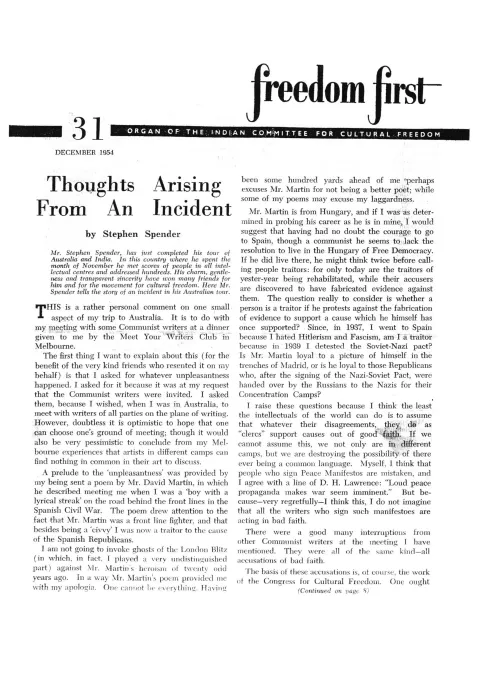
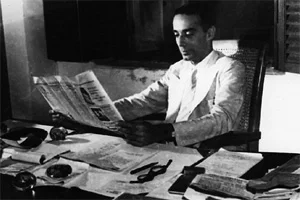
periodical issue
Freedom First
Organ of the Indian Committee for Cultural Freedom
By Nissim Ezekiel, Bertram D. Wolfe, M. K. Argus, G.D.P., Zaffar Futehally, Benedick, R.H., Shankar Shetty
Printed & published by Prabhakar Padhye at The Kanada Press, 109 Parsi Bazaar Street, Bombay 1 · Bombay · 1954
12 pages
Freedom First
Summary
This is the November 1954 issue (No. 30) of Freedom First, the monthly bulletin of the Indian Committee for Cultural Freedom (ICCF), edited by V. B. Karnik and printed in Bombay. In the rendered pages, the issue opens with Nissim Ezekiel’s profile of the British poet Stephen Spender, tracing his shift from 1930s socialist-leaning poetry to his editorship of Encounter and his anti-communist ‘revolutionary faith,’ followed by a notice of Spender’s month-long lecture tour of India under ICCF and PEN auspices. An unsigned ‘Notes’ section covers Nehru’s parliamentary rebuke of the Communist Party of India’s foreign ties, Chinese and Soviet economic policy, and headhunting practices among Naga tribes in NEFA, alongside commentary on the growth of the welfare-state bureaucracy and recommendations for teachers’ pay and job security. Bertram D. Wolfe contributes a long biographical essay on the Mexican painter Diego Rivera’s repeated expulsions from and readmissions to the Communist Party, his hosting and subsequent falling-out with the exiled Leon Trotsky, and Trotsky’s eventual assassination by Stalinist agents. M. K. Argus offers a satirical fictional ‘parliamentary report’ mocking credulous British visitors to Moscow. A substantial review section covers James Burnham’s The Web of Subversion, Herbert Carleton Mayer’s New Footprints of the Trojan Horse, Martin Turnell’s study of Baudelaire, and a hostile review of Nazim Hikmet’s Poems, plus shorter notices of several other books. The issue closes with a reader’s letter warning about the communist-aligned ‘All India Association of Democratic Lawyers’ and a page of quotations from Nehru, Govind Ballabh Pant, and other public figures under the heading ‘With Many Voices.’ The volume’s argumentative center throughout is anti-communist cultural and political commentary consistent with the Congress for Cultural Freedom’s mission.
Key points
-
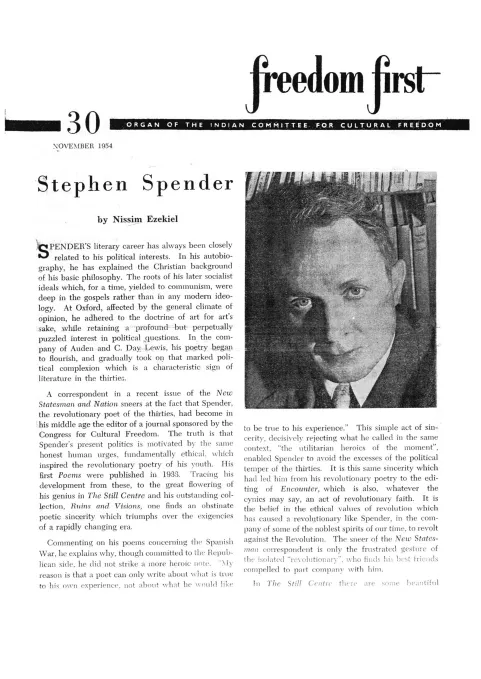
Nissim Ezekiel’s profile of Stephen Spender traces his shift from 1930s socialist-leaning poetry to his editorship of the anti-communist journal Encounter, defending the ethical continuity between both phases of his career.
-
The “Notes” section reports Nehru’s parliamentary charge that Indian Communists are tied to foreign interests, and a Ford Foundation-sponsored team’s recommendation to improve Indian teachers’ pay and job security.
-
Bertram D. Wolfe’s “Strange Case Of Diego Rivera” recounts Rivera’s repeated expulsions from and readmissions to the Communist Party, his hosting and rupture with the exiled Leon Trotsky, and Trotsky’s eventual assassination by Stalinist agents.
-
M. K. Argus’s satirical “A Parliamentary Report From Moscow” mocks the gullibility of British MPs on a Supreme Soviet-sponsored trip to Moscow.
-
G.D.P. reviews James Burnham’s “The Web of Subversion” on communist-infiltrated US government networks, while questioning whether Burnham’s narrow factual scope avoids taking a position on McCarthyism.
-
Zaffar Futehally reviews Herbert Carleton Mayer’s “New Footprints of the Trojan Horse,” endorsing its argument that free societies fall to internal infiltration rather than external invasion.
-
A reader’s letter warns that the newly formed “All India Association of Democratic Lawyers” in Calcutta is a front for the Paris-based International Association of Democratic Lawyers.
Essays
Stephen Spender
By Nissim Ezekiel
Nissim Ezekiel’s profile traces Stephen Spender’s literary career as inseparable from his politics: an ethically-rooted, gospel-derived socialism at Oxford that flowered into the political poetry of the 1930s alongside Auden and C. Day Lewis, followed by his post-war disillusionment with communism and his editorship of the anti-communist journal Encounter. Ezekiel defends Spender against a New Statesman critic who sneered at his transition from ‘revolutionary poet’ to Congress for Cultural Freedom editor, arguing that the same ethical sincerity underlies both phases of Spender’s career. The essay closes by linking this trajectory to Spender’s 1947 book Forward From Liberalism, in which he critiques the weaknesses of liberal freedom while refusing to abandon it for either fascism or communist utopianism.
- Spender’s political poetry of the 1930s grew from an ethical, gospel-rooted sensibility rather than doctrinaire ideology.
- A New Statesman correspondent mocked Spender’s shift from revolutionary poet to editor of the CCF-sponsored Encounter; Ezekiel defends this as consistent, not hypocritical.
- Spender’s Spanish Civil War poems show tenderness rather than the toughness typical of 1930s political verse.
- The Fates, from Ruins and Visions, is cited as an underappreciated survey of interwar life.
- Spender’s 1947 book Forward From Liberalism analyses the weaknesses of liberal freedom while rejecting both fascist and communist alternatives to it.
Notes (Premier Versus Sunderayya; Aping The Russians; Head Hunting In Nefa; Forms And Substance; Teachers And Their Condition)
An unsigned notes column covers five short items: Nehru’s parliamentary charge that Indian communists are tied to foreign interests, which P. Sunderayya denies but which the column defends by citing M. R. Masani’s study The Communist Party of India — A Short History; Soviet and Chinese economic policy (wage suppression and ‘petit bourgeois’ egalitarianism per a Chou En-lai speech); the abolition of headhunting among Naga tribes in NEFA and its connection to Manipur hill custom; a sardonic comment on the growth of the Indian welfare-state bureaucracy and its proliferation of official forms; and an international team’s recommendation (sponsored by the Ford Foundation) that Indian teachers’ pay and job security be improved.
- Nehru told Parliament (Sept 29 speech) that the Communist Party of India is tied to a foreign country that could exploit it; P. Sunderayya denied this as a ‘hoary slander.’
- The column cites M. R. Masani’s The Communist Party of India — A Short History as documentary support for Nehru’s charge.
- A Chou En-lai speech reported by the New China news agency warned against ‘petty bourgeois’ equal-reward policies and excessive wage increases.
- Headhunting among Naga tribes was reportedly abolished by the Political Department of NEFA; the practice is described as tied to marriage eligibility and social status.
- A Ford Foundation-sponsored international team recommended raising Indian teachers’ salaries and granting them job security after confirmation.
Stephen Spender In India
A short notice details the itinerary of Stephen Spender’s month-long visit to India (28 October to 28 November 1954), listing his stops in Travancore-Cochin, Bangalore, Bombay, Poona, Calcutta, Banaras, Lucknow, and Delhi, and the public lectures and receptions arranged for him under the auspices of the ICCF, PEN, various universities, and the British Council.
- Spender arrived in Madras on 28 October 1954 for a month-long Indian tour organized under ICCF and allied auspices.
- His itinerary included public meetings, university lectures, and receptions in Bombay, Poona, Calcutta, Lucknow, and Delhi.
- The tour was intended to bring Spender into contact with Indian writers, journalists, poets, and students.
Strange Case Of Diego Rivera
By Bertram D. Wolfe
Bertram D. Wolfe recounts his personal history with Diego Rivera, whom he met in 1922 as the Mexican Communist Party absorbed the country’s leading painters. Wolfe describes Rivera’s chaotic tenure on the party’s Executive Committee, his own effort to persuade Rivera to resign from party politics to focus on painting, and Rivera’s subsequent expulsion in 1929 during a Stalinist heresy purge. The essay covers Rivera’s hosting of the exiled Leon Trotsky in the 1930s, their personal and political rupture, and the GPU-orchestrated assassination attempts and eventual murder of Trotsky — in which Rivera’s former collaborator David Alfaro Siqueiros participated in an armed raid. It closes with Rivera’s repeated public self-denunciations and his fourth and final readmission to the Communist Party in 1954, alongside reflections on artistic freedom under Soviet communism, illustrated by an anecdote about Picasso.
- Wolfe met Rivera in 1922 as Mexican painters, including Rivera, Siqueiros, and Xavier Guerrero, took over the Communist Party’s cultural apparatus via the union and its paper El Machete.
- Wolfe personally urged Rivera to resign from the party’s Executive Committee in 1925 to focus on painting; Rivera was expelled again in 1929 during a Stalinist international purge.
- Rivera hosted Leon Trotsky and his wife Natalia in his and Frida Kahlo’s home after Trotsky’s exile, but the two men’s egos led to a rupture.
- GPU agents attempted to assassinate Trotsky in Mexico; David Alfaro Siqueiros participated in an armed raid on Trotsky’s house, and Trotsky’s guard Sheldon Harte was murdered.
- Rivera denounced his own ‘Trotskyist’ and ‘socialist’ sympathies three times before being readmitted to the Communist Party for a fourth time in 1954, despite murals still glorifying Trotsky.
- The essay closes by questioning why artists like Picasso and Rivera serve a movement that, if victorious, would abolish the artistic freedom they depend on.
I.C.C.F. News
A brief news column reports ICCF activities: a Gandhi Jayanthi poets’ meeting in Madras attended by Tamil writers under Chief Minister Kamaraj Nadar, and a Bombay reception for Tarkateertha Laxmanshastri Joshi on his election as President of the Marathi Literary Conference, presided over by V. B. Karnik with remarks by Durga Bhagwat and Prof. G. D. Parikh.
- The ICCF’s Madras committee held a ‘Kavi Arangam’ poets’ meeting for Gandhi Jayanthi on 7 October, presided over by Chief Minister Kamaraj Nadar.
- A Bombay reception honored Tarkateertha Laxmanshastri Joshi’s election as President of the Marathi Literary Conference.
A Parliamentary Report From Moscow
By M. K. Argus
M. K. Argus’s satirical piece imagines the credulous reports British MPs might file after a Supreme Soviet-sponsored trip to Moscow, mocking their gullibility about Soviet hospitality, staged banquets, a scripted ‘man in the street’ encounter, and a collective farm visit — poking fun at Western visitors who take Soviet propaganda at face value.
- The piece is a fictional parody of naive British parliamentary reports from a Moscow visit hosted by Marshal Voroshilov.
- It satirizes staged encounters with ‘ordinary’ Russians who parrot state talking points about peace and Western aggression.
- It mocks Western visitors’ credulity toward Soviet claims of hospitality, abundance, and openness.
Review: The Web of Subversion
By G.D.P.
A review by G.D.P. of James Burnham’s The Web of Subversion, which documents communist-infiltrated networks within the United States government. The review credits Burnham’s factual, narrowly-scoped approach but questions his selective moral judgments about individual guilt, and uses the book to reflect more broadly on the dangers of McCarthyist overreach even while endorsing vigilance against genuine subversion.
- Burnham’s book documents three ‘cells’ of communist-influenced officials across U.S. government agencies from the 1930s through the Cold War.
- The reviewer questions whether Burnham’s narrow factual scope avoids taking a position on the broader McCarthyism controversy.
- The review argues that defending democracy against subversion must not itself violate democratic and legitimate means.
Review: New Footprints of the Trojan Horse
By Zaffar Futehally
Zaffar Futehally reviews Herbert Carleton Mayer’s New Footprints of the Trojan Horse, a history of communism’s origin and progress framed as a warning against Indian impatience with American anti-communist ‘hysteria.’ The review endorses the book’s Troy analogy — that free societies fall to internal infiltration rather than external invasion — and its argument that voluntary democratic cooperation must be distinguished from coerced compliance in the Soviet system.
- The review responds to Indian impatience with American anti-communist measures like McCarthyism.
- It endorses the book’s central Troy/infiltration analogy for understanding communist subversion.
- General Lucius Clay’s introduction is quoted on the danger of repeated, unchallenged lies obscuring truth.
Review: Baudelaire, A Study of His Poetry
By Margaret Johnson
Margaret Johnson reviews Martin Turnell’s Baudelaire, A Study of His Poetry, praising its bibliographic detail but arguing that Turnell’s cold analytical approach fails to convey sympathy for Baudelaire’s poetry, ultimately serving the bibliographer more than the general reader.
- Turnell’s study covers Baudelaire’s originality, the dating and structure of Les Fleurs du Mal, and his versification and imagery.
- The reviewer argues Turnell lacks sympathy with Baudelaire and that cold analysis adds little to appreciation of the poetry.
Review: Poems by Nasim Hikmet
By Benedick
A reviewer signing as ‘Benedick’ harshly criticizes a translated collection of Nazim Hikmet’s Poems (translated from Turkish by Ali Yunus), dismissing the introduction by Samuel Sillen and the poems themselves as propagandistic rather than poetic, quoting lines about imprisonment and persecution that the reviewer regards as doggerel serving communist messaging.
- The review is skeptical of both translator competence and the introduction’s political framing of Hikmet as a martyr-poet.
- It quotes Hikmet’s verse and Samuel Sillen’s comparison of him to Paul Robeson.
- The reviewer concludes the poems are propagandistic ‘stupidities’ rather than genuine poetry.
Books In Brief
By R.H.
A ‘Books in Brief’ column by R.H. gives short notices of several new titles: Vernon Watkins’ The Death Bell: Poems and Ballads, Dr. S. Radhakrishnan’s edition of The Principal Upanisads, Emlyn Williams’ play Someone Waiting, Enid Starkie’s biography Petrus Borel, The Lycanthrope, and Paride Rombi’s novel Perdu and His Father.
- Radhakrishnan’s edition of the Upanisads is praised for completeness (eighteen Upanisads) but criticized for lacking idiomatic grace in translation.
- Several other new poetry, drama, and fiction titles receive brief favorable notices.
Letter to the Editor: “All India Association Of Democratic Lawyers”
By Shankar Shetty
A letter to the editor from Shankar Shetty warns readers about the newly formed ‘All India Association of Democratic Lawyers’ in Calcutta, framing it as a front for the International Association of Democratic Lawyers (founded in Paris in 1946 under D. N. Pritt), and detailing the parent body’s history of pro-Soviet advocacy, its expulsion of Yugoslav members in 1949, and its condemnation by the British Labour Party and UK Home Secretary as a vehicle for Soviet propaganda.
- The letter alleges the new Calcutta association is a front for the International Association of Democratic Lawyers, founded in Paris in 1946 under D. N. Pritt.
- It cites the parent body’s 1949 expulsion of its Yugoslav section for alignment with the ‘Tito clique.’
- It cites a 1952 ‘Commission’ report alleging U.S. germ warfare in Korea as evidence of the association’s propagandistic character.
- It notes the British Labour Party’s 1953 declaration that membership was incompatible with party membership, and the UK Home Secretary’s 1952 description of the group as carrying on Soviet propaganda.
With Many Voices
The closing page, ‘With Many Voices,’ is a compilation of topical quotations from Indian and international public figures on communism, the Cold War, and world affairs, drawn from October 1954 newspapers and journals, framed by an epigraph from Tennyson.
- Includes quotations from Jawaharlal Nehru, Govind Ballabh Pant, H. V. Kamath, Rajkumari Amrit Kaur, and T. T. Krishnamachari among Indian figures.
- Includes international commentary from Irving Brown, The Economist, and the New York Times on Soviet and Chinese policy.
- Pant is quoted describing communism as treating human beings as ‘mere cattle to be well looked after… but without any soul.’
Generated by the v1.5 extraction pipeline. Awaiting editorial review.
Metadata and summary are AI-extracted from the source PDF and reviewed for editorial accuracy. The original work is available via the Read PDF tab above (where present); paragraph-level citation inside the PDF is deferred to a future engagement.