periodical issue
Freedom First
By V. B. Karnik, Wolfgang Harich, M. A. Venkata Rao, Ekalavya
Edited, printed & published for the Democratic Research Service by V. B. Karnik at The Kanada Press, 109 Parsi Bazar Street, Bombay 1. · Bombay · 1957
12 pages
Freedom First
Summary
Freedom First No. 60 (May 1957) is a monthly issue of the Bombay-based liberal-anticommunist periodical published by the Democratic Research Service for the Indian Committee for Cultural Freedom. The issue’s argumentative center is anticommunism on two fronts: a domestic warning, following the 1957 general elections, that the Communist Party of India’s capture of Kerala and its gains in Bengal and Parliament represent a serious and growing threat that complacent Congress and non-Congress democrats alike are failing to counter; and an international documentation of communist practice — Soviet and Chinese agricultural collectivisation, East German party dissent, and communist mis-education of children — offered as evidence for that domestic warning. Contributors include the editor V. B. Karnik, the East German dissident academic Wolfgang Harich (via a smuggled memorandum), M. A. Venkata Rao writing on Chinese cooperative farming, and a writer under the pseudonym ‘Ekalavya’ on communist education. Unsigned ‘Notes’ and news items round out the issue with commentary on Aneurin Bevan’s criticism of Soviet collectivisation, the wave of resignations in the British Communist Party, hero-worship as a threat to democracy, and reports from the Congress for Cultural Freedom’s Indian and international activities.
Key points
-
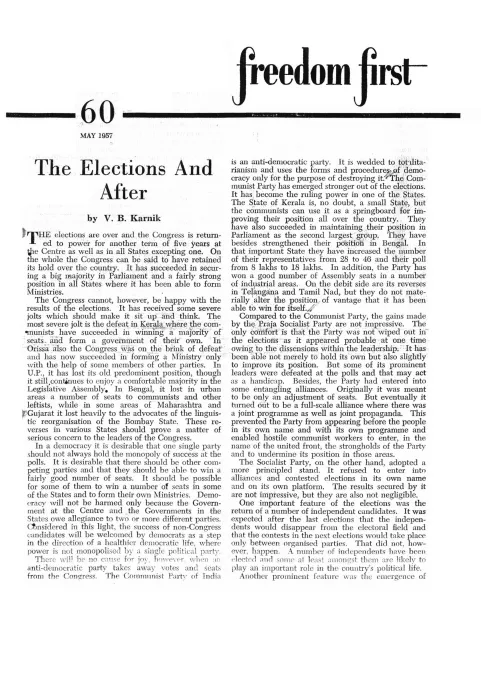
V. B. Karnik’s ‘The Elections And After’ reviews the 1957 general elections, attributing the CPI’s stronger showing — capturing Kerala and gaining seats in Bengal — not to communist strength but to the ‘confused, supine and divided’ state of India’s democratic forces.
-
An extract from Wolfgang Harich’s smuggled memorandum, ‘Testament Of A Party Rebel,’ describes an East German reformist faction seeking to shed the party’s residual Stalinism and calling for elections with real choice, written shortly before his arrest and ten-year sentence for treason.
-
M. A. Venkata Rao praises the Patel-Rana Dissenting Note on Chinese ‘agricultural cooperatives,’ which argues Chinese collectives strip peasants of proprietorship through manufactured ‘voluntary’ accession following prior land-reform terror.
-
Writing as ‘Ekalavya,’ an essay on communist ‘mis-education’ documents Soviet-bloc textbooks’ indoctrination of hatred toward ‘Anglo-American imperialists’ and warns the same methods could reach Kerala’s newly communist-run schools.
-
A ‘Notes’ section reports Aneurin Bevan’s candid criticism of Soviet and Chinese collectivisation’s countryside discontent and a wave of British Communist Party resignations after Hungary and Poland.
-
‘With Many Voices’ closes with a satirical mock dinner-invitation from A. K. Gopalan’s Kerala communist government to leading industrialists, ‘and Harakiri soon thereafter.‘
Essays
The Elections And After
By V. B. Karnik
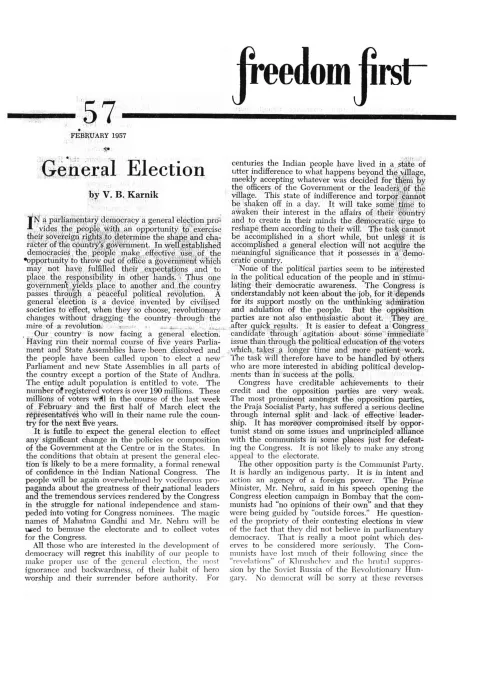
V. B. Karnik reviews the outcome of the 1957 general elections. The Congress retained power at the Centre and in nearly every state but suffered a severe setback in Kerala, where the Communist Party won a majority and formed a government, and narrowly avoided defeat in Orissa. Karnik reads the results chiefly as evidence that the Communist Party of India has emerged stronger despite the domestic and international shocks of Khrushchev’s revelations about Stalin and the upheavals in Poland and Hungary, while the Praja Socialist Party’s position is only middling and weakened by its entanglement in joint fronts with communists in Bengal and Maharashtra. He argues that democracy is not harmed by the rise of non-Congress parties as such, but warns that the Communist Party is an anti-democratic party using democratic procedures instrumentally, and that the country’s democratic forces are ‘confused, supine and divided,’ allowing communists to expand through popular ignorance of what communism actually entails. The essay closes by calling for democratic groups across parties to unite in defence of democracy itself, since the survival of every democratic party and organisation depends on it.
- Congress retained power nationally and in all states but one, but lost Kerala outright to the Communist Party and nearly lost Orissa.
- The Communist Party of India increased its Bengal assembly representation from 28 to 46 seats and its poll from 8 lakhs to 18 lakhs.
- The Praja Socialist Party’s modest gains are undercut by its electoral alliances with communists in Bengal and Maharashtra, in contrast to the Socialist Party’s more principled independent contesting.
- Karnik attributes communist success not to communist strength but to the confusion, passivity, and division of India’s democratic forces.
- The essay calls for cross-party democratic groups to form a ‘conscious vanguard’ in defence of democracy, framing the stakes as the survival of a free society itself.
Testament Of A Party Rebel
By Wolfgang Harich
This unsigned ‘Notes’ section and accompanying news items cover several short pieces. ‘Bevan’s Home Truths’ reports British Labour leader Aneurin Bevan’s candid criticism of Soviet and Chinese agricultural collectivisation, contrasting his account of countryside discontent and falling production with the Bombay Chief Minister’s stated interest in adopting Chinese-style cooperative farming ideas. ‘Wave Of Resignations’ describes internal revolt within the British Communist Party following Khrushchev’s revelations and the Hungarian and Polish upheavals, including mass resignations after the Party’s national congress. ‘Evil Of Hero-Worship’ relays a speech by the Governor of Bombay, Sri Prakash, at the P.E.N. annual meeting, warning that India’s culture of hero-worship undermines democratic functioning. ‘Sharp Rebuff’ notes the Hind Mazdoor Sabha’s rejection of Soviet and Chinese trade-union invitations in protest at the suppression of the Hungarian revolt. ‘Communist Success’ argues that India’s neutralist foreign policy has failed to check communist growth at home, as shown by the 1957 election results. The section closes with I.C.C.F. and C.C.F. news items (a reception for Prof. A. A. Kanekar and Prof. Gangadhar Gadgil, a report on Daniel Bell’s visit) and, later in the issue, further C.C.F. news on Hungarian writers in exile and an Italian painters’ exhibition, plus a notice of an international Exhibition of Asian Paintings organised by the Japan Cultural Forum and the Yomiuri newspaper.
- Aneurin Bevan’s account of a two-week Soviet visit described collectivisation-driven countryside discontent, falling cattle numbers, and production below pre-revolutionary and even 1941 levels.
- The Bombay Chief Minister Y. B. Chavan’s stated interest in Chinese-style cooperative farming is criticised as based on a misunderstanding of the coercive nature of Chinese ‘cooperatives.’
- British Communist Party members tore up membership cards after the Party leadership dismissed rank-and-file protests over Hungary and Poland; the Daily Worker and News Chronicle are quoted on the resulting crisis of confidence in Marxism.
- Sri Prakash’s P.E.N. speech frames hero-worship as one of the serious obstacles to India’s democratic development.
- The Hind Mazdoor Sabha rejected Soviet and Chinese trade union invitations as a protest against the suppression of the Hungarian uprising.
- News items report Congress for Cultural Freedom activity: a Bombay reception for two Marathi literary figures, Daniel Bell’s visit, formation of the Hungarian Writers’ Association Abroad in London, and an Italian painters’ exhibition supporting Hungarian refugee artists.
Co-operative Farming In China
By M. A. Venkata Rao
This is an extract from a memorandum by Wolfgang Harich, then 36-year-old chair of Social Sciences at East Berlin University, written shortly before his arrest and eventual ten-year sentence for treason in East Germany. Harich describes a reformist faction within the Socialist Unity Party seeking to reform the party from inside on a platform developed after the Twentieth Party Congress, rejecting Stalinism while retaining Marxism-Leninism, and rejecting any exclusive Communist claim to leadership in building socialism, arguing that in Western Europe socialism could arise through the Social Democratic Party without communist involvement or revolution. The memorandum offers a historical account of Soviet development — endorsing forced industrialisation under Stalin as historically necessary while condemning the political degeneration of party and state that accompanied it — and calls for a program of internal party reform (breaking party-apparatus domination, restoring ‘democratic centralism’ in fact) alongside state reforms: raising living standards, profit-sharing, ending forced collectivisation, restoring freedom of thought and full rule of law, abolishing the secret police and secret trials, and holding genuinely competitive elections. On rendered pages continuing past page 6, Harich extends the argument to conditions for German reunification, insisting reunification must not mean capitalist restoration, and to the group’s internal admission that their own remaining obstacle is Stalinism within their own ranks, which they must shed before honest cooperation with West German Social Democrats becomes possible.
- Harich’s faction developed a reform platform after the Twentieth Party Congress but was refused a hearing by Socialist Unity Party leaders, forcing them to route it through the Soviet Ambassador.
- The memorandum holds that Stalin was right that rapid industrialisation was historically necessary, but wrong (against Trotsky) to deny the political degeneration of party and state that resulted.
- The group rejects any single-party monopoly over the transition to socialism, arguing socialism in Western Europe can come via Social Democratic parties without communist involvement.
- Proposed reforms include: breaking party-apparatus domination, ending forced collectivisation, restoring rule of law and abolishing secret police/trials, and holding elections with real electoral choice.
- The reformers state their program aims to give the East political liberty and the West structural economic changes, calling this the ‘true meaning of co-existence.’
- The group frames their chief remaining obstacle as their own residual Stalinism, which must be shed before genuine cooperation with West German Social Democrats is possible.
Communist Mis-education
By MA Venkata Rao
M. A. Venkata Rao praises the Dissenting Note filed by B. J. Patel and F. N. Rana against the majority report of the Indian Delegation, led by R. K. Patil, that had studied ‘Agricultural Cooperatives’ in Communist China. The Note argues that Chinese ‘high grade cooperatives’ are in truth Soviet-style kolkhoz collectives in which the peasant’s status as independent proprietor is destroyed, that the appearance of voluntary accession is manufactured through terror during the preceding land-reform phase and subsequent state-engineered isolation and dependency, and that the claim of a phenomenal production increase attributable to collectivisation is unconvincing once government stability, technical inputs, and hard peasant labour are properly accounted for. Venkata Rao endorses the Note’s central finding that China collectivised agriculture not because collectivisation was economically necessary but because it served the requirements of communist political philosophy, and frames the choice facing India as one between a rural democracy of free peasant proprietors aided by genuine, voluntary cooperatives and a communist path that reduces peasants to a propertyless proletariat under state dictatorship.
- The Dissenting Note by Patel and Rana rebuts the majority report’s uncritical acceptance of official Chinese claims about voluntary, high-production ‘agricultural cooperatives.’
- Chinese ‘cooperatives’ are argued to be true collectives (like the Russian kolkhoz) in which peasants lose independent proprietor status and become agricultural labourers under state-dictated production quotas.
- ‘Voluntary’ accession is manufactured by prior terror during land redistribution and later economic/psychological coercion (state monopoly on inputs, credit, and markets).
- The Note attributes claimed production gains to government stability, technical improvements, and peasant labour rather than to collectivisation itself, and finds collectivisation was pursued for ideological rather than economic reasons.
- Venkata Rao frames India’s choice as a ‘Divide and Crossroads’ between a democracy of free peasant proprietors aided by genuine cooperation, versus a communist path reducing peasants to a ‘class of propertyless proletariat.‘
Notes (Bevan’s Home Truths / Wave Of Resignations / Evil Of Hero-Worship / Sharp Rebuff / Communist Success)
Writing under the pseudonym ‘Ekalavya,’ the author argues that communist regimes commit a distinctive crime against humanity through the deliberate mis-education of children, contrasting free-country pedagogical methods (Montessori, project method) with Soviet-bloc education built on the doctrine of irreconcilable class war and directed hatred of the ‘Anglo-American imperialists.’ The essay documents, through quoted textbook and teacher’s-gazette excerpts from the USSR, Czechoslovakia, Poland, Hungary, and Bulgaria, how language lessons, grammar exercises, and adapted extracts from Western literature (Hardy, Dickens, Charlotte Bronte, Jack London) are used to indoctrinate hatred of capitalist countries while omitting the social progress those societies subsequently achieved. It further describes systematic falsification of Soviet-authored world and Second World War history (e.g., omitting Western Lend-Lease aid) as a parallel instrument of mis-education, and closes by warning that the same techniques of Marxist perversion of education could be introduced into schools by the newly elected communist government of Kerala, placing a responsibility on Indian educators and the Central Ministry of Education to guard against it.
- The essay contrasts free-country pedagogy (Montessori, project method, self-directed activity) with communist education built on doctrines of class war and inculcated hatred of ‘Anglo-American imperialists.’
- Quoted Soviet, Czech, Polish, Hungarian, and Bulgarian textbook and teacher’s-gazette material instructs students to view capitalist countries as places of poverty, exploitation, and impending war.
- Western literary works (Hardy’s Tess of the D’Urbervilles, Bronte’s Jane Eyre, Jack London) are selectively excerpted in communist-bloc textbooks to depict capitalist misery while omitting subsequent social reform.
- Soviet historiography of World War II is described as systematically omitting Western Lend-Lease assistance while crediting the USSR with sole responsibility for victory.
- The essay warns that the same ‘mis-education’ methods could be introduced into Kerala’s schools under its new communist government, and calls on Indian educators and the Central Ministry of Education to guard against it.
I.C.C.F. News
The issue’s back page, ‘With Many Voices,’ is a compiled column of short quotations from contemporary commentators and public figures on communism, Kerala, and related themes, drawn from Indian and international press (Hindustan Times, Hindu, Encounter, New Leader, Sunday Standard, Current) and including a satirical mock dinner-invitation from A. K. Gopalan’s Kerala communist government to leading Indian industrialists (J. R. D. Tata, Kasturbhai Lalbhai, G. D. Birla, Ambalal Sarabhai, Chinubhai Kilachand), ‘and Harakiri soon thereafter.’ The page also carries the subscription form for Freedom First and the publication’s colophon.
- The column collects short quotations on communism and Kerala’s new government from figures including Bertrand Russell, John Foster Dulles, Albert Camus, Nikita Khrushchev, and Nirad Chaudhury.
- A satirical item imagines A. K. Gopalan’s Kerala communist government inviting prominent industrialists (Tata, Lalbhai, Birla, Sarabhai, Kilachand) to ‘DINNER and Harakiri soon thereafter.’
- Albert Camus is quoted from Encounter warning that none of totalitarianism’s claimed remedies is worse than totalitarianism itself, and that conformism ‘has fastened on the Left.’
- The page includes the Freedom First subscription form and the publication’s colophon naming V. B. Karnik as editor/publisher.
Generated by the v1.5 extraction pipeline. Awaiting editorial review.
Metadata and summary are AI-extracted from the source PDF and reviewed for editorial accuracy. The original work is available via the Read PDF tab above (where present); paragraph-level citation inside the PDF is deferred to a future engagement.