periodical issue
Freedom First
Democratic Research Service, Maneckji Wadia Building, 4th Floor, 127 Mahatma Gandhi Road, Bombay 1 · Bombay · 1957
12 pages
Freedom First
Summary
This is the complete August 1957 issue (No. 63) of Freedom First, the monthly journal of the Democratic Research Service, edited by V. B. Karnik and published from Bombay. In the rendered pages the issue runs a lead essay by V. B. Karnik questioning whether the Bhoodan movement’s shift toward Gramdan (village-level land gifts) is drifting toward Soviet-style collectivisation despite its leaders’ professed anti-communist ideals; an editorial “Notes” section rebutting attacks on the Democratic Research Service and M. R. Masani published in the Paris journal Liberation and reprinted by Blitz, alongside notes on Second Five Year Plan priorities, communist-era lawlessness in Kerala under E. M. S. Namboodiripad’s ministry, and a new DRS publication on Indian Communist Party documents; a full reprint of the United Nations Special Committee’s report on the Soviet intervention in Hungary; a first-person account of the 1956 Hungarian Revolution by Hungarian writer Paul Ignotus; a further “Notes” item on Kerala’s proposal to nationalise private schools, framed as indoctrination; an essay by M. A. Venkata Rao arguing that India’s cooperative-farming push is following “the Chinese road” toward state control of agricultural surplus; a book review of Samuel Eliot Morison’s Freedom in Contemporary Society by Adam Adil; a letter to the editor from Rev. T. Mascarenhas responding to Venkata Rao’s earlier article and defending Catholic-run schools against the charge of indoctrination; notes on Indian Committee for Cultural Freedom (ICCF) lecture events; and a closing page of aphoristic quotations (“With Many Voices”) from a Congress for Cultural Freedom seminar on Soviet society held at Oxford. The issue’s argumentative center is a sustained anti-communist, classical-liberal critique of collectivism — whether in Indian land reform, Chinese agricultural policy, Kerala’s communist government, or Soviet rule over Eastern Europe — paired with a defence of private property, free institutions, and civil liberties against state encroachment.
Key points
-
V. B. Karnik’s ‘Whither Bhoodan?’ questions whether the Bhoodan movement’s evolution into Gramdan, whole-village land gifts, risks drifting toward Soviet-style collectivisation, citing Vinoba Bhave’s remark that he might accept ‘the communist way’ if non-violence fails.
-
A ‘Notes’ section rebuts a libel republished by Blitz alleging foreign funding of the Democratic Research Service and M. R. Masani, and reports growing complaints of lawlessness under Kerala’s communist ministry led by E. M. S. Namboodiripad.
-
The United Nations Special Committee’s report on Hungary, reprinted in full, concludes the 1956 uprising was a spontaneous national revolt, not fomented by Western or reactionary forces, and finds evidence Soviet troop movements began before the Hungarian government’s request.
-
Paul Ignotus’s firsthand account, ‘The Hungarian Revolution,’ recalls Hungarian writers’ central role in the uprising and catalogues fellow writers arrested, imprisoned or disappeared afterward.
-
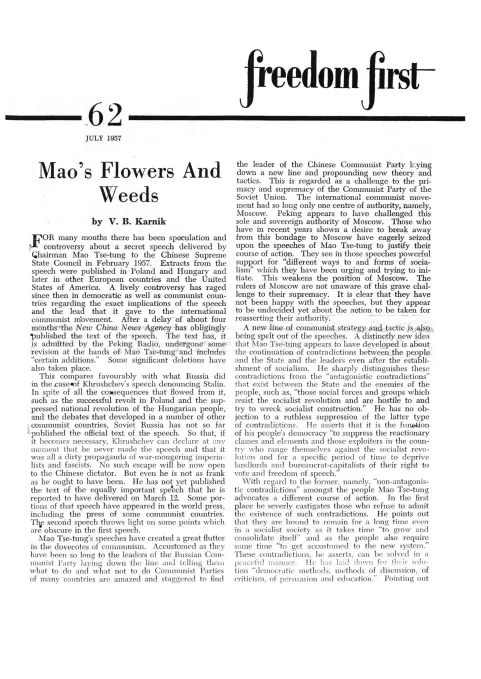
M. A. Venkata Rao’s ‘On The Chinese Road!’ argues India’s cooperative-farming push mirrors Communist China’s collectivisation, which transferred control of the harvest from peasant to state, contrasting this with Denmark’s ownership-preserving cooperative model.
-
A statement by Kerala’s Private Schools’ Rights’ Defense Committee opposes the communist government’s plan to nationalise ‘badly run’ private schools, comparing the approach to Hitler’s Germany and Mussolini’s Italy.
-
A letter from Rev. T. Mascarenhas rebuts Venkata Rao’s suggested equivalence between Catholic school doctrine and communist indoctrination, defending Catholic schools’ constitutional right to operate without compelling outsiders.
Essays
Whither Bhoodan?
By V. B. Karnik
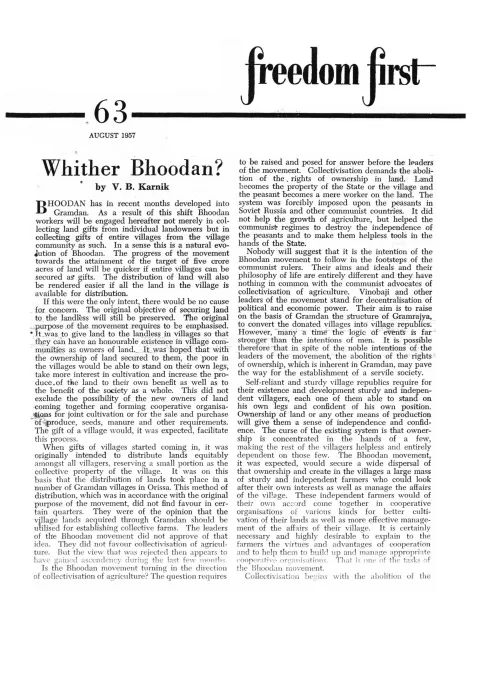
V. B. Karnik’s “Whither Bhoodan?” traces the Bhoodan land-gift movement’s evolution into Gramdan, the collective donation of entire villages, and asks whether this shift represents a move toward Soviet-style collectivisation. Karnik argues the original purpose of Bhoodan was to give land to the landless as individual owners, preserving private ownership and allowing voluntary cooperative organisation, whereas Gramdan-based collectivisation would abolish rights of ownership altogether, making the peasant a mere worker for the state or village collective. He acknowledges Vinobaji and the movement’s leaders reject Soviet-style aims and instead seek decentralised “Gramrajya” (village republics), but warns that “the logic of events is far stronger than the intentions of men,” and that recent statements — including Vinoba’s remark that he might be driven to accept “the communist way” if non-violence and love fail to solve the land problem — combined with a Sevagram seminar’s declared aim of “the ultimate aim of achieving the abolition of private property,” are raising serious doubts among both critics and admirers of the movement.
- Bhoodan (individual land gifts) has shifted toward Gramdan (whole-village gifts), which Karnik sees as a natural but concerning evolution.
- The original Bhoodan purpose was individual land ownership for the landless, not collectivisation.
- Karnik distinguishes the Bhoodan movement’s stated aims from Soviet/Chinese collectivisation, noting its leaders explicitly reject the communist model.
- He warns that abolishing ownership rights in land removes the logical basis for defending ownership of any other property.
- Maganbhai Desai is cited warning that Vinobaji suggested he might accept ‘the communist way’ if non-violent methods failed on land reform.
- A Sevagram seminar of Bhoodan workers reportedly declared the movement’s ultimate aim to be abolition of private property, per a Times of India report.
- Karnik frames self-reliant, individually-owned village republics (Gramrajya) as the movement’s proper aim, at risk of drifting into a ‘servile society.‘
Essay 2
The unsigned ‘Notes’ section (For The Record; Order Of Priorities) defends the Democratic Research Service (DRS) and M. R. Masani against a libel republished by Blitz and originally run in the Paris journal Liberation, which alleged foreign (American) funding tied to Masani’s role with the organisation. The Notes insist DRS receives no foreign financial assistance, that its accounts are independently audited, and that it does not act against the Congress Party or socialism as such but against totalitarian communism. A second item, ‘Order Of Priorities,’ discusses difficulties facing India’s Second Five Year Plan — rising costs, foreign exchange strain, inflation, strike threats — and cites C. D. Deshmukh’s and Rajagopalachari’s calls to prioritise the Plan’s ‘hard core,’ quoting Masani’s Yojana article that ‘planning is essentially a field where we should proceed through a process of trial and error.’
- Blitz republished a libel originally run in the Paris paper Liberation alleging Democratic Research Service and M. R. Masani receive US funding.
- DRS states its funds are raised entirely in India from public-spirited citizens and independently audited.
- DRS says its work targets totalitarian communism, not the Congress Party or socialism as such, and counts Congress leaders and socialists among its patrons.
- The Second Five Year Plan faces rising cost estimates (from Rs. 4000 to Rs. 6000 crores), foreign exchange strain, and inflation pressure.
- C. D. Deshmukh and Rajagopalachari are cited urging the government to prioritise fulfilling the Plan’s ‘hard core’ rather than the whole Plan.
- M. R. Masani is quoted from Yojana arguing planning should proceed through trial and error, with nothing ‘sacrosanct’ about a plan.
Notes (For The Record; Order Of Priorities)
A further unsigned Notes item, ‘Lawlessness in Kerala,’ reports growing complaints of lawlessness under the communist ministry led by Chief Minister E. M. S. Namboodiripad, drawing on Congress general secretary Shriman Narayan’s tour findings and a United Planters’ Association of Southern India note describing a ‘wave of violence and hooliganism’ against plantation managers. It notes Namboodiripad’s admission that ‘incidents’ had occurred while praising British policing methods, which the Notes call inconsistent given his party’s ideology. A companion item announces the DRS’s new publication, Indian Communist Party Documents, produced jointly with the Institute of Pacific Relations, containing secret CPI documents from the 1930s and 1954-55 whose authenticity was affirmed by Madras and Travancore-Cochin legislative committees.
- Congress general secretary Shriman Narayan reportedly found the law-and-order situation in Kerala ‘dark and disquieting,’ with police ‘demoralised.’
- The United Planters’ Association of Southern India (UPASI) documented violence and intimidation against plantation managers under the communist ministry.
- Chief Minister Namboodiripad denied the complaints as unfounded but admitted incidents where ‘peaceful life and property’ of employers were endangered.
- The Notes call it ‘surprising’ that Namboodiripad praised British policing as a democratic model while communist unionists in Kerala used different, more coercive methods.
- DRS announces the publication Indian Communist Party Documents (with the Institute of Pacific Relations), containing CPI documents from the 1930s Madurai/Palghat congresses and 1954-55, whose authenticity was upheld by Madras and Travancore-Cochin legislative privileges committees.
U. N. Report On Hungary
This unsigned piece reprints the unanimous conclusions of the United Nations Special Committee on Hungary (representatives of Australia, Ceylon, Denmark, Tunisia, and Uruguay), which investigated the Soviet armed intervention in Hungary in October-November 1956. The report concludes the uprising was a spontaneous national revolt, not fomented by reactionary or Western circles, driven by grievances over the AVH secret police, Soviet-imposed cultural and military influence, and demands for democratic socialism and independence from the USSR. It details how Imre Nagy became a symbolic (though not instigating) leader of the uprising, the ambiguity around invitations for Soviet intervention, and evidence that Soviet troop movements began before the uprising’s climax, suggesting the USSR was prepared to intervene regardless of Hungarian requests. The account continues onto later pages describing the installation of the Kadar government by Soviet forces as a ‘counter-revolution’ against a government enjoying popular support, subsequent repression (executions, forced-labour deportations, dissolution of the Social Democratic Party, postponed elections), and the Committee’s judgment that UN consideration of the matter was legally proper despite Article 2(7) objections.
- The UN Committee (Australia, Ceylon, Denmark, Tunisia, Uruguay) examined over a hundred witnesses and 2,000 pages of testimony but was barred from direct observation inside Hungary.
- The uprising is found to be spontaneous, driven by grievances against AVH secret police terror and USSR-imposed cultural/military dominance, not planned in advance or fomented by ‘reactionary’ or Western forces.
- Erno Gero’s truculent 23 October speech and news of Poland’s push for independence from the USSR are identified as the immediate triggers.
- Imre Nagy became a symbolic figure of the uprising by throwing in his lot with the revolutionary councils, though the Committee finds he neither instigated nor fully led it.
- Evidence of Soviet troop movements from as early as 20 October suggests preparation for armed intervention independent of any Hungarian government invitation.
- The Kadar government, installed after the 4 November second Soviet intervention, is characterised as a Soviet-imposed ‘counter-revolution’ lacking popular support.
- Post-intervention repression included capital punishment for strike activity, distorted judicial processes, dissolution of the Social Democratic Party, and deportations to the USSR.
- The Committee holds that UN consideration of Hungary was legally proper and not barred by Article 2(7) of the Charter, given the scale of foreign armed intervention.
The Hungarian Revolution
By Paul Ignotus
Paul Ignotus’s essay ‘The Hungarian Revolution,’ written as a message to the April 1957 Bulletin of the Committee on Science and Freedom, gives a first-person Hungarian perspective on the 1956 revolution. Ignotus recounts how Hungarian intellectuals had feared their Russified, indoctrinated youth would never resist Soviet rule, or would rebel only toward a ‘near-Hitlerite’ reaction — fears he says proved unfounded, as the youth fought the invaders with courage while remaining free of both Bolshevik and fascist sympathies. He emphasises the distinctive role Hungarian writers and scholars played in the revolution, given the deep popular reverence for literary figures, and closes by cataloguing the post-revolution fate of Hungarian writers: some arrested and released (Dery, Hay, Benjaamin, Tamasi), others still imprisoned (Gali, Obersovszky) or disappeared, likely to Romania (Lukacs, Lozonozy, Haraszti), with the Writers’ Association and Union of Journalists dissolved under government control. He calls on foreign writers and scholars to show solidarity.
- Ignotus recalls pre-revolution fears that Russified, indoctrinated Hungarian youth would either passively accept Soviet rule or rebel toward a ‘near-Hitlerite’ reaction.
- These fears proved unfounded: youth fought the Soviet invaders with courage while remaining free of both pro-Bolshevik and fascist sympathies.
- Ignotus highlights the unusually central role Hungarian writers and scholars played in the revolution, tied to popular reverence for literary figures, including some Communist Party members among the sympathetic writers.
- Post-revolution, the Writers’ Association and Union of Journalists were dissolved and placed under government tutelage.
- Some writers (Dery, Hay, Benjaamin, Tamasi) were arrested and later released; others (Gali, Obersovszky) remained imprisoned; several (Lukacs, Lozonozy, Haraszti) disappeared, probably to Romania.
- Ignotus calls on foreign writers and scholars to publicly show solidarity with their Hungarian colleagues.
Education Or Indoctrination?
An unsigned Notes item, ‘Education Or Indoctrination?,’ reprints extracts from a statement by the Private Schools’ Rights’ Defense Committee (Kerala State) opposing the Communist Kerala Ministry’s proposal to nationalise education and take over ‘badly run’ private schools. The Committee, though constituted by the Kerala Catholic Bishops’ Conference’s Education Committee, argues it defends the rights of all private schools regardless of religious affiliation, contending private schools are better run than government ones and that the proposal to standardise teacher appointments and curricula amounts to converting education into Marxist indoctrination. The item compares the Kerala government’s approach to Hitler’s Germany and Mussolini’s Italy in its bid to ‘regimentalise the individual.’
- The Private Schools’ Rights’ Defense Committee (Kerala State) opposes the Communist ministry’s plan to nationalise education and take over ‘badly run’ private schools.
- The Committee argues private schools are better managed and produce better-disciplined students than government schools.
- It frames the plan to impose government-selected teacher lists and standardised curricula as a step toward converting education into indoctrination in Marxist principles.
- The Notes compare the Kerala government’s approach to Hitler’s Germany and Mussolini’s Italy, alleging an intent to ‘regimentalise the individual’ against the Indian Constitution’s democratic aims.
On The Chinese Road!
By M. A. Venkata Rao
M. A. Venkata Rao’s essay ‘On The Chinese Road!’ argues that India’s push toward cooperative farming is following the same trajectory as Communist China’s agricultural collectivisation, which Rao traces from the 1953 crisis in Chinese agricultural production through the state’s monopoly purchase of grain and the parallel development of socialist industry and agriculture under Mao Tse-tung. He argues the underlying motive of collectivisation everywhere — Soviet or Chinese — is to transfer control of the harvest from the peasant to the state so that agricultural surplus can be traded for industrial equipment, regardless of whether the state is democratic or totalitarian. The essay (continuing onto a later page) warns that India’s fascination with using cooperativisation to solve its foreign-exchange problem risks the same sacrifice of the individual to production targets, contrasting this with Denmark’s model of cooperative societies that preserve individual land ownership, and closes by insisting freedom is not ‘a superfluous good’ but the ‘indespensable condition’ of all values.
- Rao argues China’s post-1953 push for agricultural cooperativisation was driven by the need to export agricultural surplus in exchange for Soviet industrial equipment.
- State monopoly purchase orders (from November 1953) stripped Chinese peasants of control over their own harvest, transferring it to state-controlled collective farms.
- Rao quotes Mao Tse-tung’s July 1955 declaration proposing to complete agricultural socialisation in China within seventeen years, paralleling Soviet industrialisation strategy.
- He argues collectivisation’s aim — concentrating control of production in the state — is the same whether the state is democratic or totalitarian, differing only in ‘harshness and violence.’
- Rao warns India’s own Five Year Plans show a ‘fatal fascination’ with cooperativisation as a solution to the foreign exchange problem, similar to the Chinese approach.
- He contrasts this with Denmark’s cooperative model, visited by the Prime Minister, where peasants retained ownership of their land while gaining credit, technical advice, and marketing advantages.
- The essay closes arguing that freedom is ‘the indespensable condition and atmosphere of all values,’ and that only a plan enabling ‘individuals to plan their own lives’ has final value.
- This essay drew a critical letter to the editor from Rev. T. Mascarenhas in the same issue, defending Catholic-run private schools against an analogy Rao allegedly drew to Communist indoctrination in an earlier July issue article.
Review: Freedom in Contemporary Society by Samuel Eliot Morison
By Adam Adil
Adam Adil’s review of Samuel Eliot Morison’s Freedom in Contemporary Society praises the book’s analysis of political, economic, and academic freedom in contemporary society, noting Morison’s frank support for strict measures against communists (quoting his rejection of ‘sweet reasonableness’ as a strategy against communist doctrine) alongside his simultaneous condemnation of ‘guilt by association’ practices associated with McCarthyism. The review notes the book originated as the Chancellor Dunning Trust lectures at Queen’s University, Kingston, Ontario, and that Morison, a noted historian, won the Pulitzer Prize for Admiral of the Ocean Sea.
- Morison ranks political freedom as ‘most important and inclusive,’ economic freedom as most subject to erosion, and academic freedom as ‘youngest of the family.’
- Morison discusses McCarthyism, the New Deal, trade unions, and academic freedom from a liberal, anti-communist standpoint.
- He advocates strict measures against communists while opposing the doctrine of ‘guilt by association’ that harmed innocent Americans during the McCarthy era.
- The book originated as the Chancellor Dunning Trust lectures at Queen’s University, Kingston, Ontario.
- Morison won the Pulitzer Prize for Admiral of the Ocean Sea.
Letter To The Editor
By (Rev.) T. Mascarenhas
No summary was extracted for this article. Listed for completeness.
I. C. C. F. News
A letter to the editor from Rev. T. Mascarenhas (Bombay, 17 July 1957) responds to M. A. Venkata Rao’s July issue article, rebutting what he characterises as a misleading suggestion equating Catholic schools’ religious doctrine with communist indoctrination in Kerala. Mascarenhas argues Catholic schools teach their own doctrine without coercing others, unlike the Communist government which he says seeks to make its worldview compulsory for everyone, and defends the constitutional right of religious minorities to run aided schools.
- Mascarenhas responds to an ‘if’ raised by M. A. Venkata Rao in the July issue that he says wrongly lumps Catholic and Communist approaches to education together.
- He argues Catholic schools have an ‘exact doctrine’ and discipline but do not attempt to coerce others outside their own institutions.
- He contrasts this with the Communist government of Kerala, which he says seeks to make its worldview ‘compulsory on everybody else.’
- He defends the Indian Constitution’s grant of the right to religious minorities to run their own schools and claim grant-in-aid, tracing this tradition to ‘the days of Asoka.’
- He argues that objecting to Communist indoctrination while defending Catholic educational freedom is not ‘the pot calling the kettle black.’
Generated by the v1.5 extraction pipeline. Awaiting editorial review.
Metadata and summary are AI-extracted from the source PDF and reviewed for editorial accuracy. The original work is available via the Read PDF tab above (where present); paragraph-level citation inside the PDF is deferred to a future engagement.