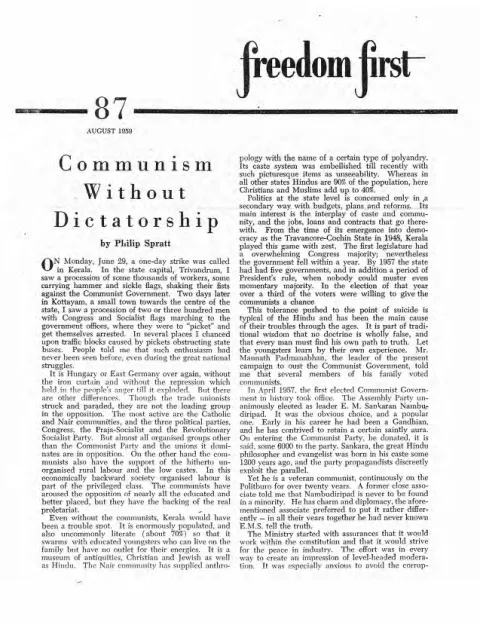
periodical issue
Freedom First
By Dinu Randive, V. B. Karnik, Sutan Sjahrir
Freedom First, Maneckji Wadia Building, 4th Floor, 127 Mahatma Gandhi Road, Bombay 1 / Edited, printed & published for the Democratic Research Service by V. B. Karnik at The Kanad Press, 109 Parsi Bazar Street, Bombay · Bombay · 1958
12 pages
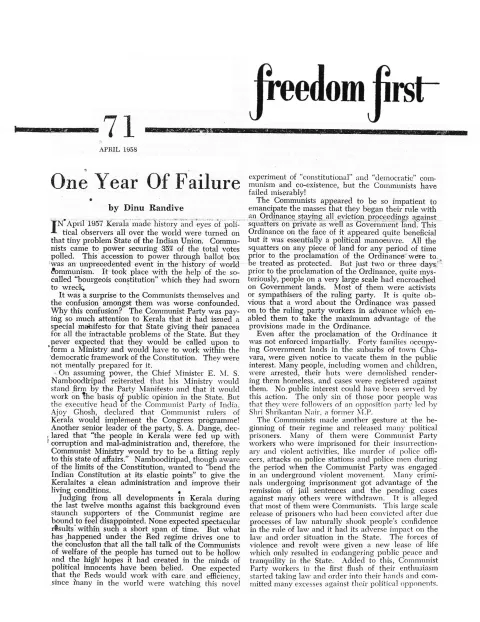
Freedom First
Summary
This is the complete April 1958 issue (No. 71) of Freedom First, the monthly journal published by the Democratic Research Service in Bombay. The issue is anchored by an anti-Communist polemic assessing one year of Communist rule in Kerala from two angles: Dinu Randive’s “One Year Of Failure” surveys the Ministry’s use of ordinances, police partiality, and creeping party control of law and order, while the unsigned “Kerala Under Communism” catalogues administrative failures, corruption scandals (the Andhra rice deal, land purchases, book-supply contracts), packed committees, lathi-charge controversies, a string of local election defeats for Communist candidates, and Minister salaries and allowances. V. B. Karnik’s “Communist Party Of India—A Transformation?” argues that the CPI’s new draft constitution and talk of peaceful, mass-party methods are tactical rather than a genuine renunciation of Marxism-Leninism. The issue also reprints, from The Socialist Call (New York), Sutan Sjahrir’s reflective essay on the causes of Indonesia’s post-independence political and economic crisis. Together the pieces read as a coordinated case, from the classical-liberal Forum-of-Free-Enterprise-adjacent Democratic Research Service milieu, that the Kerala Communist government’s record disproves claims of a peaceful, democratic transformation of world communism.
Key points
-
Dinu Randive’s “One Year Of Failure” reviews the first year of E. M. S. Namboodiripad’s Communist ministry in Kerala, detailing an eviction-staying Ordinance benefiting ruling-party sympathisers, the release of prisoners convicted of violent underground activity, and hardening ministerial rhetoric defending the use of “lathis or even worse tear gas.”
-
V. B. Karnik’s “Communist Party Of India — A Transformation?” argues the CPI’s new draft constitution and talk of “socialism through peaceful means” is tactical, since Article XIV’s principle of Democratic Centralism still subordinates the base to central directives and the Preamble commits the party to Marxism-Leninism and the experience of the USSR and China.
-
Sutan Sjahrir’s “The Background Of Indonesia’s Crisis,” reprinted from The Socialist Call, attributes Indonesia’s post-independence chaos to nationalism’s insufficiency as a governing creed once independence was won, calling for a new national “directive” grounded in social justice and rational economic planning.
-
“Kerala Under Communism” catalogues the Ministry’s underspending of its own Plan allotment, proliferation of Communist-stacked “people’s committees,” and specific corruption allegations including the Andhra rice deal and a book-supply contract for the Education Minister’s son.
-
The same feature documents rising unemployment, numerous lathi-charge incidents, and a run of local elections showing Communist losses, alongside a comparison showing Communist Ministers’ effective pay exceeded that of their Congress and PSP predecessors despite “Spartan life” rhetoric.
Essays
One Year Of Failure
By Dinu Randive
Dinu Randive reviews the first year of the Communist Ministry in Kerala under E. M. S. Namboodiripad, arguing that the party was unprepared to govern within a democratic constitutional framework despite winning power through the ballot box. The essay details an eviction-staying Ordinance that Randive presents as a political manoeuvre benefiting ruling-party sympathisers who had encroached on government land just before the Ordinance’s proclamation, contrasted with harsher treatment of the followers of an opposition former M.P., Shrikantan Nair. It also describes the release of Communist prisoners convicted of violent underground activity, police demoralisation and partiality, rising lawlessness including cell courts operating as parallel justice, and a hardening Ministerial rhetoric defending the use of force (lathis, tear gas, or worse). The piece closes (as continued on page 12) with an account of Communist targeting of the Catholic Christian community and the Christopher organisation, and a broader argument that corruption, land-trust manoeuvres, and industrial stagnation exposed the gap between Communist promises and Communist governance, while noting a silver lining: growing defections of sincere Communist workers disillusioned by the party’s practice in office.
- Kerala’s 1957 Communist victory via ballot box was described as unprecedented in world communist history, and the party itself was caught unprepared to govern democratically.
- An eviction-staying Ordinance is characterized as a political manoeuvre that mainly benefited recent encroachers sympathetic to the ruling party, while enforcement against opposition-aligned squatters (followers of Shrikantan Nair) was harsher.
- Large-scale release of political prisoners, including some convicted of violent underground activity (murder of police officers, attacks on police stations), is linked to a subsequent rise in lawlessness.
- Police were ‘abused and neutralised’ by Communists and their sympathisers, per the account, emboldening opponents of the ruling party while Communist cell courts assumed quasi-judicial power.
- State Assembly statements by the Law Minister (‘We must and will use force—lathis or even worse tear gas or firearms if necessary’) are cited as evidence the government had abandoned earlier appeasement rhetoric toward opposition parties.
- The Catholic Christian community and the Christopher organisation are described as being targeted, including revival of an old police report on the Sabarimala Temple-burning enquiry timed near a Hindu pilgrimage season.
- The essay (continuation on page 12) closes noting rising defections of Communist workers disillusioned by the gap between party myth and the reality of governance in Kerala.
Communist Party Of India — A Transformation?
By V. B. Karnik
V. B. Karnik examines claims that the Communist Party of India is undergoing a genuine transformation into an ordinary constitutional political party, using Kerala as the supposed proof case. He traces the party’s new draft constitution, which defines its objective as ‘socialism through peaceful means,’ and argues that General Secretary Ajoy Ghosh’s own statements (‘the peaceful transformation also depended on the ruling party’) show the peaceful-means commitment is tactical rather than principled. Karnik cites Asoka Mehta’s warning that Hitler too came to power through peaceful, constitutional means before destroying pluralist politics, and argues the crucial test is whether Communists, once in power, would ever allow themselves to be voted out. He concludes that the party’s move toward becoming a ‘mass party’ and abolishing the cell system does not soften its character, since the new constitution still enshrines ‘Democratic Centralism’ with centralized command over the base, and its Preamble explicitly commits the party to Marxism-Leninism and the experience of the Soviet Union, China, and international Communist and Workers’ Parties.
- The Communist Party of India was preparing to adopt a new constitution (a special conference moved from January to April 1958) defining its objective as ‘socialism through peaceful means.’
- General Secretary Ajoy Ghosh reportedly qualified the peaceful-means commitment by warning that ‘the peaceful transformation also depended on the ruling party,’ which Karnik reads as making non-violence conditional rather than a matter of conviction.
- Asoka Mehta is cited arguing that Hitler also rose through peaceful, constitutional means, framing the real test as whether Communists would accept being voted out of office once in power.
- The party’s move to abolish the ‘cell’ system in favour of territorial ‘Branches’ (which can still be subdivided into ‘Groups’) is presented as cosmetic, since Article XXVI still subordinates the base unit to directives from higher committees.
- The constitution’s principle of ‘Democratic Centralism’ (Article XIV) is quoted as requiring the minority to follow the majority and lower units to follow higher committees under centralized leadership.
- The Preamble commits the party to drawing on the experience of the Soviet Union, China, and ‘all Communist and Workers’ Parties’ and to the fundamental principles of Marxism-Leninism, which Karnik argues proves the party remains ideologically tied to Moscow despite the rhetoric of adapting to ‘concrete Indian conditions.‘
The Background Of Indonesia’s Crisis
By Sutan Sjahrir
In this piece reproduced from The Socialist Call (New York), Indonesian statesman Sutan Sjahrir reflects on the causes of his country’s political and economic chaos in the years following independence (a footnote notes the article predates the outbreak of the civil war then raging). Sjahrir argues that the unity and idealism that powered the 1945-1949 revolution against Dutch rule dissipated once independence was won, because nationalism alone proved an insufficient guide for governing: it curdled, in his account, into a scramble by a small lucky elite (including former revolutionary leaders) for riches, government posts, and power, often disguised as national interest. He contends the country lost its ‘compass’ and needs a new directive grounded in social justice, humanitarian feeling, and rational economic planning based on objective calculation of resources and needs, rather than nostalgia for revolutionary-era unity or emotional appeals to nationalism.
- Sjahrir attributes Indonesia’s post-independence ‘chaos’ — political tension, army unrest, and worsening economic conditions — to the loss of the unifying national purpose that existed during the 1945-1949 revolutionary struggle.
- He argues that nationalism, once victorious, proved insufficient as an ongoing guide for governance and in some cases curdled into a ‘passion for position, power and riches’ among a small elite, including former revolutionary leaders.
- Nationalist rhetoric was, in his account, sometimes used to cloak self-interested or corrupt actions (‘extortion, graft and other actions… in the name of the nation’).
- Sjahrir calls for a renewed national ‘directive’: humanitarian feeling, social justice, and rational, plan-based economic reconstruction grounded in objective calculation of resources, capital, and labour.
- He rejects the older view (attributed to unnamed Western economists and philosophers decades earlier) that money and economic motive were of little relevance to understanding Indonesia’s economy, arguing that daily economic life can now be measured and planned in figures.
Kerala Under Communism
This unsigned feature (continuing the issue’s Kerala focus, running from March into the April 1958 issue) catalogues the Communist Ministry’s record after taking office: shedding the 94 manifesto promises in favour of a more modest pledge to implement the existing Five-Year Plan, while under-spending its own Plan allotment; a running conflict with the police, including the bifurcation of the Inspector General of Police post and allegations that the administrative machinery was being reshuffled to suit the ruling party; and proliferation of Communist-stacked ‘people’s committees’ at every administrative level, which the piece presents as an instrument for extending party control despite austerity rhetoric. It details specific corruption allegations — the Andhra rice deal (naming a firm allegedly linked to a Communist minister’s relative and a large mark-up over market price), land purchases at inflated and deflated prices for Communist-linked and government parties respectively, a book-supply contract for the Education Minister’s son, and Transport Department ticket fraud. It surveys chronic food shortages and rising unemployment (Live Register at 68,155 by January 1958), contradictory Government messaging on private industrial investment versus ‘saboteur’ rhetoric against critics, extensive lathi-charge incidents and the Government’s shifting denials, a run of local election results showing Communist losses across library, teachers’, municipal, and cooperative-society bodies, and a comparison of Minister salaries showing Communist Ministers’ effective pay exceeded that of their Congress and PSP predecessors despite ‘Spartan life’ rhetoric.
- The Communist Ministry, per the piece, abandoned its 94-point manifesto in favour of a narrower promise to implement the existing Five-Year Plan, yet underspent even that allotment (Rs. 4.21 crores of Rs. 17.90 crores in the first seven months).
- The Communist government is accused of pulling apart administrative departments (e.g., six Directors of Public Instruction where there was one; two Directors of Industries where there was one) allegedly to install party loyalists.
- Communist-dominated ‘people’s committees’ (out of roughly 13,000 members on 1,400 committees, an alleged 10,000 Communists or fellow travellers) are presented as instruments extending party control over administration.
- Detailed corruption allegations include the Andhra rice deal (a firm allegedly linked to Communist leader P. Sunderayya’s brother, purchasing rice above market price), land deals benefiting a Communist M.P. and disadvantaging the government elsewhere, a book-supply contract benefiting the Education Minister’s son, and Transport Department ticket fraud.
- Unemployment rose (68,155 on the Live Register by January 1958) and food/rice shortages persisted despite Central Government grain allotments and subsidies to Kerala.
- The piece documents numerous lathi-charge incidents and the Kerala Government’s shifting or evasive characterizations of them (denying, then admitting, then disputing whether incidents technically qualify as ‘lathi charges’).
- A survey of local elections (library associations, teachers’ associations, municipal and panchayat by-elections, cooperative society boards) is presented as showing a consistent trend of Communist electoral losses across the State during the period covered.
- Comparison of Ministerial salaries and allowances shows that, despite promises of a frugal ‘Rs. 350’ Communist Minister’s salary, the actual combined salary/allowance system left Communist Ministers earning more than their Congress or PSP predecessors (approx. Rs. 1,585/month average versus Rs. 1,145 for a Congress Minister and Rs. 935 for a PSP Minister).
Generated by the v1.5 extraction pipeline. Awaiting editorial review.
Metadata and summary are AI-extracted from the source PDF and reviewed for editorial accuracy. The original work is available via the Read PDF tab above (where present); paragraph-level citation inside the PDF is deferred to a future engagement.