periodical issue
Freedom First
By B. K. Desai, Istvan Vizinczei
Edited, printed & published for the Democratic Research Service by V. B. Karnik at The Kanado Press, 109 Parsi Bazar Street, Bombay 1 · Bombay · 1958
12 pages
Freedom First
Summary
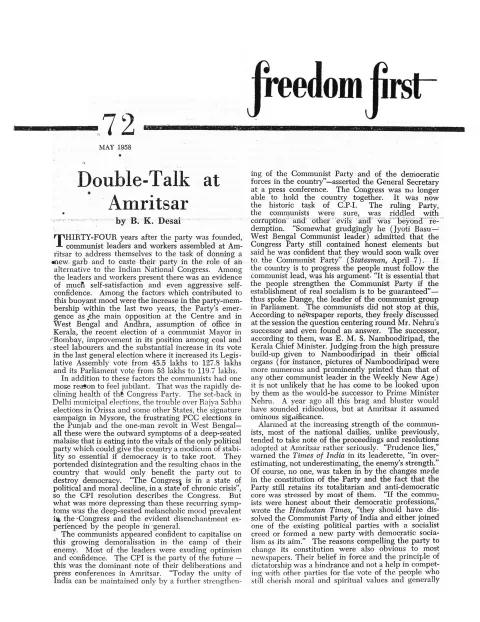
This is issue No. 72 of Freedom First (May 1958), the monthly journal of the Democratic Research Service, Bombay, edited by V. B. Karnik. The issue is anchored by two long pieces: B. K. Desai’s “Double-Talk at Amritsar,” a close textual analysis of the Communist Party of India’s newly adopted constitution following its Fourth Congress at Amritsar, arguing that the CPI’s apparent turn toward national independence, peaceful methods, and tolerance of opposition parties is cosmetic and lifted almost verbatim from the Moscow Declaration of the ruling Communist parties; and Istvan Vizinczei’s “A Hungarian Writer’s Story,” a first-person memoir by a young Hungarian writer describing literary life, censorship, and comradeship under Communist rule before and during the 1956 Revolt, and his eventual escape to the West. The rest of the issue consists of shorter unsigned pieces characteristic of the journal’s anti-Communist, classical liberal orientation: a report and commentary on the controversy surrounding Paul Robeson’s sixtieth-birthday celebrations in India as a Communist-organised propaganda exercise; a piece on the diplomatic uproar caused by Freedom First’s earlier criticism of US Ambassador Henry Cabot Lodge’s conduct toward V. K. Krishna Menon; an account of Bolesław Piasecki as an example of Nazi-Communist ideological kinship in Poland; a note on a Bombay exhibition on the Hungarian Revolution inaugurated by Jayaprakash Narayan; organisational news from the International Committee for Cultural Freedom (I.C.C.F.) and the Democratic Research Service (D.R.S.); and a closing page of quotations from public figures (“With Many Voices”).
Key points
-
B. K. Desai’s “Double-Talk at Amritsar” shows the CPI’s new constitution, adopted at its Fourth Congress, lifts language nearly verbatim from the 1957 Moscow Declaration, and that General Secretary Ajoy Ghosh’s own writings concede “peaceful transition” is only a tactical possibility, not a genuine commitment.
-
Istvan Vizinczei’s “A Hungarian Writer’s Story” recounts literary life under Communist patronage and repression in Hungary, profiling fellow writers Istvan Eorsi and Jozsef Gali, and his own escape after the 1956 Revolt despite Gali’s charge that leaving was cowardice.
-
An unsigned report on Paul Robeson’s sixtieth-birthday celebrations, organised simultaneously in twenty-six countries, describes Indian Communists enlisting figures including Chief Justice M. C. Chagla onto organising committees, and cites the NAACP’s own journal The Crisis distancing itself from Robeson’s Soviet-aligned politics.
-
An editorial note defends an earlier Freedom First item criticising US Ambassador Henry Cabot Lodge’s “hugging handshakes” with V. K. Krishna Menon, reporting wide American press pickup and Lodge’s on-record dismissal of the charges as “ridiculous.”
-
An unsigned piece traces Boleslaw Piasecki’s path from pre-war Polish Falangist to Stalinist ally, using his later opposition to Gomulka’s liberalisation as a case study in the ideological kinship between Nazism and Communism.
-
A note reports the Bombay Praja Socialist Party’s “Hungary Fights for Freedom” exhibition, inaugurated by Jayaprakash Narayan, who contrasted the end of Western imperialism in Asia with the more “sinister” Soviet imperialism shown in Hungary.
-
I.C.C.F. News covers Melvin Lasky’s April tour of India, including meetings with Jamini Roy, Satyajit Ray and C. Rajagopalachari, while the closing “With Many Voices” quotes Nehru suggesting the Amritsar resolution might make Communists “cease to exist as such.”
Essays
Double-Talk at Amritsar
By B. K. Desai
B. K. Desai’s “Double-Talk at Amritsar” examines the Fourth Congress of the Communist Party of India held at Amritsar, at which the party revised its constitution to project a more national, democratic, and peaceable image. Desai argues this revision is largely borrowed, sometimes verbatim, from the Moscow Declaration signed by twelve ruling Communist parties, and that the CPI’s professed independence from Moscow, its avowal of peaceful methods, and its guarantee of rights to opposition parties are tactical concessions rather than substantive changes, since the party’s core commitment to “proletarian internationalism” and eventual one-party rule under a socialist constitution remains intact. The essay also surveys press reaction (Times of India, Hindustan Times, Statesman), notes the party’s uneven regional strength (strong in West Bengal’s industrial and urban areas but weak among Hindi-speaking and rural populations, though it commands peasant support in Kerala, Andhra, and parts of U.P. and Punjab), gives a class breakdown of the 475 Amritsar delegates (only 45 workers, 101 peasants, and 13 landless labourers against 276 middle-class/bourgeois delegates and 31 landlords), and closes with an account of internal factional struggle at the Congress between Ajoy Ghosh’s leadership, a “Right reformist” group led by P. C. Joshi, and a “Left sectarian” group led by Bhupesh Gupta, resolved only by a fragile balance of seats on the new Central Executive.
- The CPI’s new constitution, adopted at its Fourth Congress in Amritsar, emphasises national character, peaceful intentions, and tolerance of opposition parties.
- Desai demonstrates through side-by-side quotation that large parts of the CPI preamble paraphrase or directly lift language from the Moscow Declaration of November 1957.
- The party’s guarantee of peaceful transition and opposition rights is conditioned on opponents not violating a future ‘socialist constitution,’ which Desai reads as a hollow guarantee.
- General Secretary Ajoy Ghosh’s own writings in New Age concede that ‘peaceful transition’ is only a possibility, not a certainty, and is adopted tactically to extend the party’s influence.
- The CPI’s social base is analysed as unevenly distributed: strong in West Bengal’s industrial/urban areas, strong among peasants only in Kerala, Andhra, and parts of U.P. and Punjab, and largely middle-class/bourgeois in composition (276 of 475 Amritsar delegates).
- The Congress was marked by factional struggle between Ghosh, a ‘Right reformist’ group (P. C. Joshi) and a ‘Left sectarian’ group (Bhupesh Gupta), with the Central Executive split 13 Left, 7 Right, 5 Centre.
- Ajoy Ghosh and A. K. Gopalan were reportedly departing for Moscow shortly after the Congress, ostensibly for medical treatment but, per the Hindustan Times, actually to report to Kremlin principals.
A Hungarian Writer’s Story
By Istvan Vizinczei
Istvan Vizinczei, a young Hungarian writer who escaped after the 1956 Revolution and settled in Canada, recounts his literary coming-of-age under Communist rule. He describes the Party’s mixture of patronage and repression toward young writers (state stipends alongside banned manuscripts and blacklisted classmates), the founding and covert independence of the Young Writers’ Workshop that fed into the Petofi Club, and the courage of fellow writers Istvan Eorsi and Jozsef Gali, the latter a Auschwitz survivor later imprisoned for protesting the Soviet invasion. Vizinczei reflects on the impossibility of separating art from politics in a dictatorship, contrasting his position with John Steinbeck’s, and describes the tight-knit ‘family life’ of Hungarian literary culture that helped writers survive under repression. The piece closes with his own escape after the Revolt’s suppression, including a debate with Gali (who chose to stay and was imprisoned) over whether leaving constituted cowardice. The piece is credited as condensed from the periodical Eastern Europe.
- Vizinczei describes the Communist Party’s dual strategy toward promising young writers: generous stipends and study support alongside abrupt censorship and blacklisting for perceived ideological infractions.
- The Young Writers’ Workshop, founded in 1951 under Party/DISZ sponsorship, became the first youth organisation to partly escape Party control and fed into the Petofi Club.
- Istvan Eorsi and Jozsef Gali are profiled as the workshop’s most talented and courageous members; Eorsi was sentenced to five years for a poem written the day the Soviets crushed the Revolt.
- Jozsef Gali, an Auschwitz survivor, wrote a play about the Rajk trial and was later imprisoned, eventually sentenced to death and commuted to fifteen years, for protesting the Soviet invasion.
- Vizinczei argues that in a dictatorship even a sad love poem becomes a political act, contrasting his situation with the freedom enjoyed by writers like John Steinbeck in the West.
- The essay describes a close-knit Hungarian literary ‘family’ tradition that helped sustain writers’ morale and mutual support under both Fascist and Communist repression.
- The piece ends with the author’s decision to flee after the Revolt, over Gali’s objection that leaving was cowardice, an argument the author says he ‘cannot judge’ who was right about.
Another Communist Affair
This unsigned report examines the international celebration of Paul Robeson’s sixtieth birthday as a Communist-organised propaganda event, coordinated simultaneously in twenty-six countries. In India, the piece reports, Communists recruited fellow-travellers and prominent public figures — including Bombay Chief Justice M. C. Chagla — onto preparatory committees, lending the event misleading respectability. Commentators A. D. Gorwala and H. R. Pardivala are quoted extensively challenging Robeson’s status as an apolitical artist and ‘humanist,’ citing his defence of Soviet concentration camps, his affiliation with dozens of Communist-front organisations, his support for the Chinese/North Korean position in the Korean War, and the repudiation of his politics by the NAACP’s own organ, The Crisis, along with a rebuttal of claims that Robeson had been denied a livelihood in the United States.
- Robeson’s sixtieth-birthday celebrations were organised simultaneously in twenty-six countries, which the piece takes as evidence of central Communist direction.
- In India, Communists enlisted fellow-travellers and prominent figures, including Chief Justice M. C. Chagla, onto organising committees, giving the event an appearance of respectability.
- A. D. Gorwala first publicly challenged the character of the celebrations; H. R. Pardivala, writing in the Times of India, argued Chagla and other public figures were being used by political partisans.
- Mr. Mohan Das’s letter in the Indian Express disputed claims that Robeson had been denied his livelihood in the US, citing his Connecticut estate and concert earnings.
- The essay quotes The Crisis, organ of the NAACP, distancing the organisation from the Robeson celebrated by Moscow, contrasting the earlier admired Robeson with his later Communist propagandising.
- Robeson’s record of defending Soviet concentration camps and his 1948 statement about preferring ‘the opposite form of dictatorship’ to fascism are cited as evidence against his claimed humanism.
Freedom First, Mr. Lodge & Mr. Menon
This unsigned editorial note (signed “Editor”) recounts the controversy sparked by an earlier Freedom First item criticising US Ambassador Henry Cabot Lodge’s conduct during his visit to India, particularly his warm public treatment of Defence Minister V. K. Krishna Menon, which the note argued gave a misleading impression of Menon’s standing in both countries. The piece reports the item’s wide pickup in the American press (New York Times, and other outlets), Lodge’s on-record dismissal of the charges as ‘ridiculous,’ and closes by defending the original note as a legitimate minority viewpoint deserving attention, while disclaiming any desire to prolong the controversy.
- A March 1958 Freedom First note criticised Ambassador Henry Cabot Lodge’s ‘hugging handshakes’ with V. K. Krishna Menon and his visits to ‘Leftist rendezvous’ during his India visit.
- The note argued Lodge’s behaviour gave Americans a false impression of Menon’s popularity in India and gave Indians a false impression of Menon’s standing in America.
- The New York Times and other American papers gave the story wide coverage, prompting concern in US diplomatic circles given American sensitivity to accusations of softness toward Communism.
- Lodge told a reporter he maintained his views and did not subscribe to Freedom First’s characterisation, calling the charges ridiculous.
- The editorial situates Freedom First’s readership as ‘a small minority of men of thinking and sensibility’ whose opinions, it argues, ultimately mould public opinion despite limited numbers.
Nazi-Stalinist Alliance, A Polish Example
This unsigned piece uses the career of Bolesław Piasecki, a former pre-war Polish Falangist who became a Stalinist ally after the war, as a case study in the ideological kinship between Nazism and Communism. It traces Piasecki’s political trajectory from fascist student agitator through resistance fighter, arrest and mysterious release by Soviet secret police, to his current role opposing Gomułka’s liberalisation and supporting Natolin-group Stalinists within the Polish Communist Party.
- The essay argues that Communism and Nazism, despite apparent hostility, share a deep ideological kinship, evidenced by episodes like the Nazi-Soviet Pact.
- Bolesław Piasecki, a former leader of the fascist ‘National Democratic Falanga,’ is presented as the central example of this kinship in contemporary Poland.
- After being arrested by Soviet secret police in 1945, Piasecki was released, reportedly after a Polish Communist argued he would be useful for influencing Polish Catholics.
- Piasecki subsequently endorsed Stalinist economic and political doctrine and worked to block Gomułka’s return to power after the Twentieth CPSU Congress.
- The essay concludes that Stalinist Communism and a ‘professed Fascist’ have found common cause in resisting the liberalisation that began in Poland in October 1956.
”Hungary Fights for Freedom” - An Exhibition
A short unsigned note reports on the “Hungary Fights for Freedom” exhibition organised by the Girgaum Khetwadi branch of the Bombay Praja Socialist Party from April 10-16, with an accompanying lecture series. Jayaprakash Narayan, who inaugurated the exhibition, is quoted contrasting the end of Western capitalist imperialism in Asian countries with the more ‘sinister’ Communist Russian imperialism exhibited in Hungary in 1956.
- The exhibition, held April 10-16, was organised by the Girgaum Khetwadi branch of the Bombay Praja Socialist Party, with support from the Democratic Research Service and the Congress for Cultural Freedom.
- Jayaprakash Narayan inaugurated the exhibition and argued that Communist Russia’s suppression of Hungary represented a new, more sinister form of imperialism than Western capitalist imperialism.
- An accompanying lecture series featured speakers including A. D. Gorwala, V. B. Karnik, Sushil Kavalekar, Ram Joshi, M. Harris, and M. R. Dandavate.
- One lecture in the series addressed French imperialism in Algeria, broadening the exhibition’s scope beyond Hungary.
I. C. C. F. News
Two short news columns report organisational activity. “I.C.C.F. News” covers Melvin Lasky’s (editor of Der Monat) April tour of India under the Congress for Cultural Freedom, including receptions, lectures on Communist culture and post-Stalinist ferment, and meetings with Indian intellectuals, officials, and writers including Jamini Roy, Satyajit Ray, and C. Rajagopalachari. “D.R.S. News” reports talks by Norman Thomas on Indo-American relations and by Jayaprakash Narayan on ‘Parliamentary Democracy,’ plus a reception for Jayaprakash Narayan ahead of his foreign tour attended by Y. B. Chavan, Rustom Masani, and other public figures.
- Melvin J. Lasky, editor of Der Monat and chairman of the Congress for Cultural Freedom’s editorial board, toured Bombay, Delhi, Calcutta, and Madras in April 1958.
- Lasky met Indian intellectuals and officials including the Prime Minister, the Defence Minister, painter Jamini Roy, film director Satyajit Ray, and C. Rajagopalachari, and delivered lectures on Germany and cultural freedom in Eastern Europe.
- Norman Thomas, editor of the Louisville Times, spoke on ‘India in the American Press’ under DRS auspices on March 10.
- Jayaprakash Narayan delivered a public lecture on ‘Parliamentary Democracy’ under DRS auspices at the Indian Merchants Chamber Hall on April 9, chaired by R. P. Masani, and was given a reception on April 11 ahead of a foreign tour.
D. R. S. News
“With Many Voices,” the issue’s closing quotations column, collects short statements from public figures on Cold War and Indian political themes, including Khrushchev and Kadar on Hungary, Jayaprakash Narayan on Sarvodaya workers and Communist democracy, Nehru and V. K. Krishna Menon, and press commentary from Current, Blitz, Thought, and Swarajya on Indian party politics and non-aligned foreign policy.
- The column juxtaposes Khrushchev’s and Janos Kadar’s statements on Hungary’s 1956 revolt and Soviet military backing with Jayaprakash Narayan’s warnings about Communist democracy being ‘a fashion’ that gets ‘murdered’ in practice.
- Nehru is quoted suggesting that implementing the Amritsar resolution might cause the Communists to ‘cease to exist as such.’
- V. K. Krishna Menon is quoted claiming India is ‘the second greatest country in the world’ by population.
- Press commentary (Current, Blitz) speculates about an ‘unwritten understanding’ or ‘sneaking co-existence’ between the Congress and the CPI.
- The page reproduces the journal’s subscription form and colophon, confirming publication by the Democratic Research Service, edited by V. B. Karnik and printed at The Kanado Press, Bombay.
Generated by the v1.5 extraction pipeline. Awaiting editorial review.
Metadata and summary are AI-extracted from the source PDF and reviewed for editorial accuracy. The original work is available via the Read PDF tab above (where present); paragraph-level citation inside the PDF is deferred to a future engagement.