periodical issue
Freedom First
Maneckji Wadia Building, 4th Floor, 127 Mahatma Gandhi Road, Bombay 1. · Bombay · 1958
10 pages
Freedom First
Summary
This is the August 1958 issue (No. 75) of Freedom First, the monthly journal published from Bombay for members of the Indian Committee for Cultural Freedom. The issue is dominated by two international crises of that summer: the execution of Hungarian Prime Minister Imre Nagy by the Kadar regime, and the Anglo-American military intervention in Lebanon and Jordan. B. K. Desai’s lead article traces the fractures the Nagy execution opened within the Communist Party of India, contrasting the evasive, shifting line taken by CPI figures like P. C. Joshi and S. A. Dange with open dissent from some rank-and-file communists. The unsigned ‘Notes’ section turns to domestic concerns, attacking the Kerala communist government’s use of nationalised textbooks for ideological indoctrination and warning of a possible slide toward civil war amid threats from Chief Minister E. M. S. Namboodiripad. A companion ‘Matter For Investigation’ item criticises the Orissa Chief Minister Harekrushna Mahtab for pressuring newspapers. Two contributors debate the Lebanon-Jordan intervention from opposing angles of emphasis: V. B. Karnik calls the Western troop landings ‘a grave mistake’ that entrenches undemocratic regimes and cites Lord Attlee’s warnings against propping up unpopular rulers, while M. A. Venkata Rao defends the intervention as a necessary counter to Soviet-Nasserite ‘indirect aggression,’ drawing an extended analogy to the Sovietisation of Hungary and Czechoslovakia. A reprinted piece by General Bela Kiraly, ‘A Kiss For Big Brother’ (from East Europe magazine), gives a first-hand account of how the Hungarian secret police (AVH) stage-managed Khrushchev’s supposedly spontaneous public gestures during a 1950 Budapest parade, exposing the theatrical fabrication behind Soviet propaganda imagery. The issue closes with a ‘News From Poland’ brief on the state’s banning of writer Leopold Tyrmand’s novel and withdrawal of his passport, illustrating tightening cultural controls under Gomulka, alongside classified-style ads for anti-communist pamphlets (Khrushchev’s ‘The Truth About Stalin,’ Girilal Jain’s ‘Chinese Panchsheela in Burma’) and the journal Encounter.
Key points
-
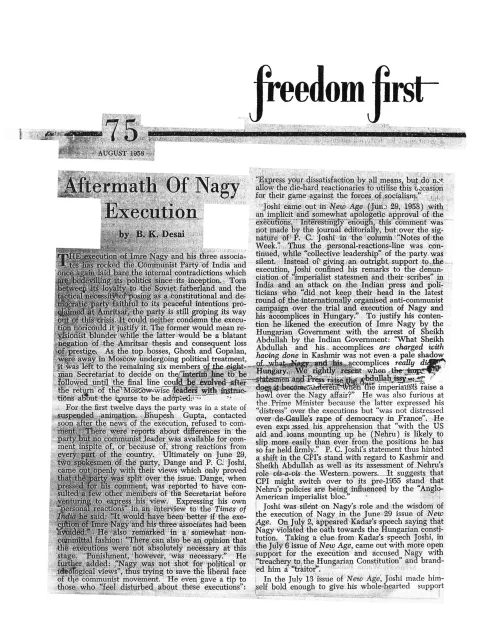
B. K. Desai’s “Aftermath Of Nagy Execution” traces the CPI Secretariat’s twelve-day paralysis after Imre Nagy’s killing, with P. C. Joshi’s New Age columns shifting from apology to endorsement while dissenting communists like Santosh Chatterjee publicly objected despite a party directive to stay silent.
-
Notes accuse the Kerala Communist government of using nationalised textbooks for indoctrination, citing a text praising Soviet education and another glorifying the Russian and Chinese revolutions while omitting the Warsaw Pact, alongside Namboodiripad’s warning that opposition could trigger civil war.
-
A companion item criticises Orissa Chief Minister Harekrushna Mahtab for demanding the replacement of three newspaper correspondents on an unproven charge, quoting opposition leader R. N. Singh Deo’s characterisation of it as “high-handed administrative blackmail.”
-
V. B. Karnik’s “A Grave Mistake” argues the Anglo-American military intervention in Lebanon and Jordan violates non-interference and props up undemocratic regimes, invoking Lord Attlee’s warning against propping up rulers lacking democratic legitimacy.
-
M. A. Venkata Rao defends the same intervention as a necessary counter to Soviet-Nasserite “indirect aggression,” drawing an extended parallel to the “salami tactics” that sovietised Hungary and Czechoslovakia and applying the analogy directly to Kerala.
-
General Bela Kiraly’s “A Kiss For Big Brother” recounts how Hungary’s secret police scripted a supposedly spontaneous 1950 Budapest parade minute-by-minute, with children selected from Politburo families rehearsed to “spontaneously” kiss Party leaders.
-
A “News From Poland” brief reports the banning of Leopold Tyrmand’s novel Seven Long Journeys and withdrawal of his passport under Gomulka’s tightening cultural policy, alongside writer Marek Hlasko’s exile to Paris.
Essays
Essay 1
B. K. Desai surveys the internal turmoil the execution of Imre Nagy and his associates caused within the Communist Party of India. With senior leaders Ajoy Ghosh and A. K. Gopalan away in Moscow, the remaining Secretariat members struggled for twelve days to find a line, caught between revisionist condemnation and doctrinal endorsement. Dange gave tepid personal remarks regretting the executions’ timing while accepting their necessity; P. C. Joshi’s commentary in New Age shifted over successive issues from implicit apology toward open endorsement, using the arrest of Sheikh Abdullah in Kashmir as a comparative justification. Desai catalogues dissenting voices — CPI member Santosh Chatterjee, the Maharashtrian communist Karadkar, and others — alongside the acute embarrassment of the ruling Kerala communist party, caught between its ‘peaceful parliamentary road’ claims and Moscow’s line. The essay closes arguing the execution had a bigger impact on Indian public opinion than the original Hungarian uprising, blunted only by the distraction of the Lebanon-Jordan crisis, and credits the Praja Socialist Party with taking a firmer, more consistent anti-communist stance as a result.
- The CPI Secretariat was paralysed for about twelve days after the Nagy execution, unable either to condemn or endorse it without political cost.
- Dange’s personal remarks to the Times of India accepted the executions’ necessity while regretting their timing.
- P. C. Joshi’s New Age columns moved from an implicit, apologetic tone toward full-throated endorsement across successive issues (June 29, July 6, July 13).
- Joshi justified the execution by comparing it to India’s arrest of Sheikh Abdullah, provoking Desai’s rebuttal of the analogy.
- The Kerala communist government faced acute embarrassment given its professed commitment to the ‘peaceful parliamentary road.’
- Dissenting communists (Santosh Chatterjee, Karadkar, Daniel Latifi, L. M. Zaveri, Ganesh Shanbag) publicly objected to the executions despite a party directive to stay silent.
- Desai credits the PSP with taking a firm, principled anti-communist stand in the aftermath, strengthening its ideological independence from CPI-led united fronts.
Essay 2
An unsigned ‘Notes’ item accuses the Kerala communist government of using the nationalisation of school textbooks to indoctrinate students, citing a Malayalam standard-ten text that reproduces a laudatory letter on Soviet education by Education Minister Joseph Mundassery, and an eighth-standard Social Studies text that lionises the Russian and Chinese revolutions with portraits of Marx, Lenin, and Mao while omitting any mention of the Warsaw Pact or Soviet-bloc unemployment and repression. A companion item, ‘Prelude To Civil War?’, reports rising tension in Kerala after Chief Minister Namboodiripad’s warning that opposition to the communist government could trigger civil war, and criticises the CPI’s plan to form ‘people’s committees’ as a device to intimidate the opposition, calling on the central government to prevent the state’s political crisis from escalating.
- A Malayalam standard-ten textbook includes a letter by Kerala Education Minister Joseph Mundassery praising Soviet education as the most efficient in the world.
- An eighth-standard Social Studies text glorifies the Russian and Chinese revolutions with portraits of Marx, Lenin, and Mao Tse-tung.
- The same textbook omits the Warsaw Pact and Soviet-bloc conditions while branding NATO, SEATO, and the Baghdad Pact as imperialistic.
- Chief Minister Namboodiripad warned of civil war if opposition parties continued opposing the Communist Party, later partially clarifying the remark.
- The CPI’s proposal for state-wide ‘people’s committees’ is characterised as a tool to terrorise the opposition with tacit government backing.
- The piece calls on the Central Government to prevent Kerala’s crisis from taking ‘a fatal turn’.
Aftermath Of Nagy Execution
By B. K. Desai
This unsigned item accuses Orissa Chief Minister Harekrushna Mahtab of behaving irresponsibly by demanding the replacement of correspondents from three reputable newspapers on the unsubstantiated ground that one was on a foreign embassy’s payroll and running propaganda against his government. After public outcry, Mahtab admitted there was no basis for the charge and the letters were withdrawn, but the piece argues this is insufficient and calls for a formal investigation into who made the charge, alongside an apology to the correspondents and punishment for those responsible, quoting opposition leader R. N. Singh Deo’s charge that the episode was ‘high-handed administrative blackmail’ meant to stifle press coverage ahead of the Assembly session.
- Orissa CM Harekrushna Mahtab demanded replacement of three newspaper correspondents over an unproven claim of foreign-embassy payroll influence.
- Public outcry forced Mahtab to admit there was no basis for the charge, and the letters demanding replacement were withdrawn.
- The piece calls this an insufficient resolution and demands a formal investigation, an apology, and punishment for those responsible.
- Opposition leader R. N. Singh Deo charged that the real motive was to stifle press coverage ahead of a crucial Assembly session.
A Grave Mistake
By V. B. Karnik
V. B. Karnik argues that the Anglo-American military intervention in Lebanon and Jordan is a grave mistake, violating the principle of non-interference in the internal affairs of other nations even though it was undertaken at the invitation of the two countries’ governments. He contends the intervention amounts to armed support for undemocratic regimes — a feudal prince in Jordan and a government seeking an unconstitutional second term in Lebanon — against their own people, invoking Lord Attlee’s warning in the House of Lords against propping up rulers lacking democratic legitimacy. Karnik distinguishes the action from the 1956 Suez war (no direct combat) and from Soviet action in Hungary (no comparable totalitarian expansion aim), but insists the West must develop a genuine, cooperative relationship with rising nationalism in West Asia rather than relying on discredited monarchs, warning that the current policy will only deepen distrust and instability. He closes hopeful that democratic self-correction — criticism within Britain’s Labour Party and in the US — will lead the two governments to withdraw and rectify the mistake.
- Karnik holds that intervention in Lebanon and Jordan is unsupportable even on grounds of expediency, let alone principle.
- He argues UN Charter Article 51 does not clearly apply since there is no internal revolt in Jordan and no proven ‘aggression’ in Lebanon.
- He cites the UN Observer Group’s finding of no evidence of ‘massive infiltration’ as disproving the foreign-inspired-revolt justification.
- Karnik distinguishes this action from Suez (no direct warfare) and from Soviet intervention in Hungary (different underlying objective).
- He argues the West must evolve new relationships with nationalist forces in West Asia rather than propping up feudal monarchs.
- He expresses hope that democratic self-correction (Labour Party and US criticism) will lead to withdrawal and correction of the ‘grave mistake’.
Who Are The Aggressors?
By M. A. Venkata Rao
M. A. Venkata Rao defends the American and British intervention in Lebanon and Jordan against Indian public opinion, which he says has uncritically adopted the Soviet line. He argues Indian commentators ignore the ‘indirect aggression’ of Soviet-backed subversion, drawing an extended historical parallel to how Hungary and Czechoslovakia were ‘sovietised’ through coalition governments and ‘salami tactics’ before becoming full communist states, and applies the same lens to Nasser-backed rebel movements in Lebanon and Syria. He characterises the American landing as a necessary counter-intervention against pre-existing Soviet-Nasserite subversion rather than an act of aggression itself, appeals to Article 51 and pre-UN Western defence agreements with Syria and Lebanon as legal grounds, and frames the stakes in civilisational terms — preventing Soviet-Kremlin control of West Asia’s oil wealth and strategic position. He closes by drawing a direct analogy to Kerala, describing the state as facing the ‘initial stages of indirect aggression’ analogous to what dissolved Lebanon’s political order.
- Venkata Rao argues Indian public opinion has adopted Soviet interpretations of the Lebanon-Jordan crisis with ‘a naivete that is truly disturbing.’
- He details the Soviet ‘salami tactics’ by which Hungary and Czechoslovakia were sovietised through coalition governments and gradual communist takeover.
- He frames Nasser’s Pan-Arab ambitions and Soviet backing of Lebanese rebels as an ‘indirect aggression’ that the American landing counters.
- He argues legality rests on Article 51 and pre-existing Western defence commitments to Syria and Lebanon.
- He frames the stakes as civilisational: preventing ‘Kremlin-Marxism’ from controlling West Asia’s oil and strategic position.
- He closes by directly analogising the situation in Kerala to Lebanon’s fate under indirect Soviet-backed aggression.
A Kiss For Big Brother
By Bela Kiraly
General Bela Kiraly, former Commander in Chief of the Hungarian National Guard during the 1956 Revolt, recounts (in a piece reproduced from East Europe magazine) how the Hungarian secret police (AVH) meticulously stage-managed the appearance of spontaneous popular affection during Communist Party events, prompted by recent photographs of Khrushchev mingling with and kissing Hungarian children in Budapest. Kiraly describes attending planning meetings in the early 1950s, chaired by Politburo member Istvan Kovacs, for the April 4, 1950 anniversary parade honouring Marshal Voroshilov and Party leader Matyas Rakosi, where a minute-by-minute schedule choreographed ‘spontaneous’ events down to five young workers ‘breaking through’ a security cordon at 11:35 AM and Rakosi ‘kissing children’ at 11:45 AM — with the children carefully selected from Politburo families and rehearsed in advance. He recalls watching the entire performance unfold exactly as scripted, contrasting the carefully vetted, unarmed honour guard drawn from the AVH itself with the sealed weapons and 30-yard exclusion zone imposed on regular troops.
- Kiraly recounts planning meetings for Hungary’s April 4, 1950 ‘liberation’ anniversary parade, chaired by Politburo member Istvan Kovacs.
- A precise, minute-by-minute timetable scripted supposedly spontaneous events, including workers ‘breaking through’ a cordon and Rakosi ‘kissing children.’
- The children selected for Rakosi to kiss were relatives of Politburo members (a nephew of Erno Gero and a daughter of another Communist leader), carefully rehearsed in advance.
- The honour guard for Party and Soviet dignitaries was drawn from the AVH secret police rather than regular troops, who were kept unarmed and at a 30-yard distance.
- Kiraly connects this episode to contemporary 1958 press photographs of Khrushchev spontaneously kissing Hungarian children during a Budapest visit, suggesting the same stage-management technique.
News From Poland
By MA Venkata Rao
This unsigned ‘News From Poland’ brief reports that Polish author Leopold Tyrmand has been publicly reprimanded through the banning of his latest novel, Seven Long Journeys, and the withdrawal of his passport, effectively ending his writing career under the official justification of ‘general immorality.’ The piece situates Tyrmand within Poland’s Catholic literary circles and notes his earlier public criticism of the Catholic group ‘Pax’ for collaborating with Stalinists during the 1956 October Revolution. It links the crackdown to broader tightening of cultural policy under the Gomulka regime, citing Central Committee member B. Werblan’s declaration that no further resources would go toward publishing ‘demoralising’ works, and reports that young avant-garde writer Marek Hlasko, attacked in the party paper Trybuna Ludu, is now in Paris where two of his banned-in-Poland books have been published by Kultura.
- Leopold Tyrmand’s novel Seven Long Journeys was banned and his passport withdrawn, ending his ability to publish.
- The official justification cited was the ‘general immorality’ of Tyrmand’s writings, effectively banning all his works.
- Tyrmand had previously criticised the Catholic group ‘Pax’ for collaborating with Stalinists during the 1956 uprising.
- Central Committee member B. Werblan declared that Party resources would no longer support ‘demoralising’ literary works.
- Writer Marek Hlasko, attacked in Trybuna Ludu, is in Paris where two of his Poland-banned books were published by Kultura.
Generated by the v1.5 extraction pipeline. Awaiting editorial review.
Essay 6
No summary was extracted for this article. Listed for completeness.
Essay 7
No summary was extracted for this article. Listed for completeness.
Metadata and summary are AI-extracted from the source PDF and reviewed for editorial accuracy. The original work is available via the Read PDF tab above (where present); paragraph-level citation inside the PDF is deferred to a future engagement.