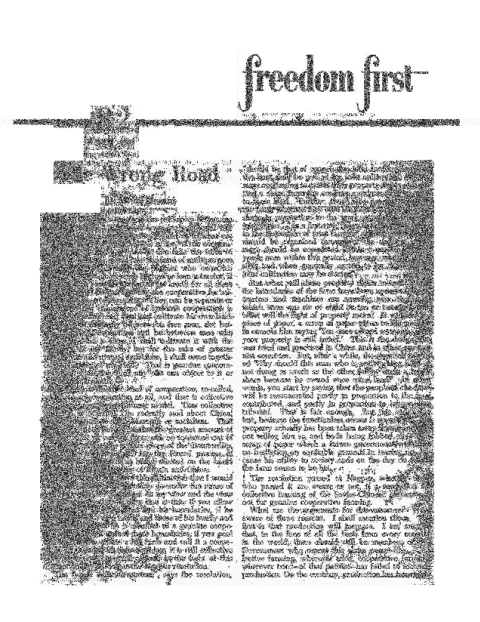
periodical issue
Freedom First
By V. B. Karnik, Adam Adil, K. A. Jelenski, M. A. Venkata Rao, Ravi Prasad
Edited, printed & published for the Democratic Research Service by V. B. Karnik at The Kanada Press, 109 Parsi Bazar Street, Bombay 1. · Bombay · 1959
12 pages
Freedom First
Summary
This is the February 1959 issue (No. 81) of Freedom First, the monthly journal of the Democratic Research Service published from Bombay and edited by V. B. Karnik. The issue is a miscellany of short essays and reports united by a classical-liberal, anti-communist editorial stance: it scrutinises the Indian National Congress’s Nagpur session and its embrace of a ‘socialist pattern of society’ and cooperative/joint farming, surveys communist manoeuvring in West Asia and Iraq, reports on internal dissent within the Polish Communist Party over ‘revisionism,’ mocks the credibility of Chinese production statistics and the coercive economics of Chinese communes, attacks Indian land-reform and cooperative-farming policy as a disguised copy of Chinese collectivisation, examines a Kerala government committee on the ‘role of the police in a welfare state’ as a possible vehicle for Communist Party control of policing, and closes with a page of press quotations under the recurring feature ‘With Many Voices.’ Contributors include V. B. Karnik, Adam Adil, K. A. Jelenski, M. A. Venkata Rao, and Ravi Prasad, alongside unsigned notes and advertisements for allied publications (Democratic Research Service, Quest, Encounter).
Key points
-
V. B. Karnik’s “The Spell Of Slogans” reviews Congress’s Nagpur session, focusing on its agrarian resolution mandating cooperative joint farming and land ceilings by the end of 1959, noting U.P. Revenue Minister Charan Singh’s forceful floor opposition and Nehru’s dismissal of Congress President Dhebar’s warnings on agriculture as “irrelevant.”
-
Adam Adil’s “West Asia In Turmoil” argues Iraq’s revolutionary regime and Arab communists, not traditional monarchs, are the real threat to Pan-Arab unity, citing roughly 150 communists arrested in Egypt and 300 in Syria as a positive sign for regional stability.
-
K. A. Jelenski’s “‘Victory’ At A Price” draws on a leaked Polish Communist Party plenary record to show Gomulka’s post-1956 economic model survived neo-Stalinist attack only at the cost of cracking down on “revisionist” intellectuals, the same writers who had earlier denounced Stalinism’s crimes.
-
An unsigned piece catalogues implausible Chinese production claims from the Great Leap Forward, quoting an internal directive that statistics must “serve the political struggle” rather than record reality, while a companion note on Chinese communes reports roughly 70% of output value is funnelled to state accumulation and taxes.
-
M. A. Venkata Rao’s “Why ‘Co-operative’ Farming?” argues Indian land reform’s push toward joint farming is designed to let the state seize the harvest, tracing a three-stage Chinese pattern from landlord liquidation to peasants reduced to supervised wage-hands, and proposes Rochdale- and Danish-style service cooperatives instead.
-
Ravi Prasad’s “A Letter from Kerala: Subversion Of The Police?” scrutinises a Kerala government committee on the police’s role in a “welfare state,” prompted by a fatal 1958 strike-firing, suspecting proposals for a village police tied to panchayats are aimed at neutralising the police as a check on Communist Party activity.
Essays
The Spell Of Slogans
By V. B. Karnik
V. B. Karnik’s ‘The Spell of Slogans’ is a critical review of the Indian National Congress’s annual session at Nagpur (1959). Karnik questions the expense and purpose of holding mass ‘Melas’-like sessions in the post-independence era, argues that the controversy over the ‘socialist pattern’ and ‘goal of socialism’ is a semantic distraction since the term has ‘lost all precise meaning,’ and focuses his sharpest criticism on the session’s agrarian resolution mandating cooperative joint farming, ceilings on land holdings, and abolition of intermediaries by the end of 1959. He reports that U.P. Revenue Minister Charan Singh mounted forceful opposition to the resolution in the Subjects Committee, and that Congress President Dhebar’s warnings on the primacy of agriculture were dismissed by the Prime Minister as ‘irrelevant.’ Karnik concludes that Congress leaders remain wedded to doctrinaire slogans rather than realistic, evidence-based policy, and that only careful thinking rather than sloganeering will let India avoid replicating Russian, Chinese, or American models by rote.
- Questions whether costly, mass-attended Congress sessions serve any purpose in post-independence India beyond spectacle.
- Argues the ‘socialist pattern’/‘goal of socialism’ debate is semantically empty and shouldn’t distract from evaluating concrete measures.
- Reports the Nagpur session’s core resolution: cooperative joint farming, land ceilings, abolition of intermediaries by end of 1959, organised via village panchayats and cooperatives.
- Notes U.P. Revenue Minister Charan Singh’s forceful floor opposition to state trading in foodgrains and to ceilings/joint cultivation.
- Cites the Prime Minister’s own admission that the Second Plan fell short of agricultural targets, and Congress President Dhebar’s warnings on agricultural primacy being dismissed as ‘irrelevant.’
- Criticizes lack of a realistic approach to the public/private sector debate despite acknowledging their interdependence.
- Frames the whole session as evidence Congress leadership ‘refuse to learn from experience’ regarding failed collectivisation in Russia, Poland, and China.
West Asia In Turmoil
By Adam Adil
Adam Adil’s ‘West Asia in Turmoil’ surveys the collapse of Pan-Arab unity following the 1958 Syria-Egypt merger, attributing the fragmentation to civil war in Lebanon, the fall of the Iraqi monarchy, regime change in Sudan, and the Nasser-Bourguiba split. The essay’s central argument is that the ‘arch enemies’ of Arab nationalism are not the traditional monarchs but Iraq’s revolutionary regime and communists across the Arab world, who work covertly (citing Syrian Communist Party head Khalid Bakdash’s writings in ‘World Marxist Review’) to keep the Arab world divided and vulnerable to Soviet or Chinese domination. Adil details communist infiltration of Iraqi government positions under Brigadier Kassam, mass arrests of communists in Egypt and Syria, and argues that improved relations between Arab states and the West are now more likely than a genuine, durable Pan-Arab unity, given the shared threat of communist encroachment.
- Argues Pan-Arabism has weakened due to the Lebanese civil war, Iraq’s monarchy collapse, Sudan’s regime change, and the Nasser-Bourguiba rift.
- Identifies Iraq’s revolutionary leadership and Arab communists, not traditional monarchs, as the real threat to Arab nationalist unity.
- Cites Khalid Bakdash (Syrian Communist Party) arguing communists must retain the ‘key role of the proletariat’ even while allying with bourgeois nationalists like Nasser.
- Reports approximately 150 communists arrested in Egypt and 300 in Syria in three weeks, read as a positive sign for regional stability.
- Details heavy communist infiltration of the Iraqi government under Brigadier Kassam, including control of press, radio, and television.
- Notes a UAR-Britain financial agreement brokered by World Bank President Eugene Black as a sign of improving West-Arab relations.
”Victory” At A Price
By K. A. Jelenski
K. A. Jelenski’s ‘“Victory” At A Price’ analyses a secret stenographic record of the Twelfth Plenary Session of the Central Committee of the Polish Communist Party (published in Warsaw, November 1958, for internal party use), which had by early 1959 reached the West. The record reveals that Gomulka’s post-1956 economic model survived neo-Stalinist attacks (which pointed approvingly to China’s example) at the cost of a crackdown on intellectual and cultural ‘revisionism.’ Jelenski quotes extensively from Gomulka, Marxist philosopher Adam Schaff, and Stalinist writer Leon Kruczkowski to show the party’s shared hostility toward writers and intellectuals who favoured socialism but resisted total party control over thought — ‘revisionists’ accused of forming a ‘ghetto’ of leftist café intellectuals divorced from the working class. The essay closes by noting that many of the intellectuals under attack were the same Polish writers who had courageously denounced Stalinism’s crimes, quoting one 1956 statement (from an unnamed ‘famous poet’) that freedom of speech is ‘the primary condition for all creative work.’
- Reports on a leaked secret Polish Communist Party Central Committee stenographic record (Twelfth Plenary Session, published Warsaw Nov. 1958).
- Gomulka’s economic model (reduced investment rate, decollectivised countryside, adopted 1956) survived neo-Stalinist attacks that cited China’s example favourably.
- The ‘victory’ in economic policy was purchased by falling into line on cultural/ideological repression of ‘revisionist’ intellectuals.
- Quotes Gomulka’s own definition of revisionism as intellectuals who favour socialism but ‘refuse the Party the right to have complete control over life and the human conscience.’
- Quotes Marxist philosopher Adam Schaff on using Western sympathy for revisionists as a propaganda tool, and Stalinist writer Leon Kruczkowski defending administrative/censorship methods.
- Frames the repressed Polish writers as the same figures who had bravely denounced Stalinist crimes, drawing an implicit parallel to the contemporaneous Pasternak affair in the USSR.
Some Wonders Of Chinese Statistics / Chinese Communes
This unsigned piece, ‘Some Wonders of Chinese Statistics,’ catalogues a series of implausible production figures reported in Chinese state media during the Great Leap Forward — including a claimed rice yield of 60,437 catties per mow, 10.7 million tons of steel from native methods, tobacco plants ‘as tall as a man,’ claims of up to 20,000,000 rice plants per mow, a single county’s coal output exceeding a two-year target in 19 hours, and a soya bean yield ‘143 times the 1957 national’ record. The author cites an internal New China News Agency report acknowledging that Chinese statistical work is explicitly designed to ‘serve the political struggle’ rather than record actual conditions, using this admission to argue that all such figures should be read as propaganda rather than fact.
- Surveys a string of extraordinary Chinese agricultural and industrial production claims from 1958 media reports (rice, steel, coal, soya beans).
- Quotes an internal Chinese directive stating statistical work must ‘conform with the requirements of the Party’ rather than record actual conditions.
- Uses this admission as proof that Great Leap Forward statistics are propaganda instruments, not empirical data.
- Highlights a Shantung soya bean yield claimed at ‘143 times the 1957 national’ record and 1500 katties of ash fertiliser use as physically implausible.
- Questions the economic rationality of the fertiliser inputs described relative to claimed yields.
Chinese Communes
The unsigned ‘Chinese Communes’ note summarises an article by Loh Keng-mo, Vice-Chairman of China’s State Planning Commission, published in Ching Chi Yen Chin, describing the ‘supply system’ of payment (fixed food/clothing ration plus variable cash) used in Chinese communes and the wide variance in consumption-versus-accumulation ratios across different communes in Honan province. The piece concludes that communes function chiefly to funnel the bulk (about seventy percent) of agricultural output to the state via forced accumulation and taxation, with collective kitchens, nurseries, and abolition of private property serving to mobilize all labour, including women, for production — and judges that by this measure the Chinese government has ‘succeeded in its objectives.’
- Summarises Loh Keng-mo’s (Vice-Chairman, State Planning Commission) article on the commune ‘supply system’ of remuneration.
- Reports commune income variance in Honan province: e.g., 65-74 Yuan per year per member across different communes, with accumulation rates from 13.5% to 70% of output value depending on commune type.
- Argues collective kitchens, nurseries, and abolition of private property exist to mobilise all women for productive labour and enable accumulation.
- Concludes about 70% of agricultural/subsidiary output value goes to state accumulation or taxes, with only 30% consumed by commune members.
- Frames the communes’ true purpose as making produce directly available to the government, judged a success by the reporter.
Why “Co-operative” Farming?
By M. A. Venkata Rao
M. A. Venkata Rao’s ‘Why “Co-operative” Farming?’ argues that Indian land reform’s push toward cooperative/collective joint farming is not aimed at freeing the agricultural producer but at enabling the socialist state to seize control of the harvest. Drawing an extended parallel to Chinese land reform — which he describes as beginning with the violent liquidation of landlords, followed by dispossessing the newly landed peasants via mutual-aid teams and ‘low and high grade’ cooperatives, ending with peasants reduced to wage-slave status under supervisors and work quotas — Venkata Rao warns that India’s own cooperativisation drive, motivated by Second Plan foreign-exchange pressures and the arms race with Pakistan, risks repeating this trajectory. He criticizes Indian delegations (naming Mr. R. K. Patil and Mr. Krishnappa) for whitewashing coercive Chinese methods as ‘non-violent and democratic,’ and proposes an alternative: strengthening independent peasant proprietorship supported by Rochdale- and Danish-style service cooperatives, citing Japan, West Germany, and Denmark as models, rather than forced collectivisation.
- Argues cooperative/collective joint farming is designed to let the socialist state capture the harvest, not to free or benefit the peasant producer.
- Traces a three-stage pattern from Chinese land reform: liquidation of landlords, dispossession of new peasant-holders via mutual-aid teams and graded cooperatives, and final reduction of the peasant to a supervised wage-hand.
- Criticises Indian official delegations (R. K. Patil and Krishnappa named) for certifying coercive Chinese methods as non-violent and democratic.
- Links India’s cooperativisation push to Second Five-Year Plan foreign-exchange pressures and the arms race with Pakistan.
- Proposes an alternative of strong independent peasant proprietorship aided by Rochdale/Danish-style service cooperatives, citing Japan, West Germany, and Denmark as models.
- Frames total destruction of private property in industry, commerce, land, and transport as the shared totalitarian goal of Chinese communism and the article warns is being replicated in India.
A Letter from Kerala: Subversion Of The Police?
By Ravi Prasad
Ravi Prasad’s ‘A Letter from Kerala: Subversion of the Police?’ reports on a Kerala government committee appointed to examine ‘the role of the Police in a welfare state,’ formed in the aftermath of a 1958 Tea Plantation strike where police firing killed a worker and drew nationwide Communist condemnation of the (Communist-led) Kerala government. Prasad scrutinises the committee’s broad terms of reference — including whether police should be guided by ‘public aspirations’ (which he suspects is code for Communist Party aspirations), whether use of firearms should be curtailed, whether to create a ‘village police’ tied to panchayats the Communists are trying to capture in upcoming elections, and rumours of ‘progressive literature’ study classes being introduced into Special Police Establishment camps. He concludes that after 21 months of Communist rule, Kerala’s education system, administrative machinery, and cooperative/trade union movements have already been corroded, and wonders whether the police department is ‘the next item on the agenda.’
- Reports the background to a Kerala government committee on ‘the role of the Police in a welfare state,’ prompted by a 1958 Tea Plantation strike and police firing that killed a striker.
- Notes the committee lacks employer, landlord, or capital representation, and flags ‘public aspirations’ as a phrase that may function as Communist Party code.
- Examines the question of whether police firearm use should be curtailed, framed as a possible Communist tactic to neutralise the police as a check on party ‘fireworks.’
- Raises suspicion over proposed Police Advisory Committees and a village police tied to panchayats, given Communist ambitions to capture 75% of Kerala panchayats in the 1959 elections.
- Cites rumours that ‘progressive literature’ and study classes have been introduced into Special Police Establishment camps under guise of cultural/recreational programmes.
- Concludes that after 21 months of Communist rule, education, administration, and cooperative/trade union sectors in Kerala have been corroded, questioning whether the police is next.
Generated by the v1.5 extraction pipeline. Awaiting editorial review.
With Many Voices
No summary was extracted for this article. Listed for completeness.
Metadata and summary are AI-extracted from the source PDF and reviewed for editorial accuracy. The original work is available via the Read PDF tab above (where present); paragraph-level citation inside the PDF is deferred to a future engagement.