periodical issue
Freedom First
By M. R. Masani, S. R. Mohan Das, Philip Spratt, Adam Adil, Dr. C. Chandrasekhar
Edited by V. B. Karnik and printed at Inland Printers, 55 Gamdevi Road, Bombay 7 and published for the Democratic Research Service by B. K. Desai at 127 Mahatma Gandhi Road, Bombay 1. · Bombay · 1960
12 pages
Freedom First
Summary
This is Issue No. 94 of Freedom First (March 1960), the monthly journal of the Democratic Research Service, Bombay, edited by V. B. Karnik. The issue is a classical-liberal, anti-communist commentary on contemporary Indian and world affairs, centered on the Sino-Indian border crisis. Its lead editorial by M. R. Masani, ‘A Climb Down,’ attacks Prime Minister Nehru’s invitation to Chinese Premier Chou En-lai as a national humiliation and a capitulation to an untrustworthy, expansionist Chinese regime. Other contributors extend this anti-communist framing across the region and the world: S. R. Mohan Das surveys the wave of Soviet delegations to India and reads Soviet overtures as an infiltration strategy; Philip Spratt reports approvingly on the Congress-led alliance’s defeat of the Communist Party in Kerala’s mid-term election; Adam Adil praises U Nu’s electoral victory in Burma following army rule under Ne Win; and Dr. C. Chandrasekhar analyzes population pressure in Communist China and its implications for national power and potential aggression. Unsigned editorial ‘Notes’ cover Communist Party of India double-talk on the border dispute and mass executions in Hungary following the 1956 uprising. The issue closes with ‘With Many Voices,’ a compilation of press quotations on the Voroshilov/Khrushchev visits and Kerala politics, and the statutory ownership statement for the periodical.
Key points
-
M. R. Masani’s “A Climb Down” denounces Nehru’s invitation to Chinese Premier Chou En-lai as a national humiliation, proposing instead a regional South and South-East Asian security organisation and insisting Chou En-lai be received only as a government guest, not an honoured guest of the Indian people.
-
Notes report former CPI functionary Tushar Pawar’s disclosure that Maharashtra party leaders privately blamed India, not China, for border aggression, and cite BBC sources on continued mass executions in Hungary of 1956 uprising participants three years on.
-
An editorial note on Kerala’s post-election crisis criticises the Congress High Command for nearly wrecking the winning United Alliance by seeking a single-party government, defending the Muslim League’s role as representing a genuinely backward community.
-
S. R. Mohan Das surveys the surge of Soviet delegations to India culminating in Voroshilov’s and Khrushchev’s visits, arguing Soviet “peaceful co-existence” rhetoric masks an unchanged Marxist view of co-existence as “extension of the struggle between two social systems.”
-
Philip Spratt’s report on Kerala’s mid-term election presents detailed results showing the United Front winning 94 of 126 seats against the Communist Party’s 29, framing the “liberation struggle” as a moral reaction to lawlessness rather than simple class conflict.
-
Adam Adil analyses U Nu’s landslide Burmese election victory following General Ne Win’s military caretaker government, crediting the army with defeating the insurgency before warning that U Nu’s now-unchecked majority removes healthy opposition checks.
-
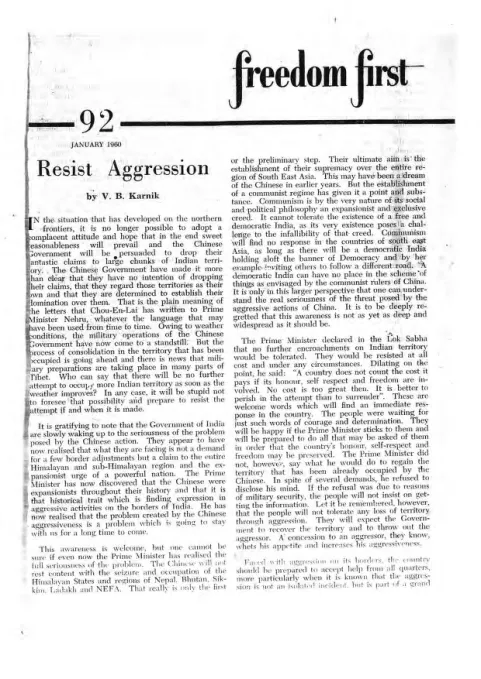
Dr. C. Chandrasekhar projects China’s population could reach 1,000 million by 1981, arguing population size interacts with resources and militarist nationalism, as in interwar Germany, Italy and Japan, to raise the risk of aggression.
-
The closing “With Many Voices” quotes V. K. Krishna Menon calling communists “servants of China” who should be “smashed,” and Dr. K. Shridharani calling Khrushchev the “biggest salesman of Eisenhower.”
Essays
A Climb Down
By M. R. Masani
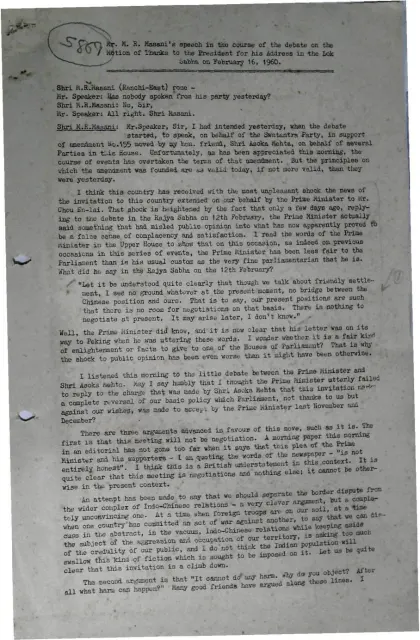
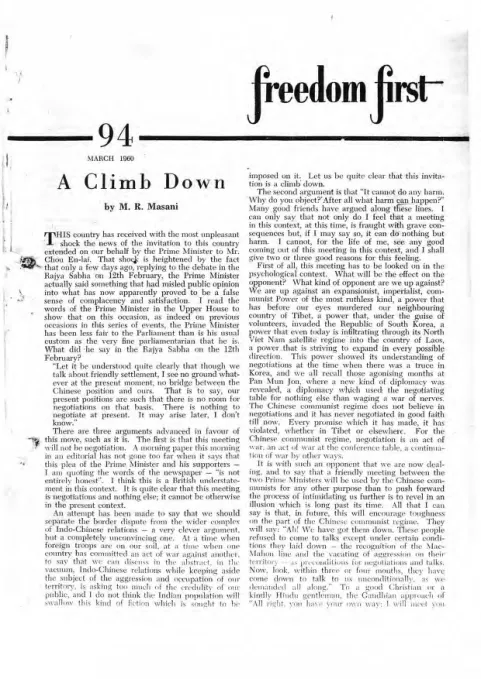
M. R. Masani’s lead editorial denounces the Indian government’s invitation to Chinese Premier Chou En-lai as a ‘climb down’ and a national humiliation, delivered as a speech in Parliament on 11 February. Masani argues the meeting amounts to negotiation under duress with an aggressor that has never negotiated in good faith, citing Chinese conduct in Tibet, Korea, and Laos. He rebuts three pro-meeting arguments in turn (that it isn’t really negotiation; that it can do no harm; that there is no alternative), warning that the invitation will demoralize India’s armed forces and police who have already suffered Chinese aggression, and will encourage further Chinese toughness. In the continuation, he sets out what India could do instead: assert its right to eject aggressors by force if capable, deny the government’s claim that any resistance would ‘lead to war,’ and propose a regional collective-security organisation of South and South East Asian countries rather than either passive acceptance of occupation or unilateral alliance-seeking. He closes by insisting Chou En-lai not be treated as an honoured guest of the Indian people.
- Frames Nehru’s invitation to Chou En-lai as a ‘climb down’ contradicting the PM’s own 12 February statement to the Rajya Sabha that there was no basis for negotiation.
- Characterizes Communist China as an aggressor that has never negotiated in good faith, citing Tibet, Korea, and Laos as evidence.
- Warns the meeting will demoralize India’s armed forces, police, and figures like Karam Singh who suffered under Chinese aggression.
- Rejects the argument that the meeting is harmless, arguing it is psychologically damaging regardless of outcome.
- Proposes a regional South and South East Asian security organisation rather than either passive resignation or unilateral foreign alliances.
- Insists that 5,000 to 10,000 square miles of Indian territory are already under foreign occupation and criticizes the government for downplaying this.
- Calls for Chou En-lai to be received only as a guest of the government, not as an honoured guest of the Indian people.
Communist Double-Talk
Unsigned editorial ‘Notes’ section with two items. ‘Communist Double-Talk’ recounts revelations by Tushar Pawar, a former Communist Party of India functionary in Maharashtra, that CPI leaders including Basavapunnaiah privately regarded China’s border aggression as justified and the Indian government as the real culprit, exposing the party’s public claim of neutrality as false. ‘Executions In Hungary’ reports, via BBC sources, ongoing mass executions and arrests in Hungary of participants in the 1956 uprising, including 150 young people and 50 adults executed in the preceding six months despite official assurances that no one under 21 would be executed.
- Tushar Pawar, a former CPI functionary, disclosed that the party’s Maharashtra leadership privately blamed India, not China, for border aggression.
- CPI acting General Secretary Basavapunnaiah reportedly argued that denouncing China as an aggressor would betray communism’s basic tenets.
- The piece frames this as proof of CPI’s character as an agent of Moscow and Peking despite public claims of patriotic neutrality.
- Hungary continues mass executions and arrests of 1956 uprising participants over three years after the revolt was suppressed by Soviet tanks.
- 150 young persons and 50 adults were executed in the six months prior to publication despite government assurances no one under 21 would be executed.
- Report notes Western complacency, framing the free world as having largely written off Hungary and Eastern Europe.
Notes (Communist Double-Talk; Executions In Hungary; Kerala)
A short unsigned editorial note on the political crisis that followed the United Alliance’s mid-term election victory in Kerala. It criticizes the Congress High Command for nearly wrecking the alliance by seeking to form a single-party government despite having contested as part of the coalition, and calls this an ethical failure given that Congress votes in the election were cast for the Alliance, not for Congress alone. It also defends the Muslim League’s role in Kerala as a legitimate representative of an economically backward community rather than a purely communal or separatist force.
- Congress High Command’s push to form a single-party government after the Alliance’s victory is criticized as opportunistic and unethical.
- Notes the crisis was resolved by the Muslim League’s gesture of withdrawing its demand for inclusion and offering cooperation to a Congress-PSP ministry.
- Defends the Muslim League as representing the socio-economic and political aspirations of Kerala’s Muslim community rather than being purely communal.
- Warns that no major party in Kerala is free from the ‘incubus of communalism.‘
Current Trends In Indo-Soviet Relations
By S. R. Mohan Das
S. R. Mohan Das surveys the surge of Soviet delegations and high-level visits to India since October 1959 — aviation workers, jurists, film, scientists, journalists, educationists, medical delegations, and finally President Voroshilov and Premier Khrushchev themselves — arguing that Soviet rhetoric of peaceful co-existence masks an unchanged Marxist-Leninist view that co-existence is merely ‘the extension of the struggle between two social systems.’ He notes India’s own positive disposition toward the USSR, reinforced by Soviet aid projects like the Bhilai Steel Plant and pledges for the Third Five Year Plan, and quotes Soviet officials (Gorkin, Kozlov, Furtseva) praising Soviet institutions and criticizing capitalist alternatives during their visits. The piece (continued on page 8, also rendered) argues that Khrushchev’s post-visit warnings against Western aid to India, and the broader Soviet courtship, form a strategy of infiltration into Indian life aimed at isolating India from non-communist ties, with China’s pressure on India serving as the ‘harder’ complement to Soviet ‘softer’ diplomacy.
- Documents nine categories of Soviet delegations to India between October 1959 and early 1960, culminating in Voroshilov’s and Khrushchev’s official visits.
- Argues Nehru does not treat Chinese aggression as a matter of international communism, complicating India’s response to Soviet overtures.
- Cites Soviet aid projects (Bhilai Steel Plant, Third Five Year Plan pledges) as concrete bases for India’s trust in Soviet intentions.
- Quotes Soviet officials Gorkin, Kozlov, and Furtseva praising Soviet ‘social justice,’ collective farming, and Soviet cinema during their visits.
- Argues Khrushchev’s warning to India to ‘beware of Western aid’ reflects a strategy to isolate India from non-communist friendships.
- Frames Chinese pressure and Soviet friendship as complementary roles (‘tamer’ and ‘big brother’) in a coordinated communist strategy toward India.
- Suggests Soviet friendship is conditional on India distancing itself from Western aid and non-alignment being reinterpreted in the Soviets’ favour.
Democratic Victory In Kerala
By Philip Spratt
Philip Spratt reports on the Kerala mid-term election as a fair contest that produced a decisive defeat for the Communist Party, which had governed the state amid controversy over its handling of law and order, corruption, and abuse of power. He argues the ‘liberation struggle’ against the Communist ministry was a genuine moral reaction to the party placing itself above the law, not merely a class-based backlash, while acknowledging Congress’s own organisational weaknesses and communal frictions in the state. Spratt presents detailed vote and seat totals showing the United Front alliance winning 94 of 126 seats with 53% of the vote against the Communist Party’s 29 seats on 43% of the vote, framing the result as a vindication of the electorate’s judgment against the previous ministry’s conduct.
- Describes the Kerala election as thoroughly prepared and supervised, making manipulation unlikely.
- Argues Chinese aggression was a minor factor in the vote compared to domestic grievances against the Communist ministry.
- Details Communist Ministry practices: shielding party members from law enforcement, transferring administrative power to the party apparatus, and corruption within party ranks.
- Notes Congress-PSP-Muslim League electoral alliance held together effectively despite internal tensions.
- Provides 1957 vs 1960 vote/seat comparison: Communist Party dropped from 65 to 29 seats despite contesting more seats, while United Front rose from 61 to 94 seats.
- Frames the ‘liberation struggle’ as a moral reaction against lawlessness rather than simple class conflict.
- Cites the jurists’ committee finding that the Communist ministry’s rule amounted to ‘a gross and systematic violation of the rule of law.‘
U Nu’s Victory In Burma
By Adam Adil
Adam Adil analyses U Nu’s landslide 1960 election victory in Burma, framing it as a restoration of civilian democratic rule after General Ne Win’s ‘invited’ military caretaker government of 1958-60. He credits the military regime with defeating a near-existential insurgent threat, restoring economic order through anti-corruption and anti-hoarding measures, and creating conditions for a free and fair election, while crediting U Nu’s personal popularity, his party’s association with Buddhist monks, and the ‘stable’ AFPFL faction’s declining reputation for U Nu’s win. Adil closes with cautious optimism about the return of democracy while warning that U Nu’s now-unchecked parliamentary majority removes healthy opposition checks and that any drift back toward corruption or political intrigue could revive public longing for army rule.
- U Nu’s ‘Clean’ AFPFL won over 200 of 250 seats in Burma’s general election.
- Credits General Ne Win’s 1958-60 military caretaker government with defeating insurgent armies (reduced from 60,000 to roughly 5,000), curbing corruption and hoarding, and enabling a fair election.
- Attributes U Nu’s popularity partly to his devout Buddhism and support from Burma’s 500,000 Buddhist monks.
- Notes U Nu’s large majority removes effective parliamentary opposition, which the author sees as a democratic risk.
- Warns that if U Nu’s government fails to match the army regime’s record or reverts to corruption, public sentiment could again favour military rule.
- Frames the episode as validating both the military’s stewardship and the resilience of Burmese democracy.
Population Pressure In China
By Dr. C. Chandrasekhar
Dr. C. Chandrasekhar analyses China’s population trajectory and its bearing on national power, projecting China’s population could reach 1,000 million by 1981 under conservative assumptions if birth rates remain stationary while death rates decline, doubling in 25 years at 2% annual growth. He argues raw population size alone does not determine national power, situating China’s per-capita income (about 33 US dollars in 1952) below even India’s, but contends that total population interacts with labour force size, natural resources, and military capacity, especially under a totalitarian regime with centralised planning and mass regimentation. In the rendered continuation, he broadens into a comparative historical argument about how population pressure combined with autarkic, militarist nationalism (citing Germany, Italy, and Japan) has previously led to war, and closes on the ambivalent question of whether a demographically expanding, ideologically confident China — with its overseas Chinese diaspora and ideological appeal — poses a similar aggressive risk, without offering a firm conclusion within the rendered pages.
- Projects China’s population could reach roughly 1,000 million by 1981 under conservative assumptions, doubling within 25 years at current 2% growth.
- Argues population size alone doesn’t equal power; per-capita income and resource base matter (China’s 1952 per-capita income was below India’s 1950 figure).
- Identifies four factors linking population to power: total national income, labour force size, resource availability, and military manpower capacity.
- Notes Soviet-assisted geological surveys are revealing substantial untapped natural resources in China.
- Draws a historical analogy to Germany, Italy, and Japan, where population pressure combined with militarist nationalism led to war.
- Discusses China’s 11 million-strong overseas Chinese diaspora and purpose-built ‘Overseas Chinese Villages’ as tools of ideological and economic leverage.
- Leaves open, without resolving in the rendered pages, whether a strong, unified, and ideologically confident China will become an aggressive power.
With Many Voices
A compilation of press quotations under the recurring feature ‘With Many Voices,’ epigraphed by Tennyson, gathering commentary from Indian newspapers and journals (Statesman, Blitz, Amrita Bazar Patrika, Swarajya, New Age, Weekly Kerala, Current) on the Voroshilov and Khrushchev visits, the Kerala election, and Congress-Communist politics. Quoted figures include Acharya Kripalani criticizing the Defence Minister, Dr. K. Shridharani calling Khrushchev ‘the biggest salesman of Eisenhower,’ P. R. Lele estimating the Communist vote gain in Kerala attributable to Voroshilov’s visit, and V. K. Krishna Menon urging that the Communist Party be ‘smashed.’ The page closes with the statutory ownership statement for Freedom First, naming B. K. Desai as printer and publisher and V. B. Karnik as editor.
- Compiles cross-press commentary on the Voroshilov/Khrushchev visits and their political effects in Kerala.
- P. R. Lele (Blitz) estimates 30-40% of CPI’s Kerala vote share and one to one-and-a-half million votes were secured via Voroshilov’s visit.
- V. K. Krishna Menon, quoted from Current, calls communists ‘servants of China’ acting as spies and calls for the Communist Party to be smashed.
- Acharya Kripalani criticizes Defence Minister Krishna Menon as failing to inspire public confidence.
- Dr. K. Shridharani calls Khrushchev the ‘biggest booster’ and ‘biggest salesman’ of Eisenhower in India.
- Statutory ownership statement confirms Freedom First is published monthly in Bombay by B. K. Desai for the Democratic Research Service, edited by V. B. Karnik.
Generated by the v1.5 extraction pipeline. Awaiting editorial review.
Essay 8
No summary was extracted for this article. Listed for completeness.
Metadata and summary are AI-extracted from the source PDF and reviewed for editorial accuracy. The original work is available via the Read PDF tab above (where present); paragraph-level citation inside the PDF is deferred to a future engagement.