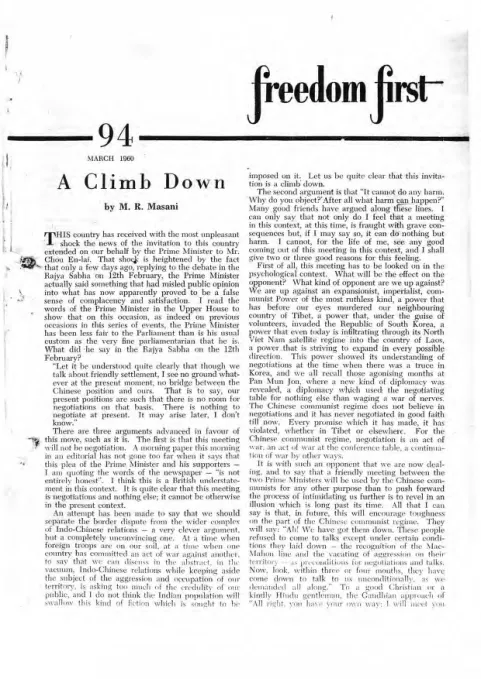
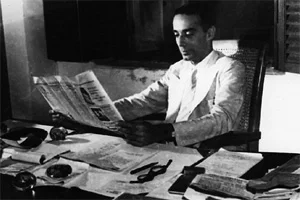
periodical issue
Freedom First
By V. B. Karnik, Saadi, A. K. Menon, S. R. Mohan Das, Rita Hinden, Anand Mohan
published for the Democratic Research Service by B. K. Desai at 127 Mahatma Gandhi Road, Bombay 1; printed at Inland Printers, 55 Gamdevi Road, Bombay 7 · Bombay · 1961
12 pages
Freedom First
Summary
Issue 108 of Freedom First (May 1961), the classical-liberal monthly published by the Democratic Research Service, is a miscellany of editorial commentary on Cold War-era Indian and world politics. Contributors including V. B. Karnik, Saadi, A. K. Menon, S. R. Mohan Das, and the British Fabian sociologist Rita Hinden write on the failed anti-Castro revolt in Cuba, the relative dangers of communism versus communalism in India, the Sixth Congress of the CPI at Vijayawada, the parliamentary defence debate centred on criticism of Defence Minister V. K. Krishna Menon, and the fragility of democracy in newly independent states. Unsigned notes cover de Gaulle’s suppression of the Algiers generals’ revolt, a new anti-subversion law in Parliament, and press dispatches on the World Peace Council’s Delhi conference, where Chinese delegates clashed with Indian hosts over Tibet and the Sino-Indian border. The issue closes with a review of an International Commission of Jurists report on the rule of law in apartheid South Africa and a ‘With Many Voices’ page of contrasting quotations from public figures on Cuba and Krishna Menon.
Key points
-
V. B. Karnik’s “Revolt In Cuba” argues the failed anti-Castro revolt was led by genuine disillusioned patriots, not a US-organised invasion as Indian commentary suggested.
-
“Saadi“‘s “Communism Versus Communalism” argues communism, not communalism, is India’s greater long-term threat, since it can infiltrate mainstream parties undetected.
-
Notes cover the collapse of the French generals’ revolt in Algeria and Parliament’s new Criminal Law Amendment Bill against subversive propaganda.
-
An unsigned “Without Comment” digest covers the World Peace Council’s Delhi conference, where Chinese delegates clashed with Indian hosts over Tibet.
-
A. K. Menon’s “The Defence Debate” reports Acharya Kripalani’s charge that Krishna Menon built cliques undermining army morale, linking this to General Thimayya’s earlier resignation.
-
S. R. Mohan Das’s “The Sixth Congress of Indian Communists” argues Indian press coverage of the CPI’s Vijayawada Congress misreads its underlying unity behind a Moscow-approved line.
-
Rita Hinden’s “The Odds Against Democracy” engages Seymour Lipset’s thesis that economic development is a precondition for democracy, citing India as a counter-example.
-
A review of the International Commission of Jurists’ report “South Africa and the Rule of Law” catalogues apartheid’s breaches of the Universal Declaration of Human Rights.
Essays
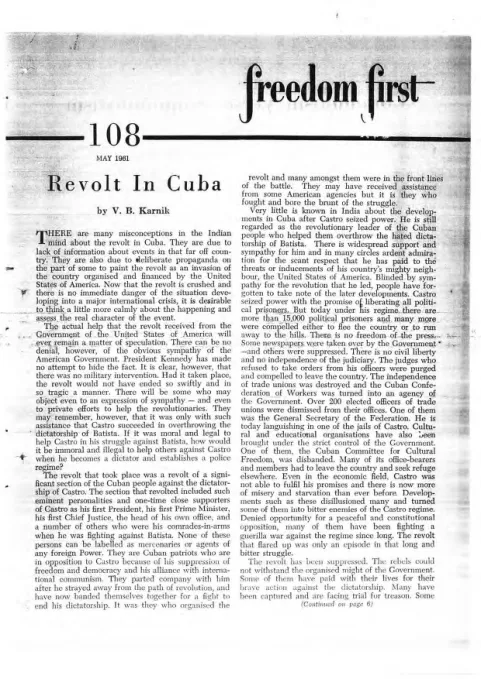
Revolt In Cuba
By V. B. Karnik
V. B. Karnik argues that Indian misconceptions about the Cuban revolt against Castro stem from poor information and deliberate propaganda casting it as a US-organised invasion. He insists the revolt was led by genuine Cuban patriots, including former close allies of Castro, disillusioned by the regime’s suppression of press freedom, judicial independence, and trade unions, and by mounting political imprisonment. Though the revolt failed for lack of external support, Karnik frames it as one episode in a continuing guerrilla struggle against the Castro dictatorship.
- Argues Indian views of the Cuban revolt are distorted by lack of information and propaganda painting it as a US-financed invasion.
- Notes the rebels included Castro’s former President, Prime Minister, Chief Justice and comrades-in-arms.
- Describes suppression under Castro: over 15,000 political prisoners, banned/seized newspapers, purged judges, crushed trade unions.
- States there was no US military intervention despite American sympathy for the revolt.
- Frames the revolt as a single episode in an ongoing struggle against the regime, continued in the hills after suppression.
Communism Versus Communalism
By Saadi
Writing under the pen name ‘Saadi’, the author argues that communism, not communalism, is the greater long-term threat to India’s security and culture, contending that Nehru’s frequent condemnation of communalism distracts from a subtler, more corrosive communist infiltration of institutions. The essay surveys Hindu, Muslim, and Sikh communal currents, argues communalism is waning post-Gandhi’s assassination, and warns that banning communal parties would not root out communism, which can operate through disguise within mainstream parties like Congress and the PSP, citing Kerala as a precedent.
- Argues communalism is a declining, discredited force post-Gandhi’s assassination, while communism is ascendant.
- Identifies three communal currents: Hindu (Hindu Mahasabha), Muslim (Muslim League, Jamiat-e-Islami), Sikh (Akali Dal).
- Warns communists can infiltrate and operate undetected within Congress and the PSP rather than through separate parties.
- Discusses proposed AICC recommendation to ban communal parties and doubts its efficacy against communism.
- Calls for determined, multi-front (political, economic, social, psychological) effort against communism before it becomes unmanageable.
Notes
An unsigned ‘Notes’ section covers two items. ‘De Gaulle Triumphs’ reports the collapse of the French Army generals’ revolt in Algeria against President de Gaulle, crediting de Gaulle’s courage in conceding Algerian self-determination and the loyalty of the French Army and public for averting civil war, and calls for renewed Algerian peace negotiations. ‘Anti-Subversion Law’ welcomes the Criminal Law Amendment Bill passed by Parliament (opposed only by the communists) as a necessary, moderate measure against anti-national propaganda near India’s borders, criticising its exclusion of Jammu and Kashmir as a loophole given Chinese-occupied Ladakh.
- Reports the failure of the French generals’ revolt in Algeria and praises de Gaulle’s handling of decolonisation.
- Argues the Fourth Republic fell from weakness while the Fifth Republic survived due to de Gaulle’s popular support.
- Welcomes the new Criminal Law Amendment Bill against subversive anti-national propaganda, noting only communists opposed it.
- Criticises the Bill’s exclusion of Jammu and Kashmir as inadequate given Chinese activity in Ladakh.
Without Comment
An unsigned ‘Without Comment’ page compiles press dispatches (Hindustan Times, Statesman, Indian Express) on the World Peace Council’s Delhi conference, held after India granted visas to 20 Chinese delegates. Coverage includes a walkout by the Chinese delegation after Minister Humayun Kabir referenced China’s suppression of Tibet during a Tagore centenary event, demonstrations by ex-communist ‘National Association of Marxists’ protesters, the Council’s decision to avoid discussing the Sino-Indian border dispute as not a proper ‘international’ matter, and reports that Nehru had privately urged the Council not to raise the border dispute, a claim contested amid a heated internal Indian-delegation row.
- Chinese delegation walks out of a Tagore centenary function after remarks referencing Tibet.
- Ex-communist demonstrators from the ‘National Association of Marxists’ protest outside the conference venue.
- World Peace Council steering committee decides not to discuss the Sino-Indian border dispute as an ‘international’ issue.
- Press reports allege a ‘tacit understanding’ between Nehru and Pandit Sunder Lal to keep the border dispute off the agenda, which Nehru’s office partially disputes.
- Chinese delegates threaten to walk out again over a Western delegate’s proposed statement on the India-China border dispute.
The Defence Debate
By A. K. Menon
A. K. Menon reviews the acrimonious parliamentary defence debate, arguing that the anger directed at Defence Minister V. K. Krishna Menon reflects widespread distrust of his temperament and ‘pro-communist leanings.’ He details Acharya Kripalani’s charge that Menon built cliques and favoritism in the Army, undermining morale and independence of judgment among officers, and links this discontent to General Thimayya’s earlier resignation. The essay accuses Menon of soft-pedalling the Chinese threat, downplaying army morale problems while claiming credit for improvements, and argues his continuance as Defence Minister endangers India given twin threats of Chinese aggression and internal communist subversion.
- Reports Acharya Kripalani’s charge that Krishna Menon pursued ‘military dictatorship’ via favouritism and cliques in army promotions.
- Notes the Prime Minister defended Menon by ridiculing opposition members rather than addressing the substantive charges.
- Cites General Thimayya’s resignation two years prior and a reported Lieutenant-General’s resignation as evidence of army discontent.
- Criticises Menon for downplaying and being slow to name China as an aggressor despite border incursions.
- Concludes Menon’s pro-communist reputation and mishandling of the Army pose a national security risk alongside Chinese aggression.
The Sixth Congress of Indian Communists
By S. R. Mohan Das
S. R. Mohan Das analyses the Sixth Congress of Indian Communists held at Vijayawada, arguing that Indian press commentary on the CPI has been dominated by wishful, superficial ‘Moscow vs Peking’ faction narratives that misread the party’s underlying unity. He contends the CPI’s factions (‘Nationalist’ pro-Dange and ‘Internationalist’ pro-Ranadive) long predate the Chinese aggression issue and reflect tactical rather than ideological splits, and that the party unanimously endorsed a Moscow-approved line despite the presence of a high-level Soviet delegation led by Comrade Suslov. He notes the CPI’s growing ‘respectable’ image via governing Kerala and warns that the real communist strategy focuses on building a ‘government of National Unity’ with Congress via coalition.
- Criticises Indian press analyses of the CPI Congress as clouded by wishful interpretation and reliance on faction ‘leaks.’
- Identifies the presence of a high-powered Soviet delegation led by Comrade Suslov as historically significant.
- Argues the ‘Nationalist’ (pro-Dange) vs ‘Internationalist’ (pro-Ranadive) factional framing is a simplistic, mistaken lens tied to Chinese aggression.
- Notes the CPI achieved political ‘respectability’ partly through governing Kerala for over two years.
- Warns the CPI’s real strategy is to secure a coalition ‘government of National Unity’ with Congress and other parties.
The Odds Against Democracy
By Rita Hinden
British Fabian sociologist Rita Hinden reflects on the disappointment of post-colonial democracy, noting rising authoritarian arguments among ex-colonial politicians in Pakistan, Ceylon, and Ghana that democratic ‘trappings’ are unaffordable luxuries for poor nations needing strong government. She engages Seymour Lipset’s thesis in Political Man that a threshold of economic development is a near-necessary condition for stable democracy, but rejects economic determinism, arguing India shows democracy can survive on the strength of committed leaders and an intelligentsia trained in parliamentary practice through contact with Britain, despite poverty and Chinese threats on its borders.
- Notes disillusionment among Asian/African leaders with the ‘Westminster model’ beyond the principle of one-man-one-vote.
- Summarises Seymour Lipset’s Political Man thesis that a level of economic development is a near-necessary condition for stable democracy.
- Argues this thesis rests on an economic determinism that discounts the human element—leadership, ideals, and political will.
- Cites India as a counter-example: democracy persisting despite poverty and totalitarian pressure from the Chinese frontier, due to committed leaders and an educated administrative class.
- Criticises Britain for equating democracy solely with one-man-one-vote, neglecting civil liberties, free press, and independent institutions as essential complements.
- Poses the open question of whether India’s apparent democratic resilience can be replicated elsewhere.
Review: South Africa and the Rule of Law
By Anand Mohan
An unsigned review (signed ‘Anand Mohan,’ condensed from Socialist Commentary) covers the International Commission of Jurists’ 1960 report South Africa and the Rule of Law, praising it as timely justification for South Africa’s expulsion from the Commonwealth. It summarises the Commission’s finding that South African law is used as an instrument of oppression rather than a safeguard of rights, cataloguing breaches of the Universal Declaration of Human Rights across racial classification, movement, labour, arrest, expression, assembly, and education. The review argues the UN Charter’s binding force gives more legitimate grounds for South Africa’s expulsion from the UN than from the Commonwealth, whose looser structure imposes no real legal obligations.
- Reviews the International Commission of Jurists’ 1960 report on South Africa’s abuse of the rule of law.
- Defines ‘Rule of Law’ per the Commission as encompassing social, economic, educational and cultural conditions, not just formal legality.
- Lists South African measures found to breach specific articles of the Universal Declaration of Human Rights (racial classification, movement, labour rights, arbitrary arrest, free expression, assembly, education).
- Argues Commonwealth membership carries no binding legal obligations, unlike UN Charter membership, making expulsion from the UN the more legally coherent remedy.
- Calls on the legal community to use the report to press for enforcement against South Africa or seek its expulsion from the UN.
Generated by the v1.5 extraction pipeline. Awaiting editorial review.
Metadata and summary are AI-extracted from the source PDF and reviewed for editorial accuracy. The original work is available via the Read PDF tab above (where present); paragraph-level citation inside the PDF is deferred to a future engagement.