periodical issue
Freedom First
By M. P. Chitale, G. L. Mehta, A. G. Mulgaonkar, Adam Adil, J. Mieroszewski, JUNIUS
published for the Democratic Research Service by Adam Adil at 127 Mahatma Gandhi Road, Bombay 1 · Bombay · 1964
12 pages
Freedom First
Summary
Issue 143 of Freedom First (April 1964) is the Bombay-based classical-liberal monthly’s take on a mix of domestic economic policy, foreign affairs, and Cold War geopolitics, closing with the magazine’s regular “With Many Voices” column of quoted press clippings. M. P. Chitale opens with a sharp critique of the 1964-65 Union Budget’s tax burden on productive and entrepreneurial activity, arguing that rising income-tax, corporation-tax and super-tax rates on private and public limited companies discourage saving, investment, and self-employment. G. L. Mehta reflects on the aftermath of the 1962 border war with China, urging Indians to build national strength through self-reliance rather than foreign aid or fatalism. A. G. Mulgaonkar argues for opening pre-1947 government records to historians, contending India’s 50-year secrecy convention (borrowed uncritically from Britain’s Public Record Act) serves no purpose given that free India’s history only begins in 1947. Adam Adil documents the suppression of Islam and Muslim institutions under Chinese Communist rule (banned waqfs, forced script changes, banned religious instruction), citing Rafiq Khan and a Djakarta interview with Dr. Shaikh Jalaluddin. J. Mieroszewski’s essay, reprinted from the Polish monthly Kultura, analyzes the Sino-Soviet territorial and ideological rift from a Polish nationalist vantage point, arguing a strong, anti-Russian China serves Polish interests against Soviet domination. An unsigned (byline “Junius”) book review covers C. L. Sareen’s U.S.S.R. vs. Tarasov, recounting the 1963-64 Calcutta/Delhi legal battle over a defecting Soviet sailor and the Soviet Union’s failed attempt to use fabricated evidence to reclaim custody of him through Indian courts, with commentary from Justice G. D. Khosla’s preface. The issue closes with “With Many Voices,” a page of quoted aphorisms and remarks on politics, communism, and democracy drawn from contemporary Indian and international press.
Key points
-
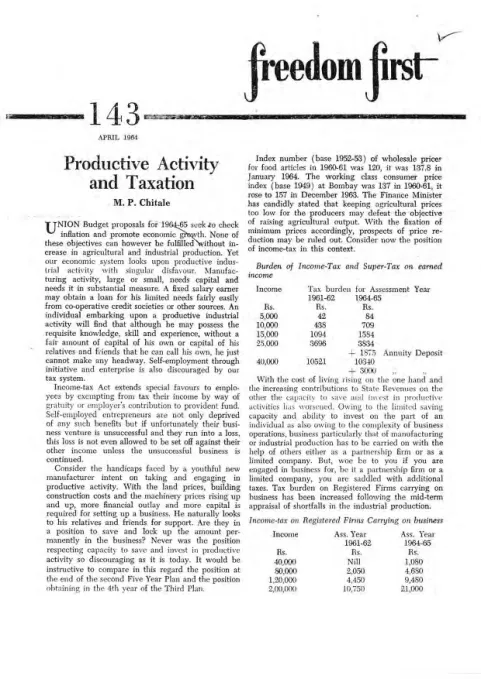
M. P. Chitale’s “Productive Activity and Taxation” argues the 1964-65 Union Budget penalises entrepreneurship, showing corporation tax on closely-held companies rising to 54-60% and new taxes on bonus shares and dividends choking the flow of savings into equity investment.
-
G. L. Mehta’s “Defence And Development” argues the 1962 Chinese invasion should have galvanised lasting national self-reliance rather than a fading emergency mood, criticising India’s growing dependence on foreign aid, which rose from about 10% of Plan outlay in the First Plan to nearly 30% in the Third.
-
A. G. Mulgaonkar’s “Access To Government Documents” argues India needlessly borrowed Britain’s 50-year secrecy rule for government records despite having no domestic Act requiring it, and calls for opening pre-1947 archives to historians before personal reminiscences are lost.
-
Adam Adil’s “Condition Of Muslims In China” documents the abolition of Muslim waqf properties, the forced replacement of Arabic with Cyrillic script, and banned Quranic instruction under Chinese Communist rule, citing continuing armed Muslim resistance in Sinkiang and criticising Pakistan’s alignment with Peking.
-
J. Mieroszewski’s “Russia And China—A Polish View,” reprinted from the Polish monthly Kultura, argues Poland’s national interest favours a strong, anti-Russian China as a counterweight to Soviet imperial dominance, framing the Sino-Soviet split as a historical-territorial dispute rather than a purely ideological one.
-
A review signed “Junius” of C. L. Sareen’s “U.S.S.R. vs. Tarasov” recounts a defecting Soviet sailor’s legal battle in Indian courts, praising the magistrates’ rejection of fabricated Soviet evidence as a vindication of Indian judicial independence against Soviet pressure.
Essays
Productive Activity and Taxation
By M. P. Chitale
M. P. Chitale’s “Productive Activity and Taxation” argues that the Union Budget for 1964-65 penalizes productive economic activity and entrepreneurship. Salaried employees enjoy tax-free provident fund benefits and job security, while self-employed manufacturers face rising land, construction and machinery costs alongside steep income-tax, corporation-tax and super-tax increases. The piece includes tables comparing tax burden on earned income and on registered firms between assessment years 1961-62 and 1964-65, and argues that new taxes on bonus shares and dividends will choke the flow of savings into equity investment, disadvantaging young entrepreneurs and small/medium enterprises.
- The 1964-65 Union Budget increases income-tax, corporation-tax, and super-tax burdens sharply compared to 1961-62.
- Self-employed and entrepreneurial taxpayers are structurally disadvantaged relative to salaried employees, who get tax-free provident fund and gratuity benefits.
- Corporation tax on private and closely-held public companies rises to 54-60 percent depending on the nature of manufacturing activity.
- A new super-tax of 7.5 percent applies to distributed dividends, and bonus shares are now taxed as short-term capital gains even before sale.
- More than 80 percent of corporations are closely held, and many represent small and medium enterprises drawing capital from less affluent investors.
- The article concludes that taxation policy favors salaried people and discourages independent enterprise, converting entrepreneurs into salary-seekers.
Defence And Development
By G. L. Mehta
G. L. Mehta’s “Defence And Development” reflects on the shock of the October 1962 Chinese invasion and argues it should have galvanized lasting national resolve, discipline, and self-reliance rather than a fading sense of emergency. He criticizes India’s growing dependence on foreign aid (up from 10 percent of outlay in the First Plan to nearly 30 percent in the Third), invokes Shakespeare and Robert Frost to argue that India’s fate lies in its own hands, and closes with a paraphrase of President Kennedy urging citizens to ask what they can do for their country.
- The October 1962 Chinese invasion shattered assumptions about the Himalayas as a natural defensive barrier and exposed the need for sustained national vigilance.
- The initial surge of patriotic unity after the invasion was not sustained into durable policy or a national sense of urgency.
- India’s reliance on foreign aid has grown from about 10 percent of Plan outlay in the First Plan to nearly 30 percent in the Third Plan.
- Mehta argues national strength depends on collective self-discipline, honesty, and effort rather than external circumstances or fate.
- The essay closes by quoting Robert Frost’s lines on self-withholding and paraphrasing President Kennedy’s inaugural call to civic duty.
Access To Government Documents
By A. G. Mulgaonkar
A. G. Mulgaonkar’s “Access To Government Documents” argues that India has needlessly borrowed Britain’s 50-year secrecy rule for Cabinet papers under the Public Record Act 1958, even though no such Act exists in India and free India’s history only begins in 1947. He contends historians and students should have full access to pre-1947 records held by Central and State Governments, and that even 1947 is an arbitrary cutoff, since withholding transfer-of-power-era material risks losing valuable historical evidence and personal reminiscences before they disappear.
- India has adopted the UK’s 50-year secrecy convention for government records despite having no equivalent domestic Act mandating it.
- The transfer-of-power period (1945 onward) is the most historically significant and least accessible era of modern Indian history.
- Access to Government of India records on this period is currently possible only through White Papers or by special permission.
- Mulgaonkar argues that opening these records now would let historians capture personal reminiscences and material that will otherwise be lost with time.
- He frames history-writing as a science requiring precision, contrasting reliable scholarship with history ‘as the propaganda of the victors.‘
Condition Of Muslims In China
By Adam Adil
Adam Adil’s “Condition Of Muslims In China” documents systematic Chinese Communist suppression of Islam, describing the abolition of waqf trust properties, the replacement of Arabic script with Cyrillic in Muslim regions like Sinkiang and Kansu, bans on Quranic instruction, forced abandonment of Islamic customs including circumcision, and communist indoctrination of Muslim children. Drawing on Rafiq Khan’s book Islam in China and a 1956 interview with Indonesian delegate Dr. Shaikh Jalaluddin, the piece estimates China’s Muslim population at nearly fifty million, notes armed Muslim resistance in Sinkiang led by figures such as Usman Khan Batur, Ma Ying, and Ma Hu-Shan, and criticizes Pakistan for tolerating Chinese persecution of Muslims despite its own claim to be a leading Muslim nation.
- Chinese Communist authorities have abolished Muslim waqf trust properties and banned the Zakat, cutting off the economic base of Muslim religious and educational institutions.
- Cyrillic script has been imposed in place of Arabic script in Muslim-majority regions such as Sinkiang and Kansu.
- Quranic instruction is banned even in Muslim schools, and children are subjected to communist indoctrination instead.
- China’s Muslim population is estimated at nearly fifty million, concentrated in Sinkiang, Szechwan, Kansu, and Tsinghai among other regions.
- Armed Muslim resistance to Communist rule has continued in regions like Sinkiang, led by figures including Usman Khan Batur, Ma Ying, and Ma Hu-Shan.
- The article criticizes Pakistan for its diplomatic alignment with Communist China despite the persecution of Chinese Muslims.
Russia And China—A Polish View
By J. Mieroszewski
J. Mieroszewski’s “Russia And China—A Polish View,” reprinted from the Polish monthly Kultura (March 1964), analyzes the Sino-Soviet split from the standpoint of Polish national interest. He argues China’s rise as a united, nationalist power would inevitably make it Russia’s rival regardless of ideology, and that Poland’s interest lies in a strong, anti-Russian China that could destabilize Soviet imperial control over Eastern Europe. Drawing heavily on J. Fryling’s documentation of Chinese claims to territories lost to Tsarist Russia (Tashkent, the Central Asian territories, Outer Mongolia, Sinkiang, Siberian coastal areas, Sakhalin, and more under 19th-century “un-even treaties”), the essay contends that the China-Russia conflict is a historical-national-territorial dispute, not merely an ideological one, and that Chinese nationalism could eventually split the Soviet bloc from within.
- Mieroszewski argues Poland’s national interest favors a strong, anti-Russian China as a counterweight to Soviet imperial dominance.
- He cites J. Fryling’s book ‘A Conflict in the Himalayas’ documenting historical Chinese territorial claims against Russia dating to 19th-century treaties (Aigun 1858, Peking 1860, Illi 1881).
- China’s split from Moscow is framed as fundamentally a historical-national-territorial conflict, not solely an ideological one.
- The essay argues the Chinese communist leadership’s advanced age (around 70) suggests a coming generational shift and possible change in China’s foreign policy tactics.
- China is described as the only country positioned to split the Soviet empire from within, but Mieroszewski argues this ‘trump card’ should be played in Moscow, not Peking.
Review: U.S.S.R. vs. Tarasov
By Junius
An unsigned review (signed “Junius”) of C. L. Sareen’s book U.S.S.R. vs. Tarasov recounts the 1963-64 legal saga of a Soviet sailor, Tarasov, who defected in Calcutta harbour and was pursued through Indian courts by Soviet authorities on fabricated theft charges, actually intending to try him for treason. The review praises the Calcutta Magistrate’s acquittal of Tarasov and Delhi Sub-Divisional Magistrate N. L. Kakkar’s later judgment rejecting Soviet evidence as false and fabricated, framing the case as a vindication of Indian judicial independence against Soviet pressure, and quotes Justice G. D. Khosla’s preface describing the trial as showing ‘ruthless discrimination and complete disregard for truth and forensic ethics.’
- Tarasov, a Soviet sailor, defected from his ship in Calcutta harbour and sought asylum aboard an American vessel; Soviet authorities accused him of theft of Rs. 700.
- A Calcutta Magistrate acquitted Tarasov, but he was immediately re-arrested for extradition proceedings sought by the Soviet Union.
- Delhi Sub-Divisional Magistrate N. L. Kakkar ultimately rejected the Soviet evidence as fabricated and false, and Tarasov was freed.
- The review argues the case set a precedent as the first time the Soviet Union sought to regain custody of a defector through a foreign court of law.
- Justice G. D. Khosla’s preface to the book is quoted describing the trial as demonstrating Soviet ‘ruthless discrimination and complete disregard for truth and forensic ethics.’
- The review frames the episode as a vindication of the independence of India’s judiciary despite pressure from a great power.
Generated by the v1.5 extraction pipeline. Awaiting editorial review.
Metadata and summary are AI-extracted from the source PDF and reviewed for editorial accuracy. The original work is available via the Read PDF tab above (where present); paragraph-level citation inside the PDF is deferred to a future engagement.