periodical issue
Freedom First
By V. B. Karnik, M. R. Hazaray, Dilip Chitre, S. H. Deshpande
Printed at Inland Printers, 55 Gamdevi Road, Bombay 7 and Edited and published for the Democratic Research Service by V. B. Karnik at 127 Mahatma Gandhi Road, Bombay 1. · Bombay · 1968
12 pages
Freedom First
Summary
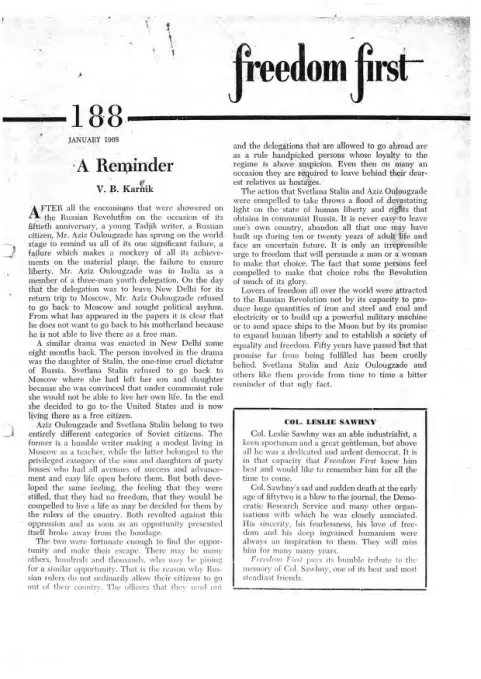
Freedom First No. 188 (January 1968) is a special issue given over almost entirely to a retrospective reckoning of the Bolshevik Revolution on its fiftieth anniversary. V. B. Karnik’s opening editorial “A Reminder” uses the defections of Svetlana Stalin and the Tadjik writer Aziz Oulougzade to argue that fifty years of Soviet rule have failed to deliver the liberty the Revolution promised, alongside a short obituary tribute to Col. Leslie Sawhny. The rest of the issue assembles multiple perspectives on Soviet life and the Revolution’s record: a digest of foreign press commentary (“Russia From Many Angles”), Dilip Chitre’s essay on the persecution and psychological bind of Soviet writers (“Creativity In Crisis: Russian Story”), S. H. Deshpande’s data-driven survey of income inequality and class privilege in Soviet society (“Equality In Soviet Life”), and a reprinted U.S. News & World Report balance sheet tallying the Revolution’s fifty-year economic, military and social record. A separate domestic-affairs piece, M. R. Hazaray’s “Death Of Fourth Plan,” indicts India’s Planning Commission for the abandonment of the Fourth Five Year Plan. The issue closes with “With Many Voices,” a compilation of press quotations on Indian politics and economics from late 1967.
Key points
-
V. B. Karnik’s “A Reminder” uses the defections of young Tadjik writer Aziz Oulougzade and, earlier, Svetlana Stalin to argue that fifty years of Soviet rule have failed to deliver the liberty the Revolution promised, showing the yearning for freedom cuts across Soviet class lines.
-
M. R. Hazaray’s “Death Of Fourth Plan” blames the Planning Commission’s own “doctrinaire dogmatists” for the Fourth Plan’s collapse, tracing outlays rising from Rs. 3,360 crores in the First Plan to a targeted Rs. 21,350 crores, alongside unemployment backlogs rising from 5.3 to 25 million.
-
“Russia From Many Angles” compiles foreign press commentary marking the Revolution’s fiftieth anniversary, including Louis Fischer on Russia’s nationalist turn and a New York Times catalogue of Stalin’s purges of Red Army officers.
-
Dilip Chitre’s “Creativity In Crisis: Russian Story” argues Soviet writers under persecution, from Pasternak to Sinyavsky and Voznesensky, achieve a moral and creative intensity unmatched by Western “alienated” avant-gardes, and warns Indian writers against romanticising revolutionary mythology.
-
S. H. Deshpande’s “Equality In Soviet Life” reconstructs Soviet income distribution from Western scholarship, tracing a hierarchy from a wealthy elite of artists and top officials down to forced-labour camp inmates estimated at several million under Stalin, and finds inequality has gradually narrowed since 1957.
-
A reprint from U.S. News & World Report, “Russian Revolution—A Balance Sheet,” tallies the Revolution’s fifty-year record, crediting the USSR with rising to second in world economic output and 95% literacy while estimating war, terror and famine cost the population 80 million relative to trend.
-
The closing “With Many Voices” column quotes Frank Moraes observing that “Communism is no longer a monolith” and C. Rajagopalachari on majority rule not being equivalent to democracy.
Essays
A Reminder
By V. B. Karnik
V. B. Karnik’s editorial “A Reminder” opens by noting the defection of young Tadjik writer Aziz Oulougzade, who sought political asylum rather than return to Moscow after a youth delegation’s visit to New Delhi, and draws a parallel with Svetlana Stalin’s earlier defection to the United States. Karnik argues both cases expose the gap between the Soviet regime’s fiftieth-anniversary self-congratulation and the reality of restricted liberty for its citizens, contrasting Oulougzade’s humble situation with Svetlana Stalin’s privileged one to show that the yearning for freedom cuts across Soviet class lines. The same page carries a short unsigned tribute to the late Col. Leslie Sawhny, an industrialist and ‘dedicated and ardent democrat’ associated with the Democratic Research Service, whom the journal mourns as a steadfast friend.
- Aziz Oulougzade, a young Tadjik writer visiting India with a youth delegation, refused to return to Moscow and sought political asylum.
- Svetlana Stalin’s earlier defection and choice to live in the United States is presented as a parallel case.
- Karnik argues that both defectors, despite belonging to very different social strata, were driven by the same ‘irrepressible urge to freedom.’
- The Soviet state’s practice of vetting delegation members and holding back relatives as hostages is cited as evidence of restricted liberty.
- Karnik contends the Revolution’s fiftieth-anniversary celebrations ring hollow given its failure to expand liberty and equality as promised.
- A companion notice mourns Col. Leslie Sawhny, an industrialist and democrat associated with the Democratic Research Service.
Death Of Fourth Plan
By M. R. Hazaray
M. R. Hazaray’s “Death Of Fourth Plan” is a polemical post-mortem on the abandonment of India’s Fourth Five Year Plan, laying blame on ‘doctrinaire dogmatists’ among the Planning Commission’s economists. Hazaray traces the escalating scale of successive Five Year Plans from the modest First Plan through the massively enlarged Fourth Plan outlay, arguing that the plans’ ever-growing size, rising deficit financing, heavier taxation, unchecked population growth, and the devaluation crisis combined to make the Fourth Plan unsustainable. He presents a table of public-sector, private-sector and total outlays across the four plans and concludes that Indian planning has failed precisely where it should have succeeded and ‘succeeded’ only in producing unemployment, inflation and economic distortion.
- Argues the Fourth Plan was killed by planners’ own doctrinaire excess in scale rather than by external shocks alone.
- Traces plan outlays rising from Rs. 3,360 crores (First Plan, 1951-56) to a targeted Rs. 21,350 crores (Fourth Plan, 1966-71).
- Cites growing deficit financing, from Rs. 532 crores in the First Plan to a targeted Rs. 1,150 crores in the Third Plan.
- Blames the devaluation crisis and two drought years for wrecking the Fourth Plan’s prospects.
- Reports unemployment backlogs rising from 5.3 million to 25 million by the start of the Fourth Plan.
- Notes food production rose from 50 million to 100 million tons and the industrial index from 74 to 190 (1956=100), but calls the gains disproportionate to the economy’s distortions.
Russia From Many Angles
“Russia From Many Angles” is an unsigned compilation of extracts from the international press marking the Revolution’s fiftieth anniversary, gathered under subheadings including ‘Another Imperialism,’ ‘Stalin’s Purges,’ ‘Second Revolution,’ ‘Stick To Simple Things,’ and ‘Quality Of Life.’ Excerpted writers include Louis Fischer (Los Angeles Times) on Russia’s nationalist turn and the arrests of Red Army officers under Stalin’s purges; a Time magazine retrospective calling the Soviet system’s cost ‘huge’ in human terms while noting the current leadership’s cautious pragmatism; an Economist letter urging observers to judge the USSR by its lack of basic human dignities like objective law and freedom of discussion; and an Economist correspondent’s account of persistent shortages, queues, and improved but still constrained living standards under the post-Stalin leadership.
- Louis Fischer (Los Angeles Times) argues Russia has become a nationalist, imperialist power rather than an internationalist one, citing the Sino-Soviet and Cuban rifts.
- A New York Times excerpt catalogues the scale of Stalin’s purges of the 1930s, including the arrest or execution of one-third to one-half of 75,000 Red Army officers.
- Time magazine’s retrospective credits the USSR with becoming the world’s second industrial power but stresses the immense human cost of terror, forced labour, and collectivization.
- An Economist letter urges readers to judge Soviet Russia by its lack of ‘objective law, logic, freedom of discussion’ rather than by propaganda symbolism.
- The Economist’s ‘Quality Of Life’ piece describes improved but still austere living conditions, marked by persistent queues and shortages fifty years on.
Creativity In Crisis: Russian Story
By Dilip Chitre
Dilip Chitre’s “Creativity In Crisis: Russian Story” argues that Soviet writers’ endurance of persecution has produced a moral and creative intensity unmatched by Western ‘alienated’ avant-gardes, contrasting the fates of Boris Pasternak, Andrei Sinyavsky, and younger poets like Yevgeny Yevtushenko and Andrei Voznesensky with the comparatively cheap alienation available to writers in affluent democracies. Chitre analyses a generation of Soviet poets born after the Revolution — Voznesensky, Yevtushenko, Bella Akhmadulina, Yevgeny Vinokurov — dividing them into declamatory, Mayakovsky-descended types versus a quieter, more introspective type, and treats Voznesensky as a symbol of the Soviet creative mind trapped between the roles of Communist prophet-poet and traitor-martyr. The essay closes (continued on page 10, not included in this excerpt’s page range but referenced) by turning to the implications for Indian writers who romanticize revolutionary mythology.
- Argues Soviet writers under persecution achieve a moral dignity in their alienation that Western avant-gardes, whose alienation is more a matter of cultivation, cannot match.
- Cites Pasternak’s persecution and the cases of Sinyavsky and Daniel as emblematic of the ‘monstrous machinery’ constraining Soviet creative vision.
- Surveys the post-Revolutionary generation of Soviet poets — Voznesensky, Yevtushenko, Akhmadulina, Vinokurov — dividing them into declamatory/Mayakovsky-type versus introspective/condensed-depth type.
- Treats Voznesensky as symbolic of the Soviet creative mind: forced to play either the Communist prophet-poet or the rebel-martyr, with no free middle ground.
- Turns toward the close to a warning about Indian writers who romanticize the Russian Revolution’s mythology of bloodshed and rebirth.
Equality In Soviet Life
By S. H. Deshpande
S. H. Deshpande’s “Equality In Soviet Life” attempts a qualitative reconstruction of income distribution in the Soviet Union, cautioning that the USSR’s refusal to publish income data forces reliance on Western scholarship and impressionistic accounts. Drawing on John Gunther’s Inside Russia, Milovan Djilas, and Abram Bergson’s wage studies, Deshpande sketches a hierarchy running from a small class of extremely wealthy artists, intellectuals and top Party/Government officials, through ‘salaried employees’ and ‘wage earners,’ down to the forced-labour camp inmates whose numbers Deshpande estimates (via Swianiewicz, Jasny and others) at several million during the Stalin era. He tracks shifting policy on wage equality across Soviet history (from the 1919 push for equality through the 1931 condemnation of ‘equalitarianism’ by Stalin to a renewed narrowing of inequality after 1957), and the persistent rural-urban income gap, concluding that inequality was sharpest under Stalin and has since been gradually reduced, though a privileged ‘class’ of top officials, managers and celebrated intellectuals persists into the present.
- The Soviet Union does not publish income distribution data, forcing analysts to rely on qualitative Western scholarship.
- The wealthiest Soviet citizens have consistently been successful artists, writers, and top-ranking Party/Government/secret-police officials, per John Gunther’s Inside Russia.
- Abram Bergson’s study finds wage inequality among Soviet wage earners was ‘distinctly less’ in 1928 than in 1914, but rose again after 1931 following Stalin’s condemnation of ‘equalitarianism.’
- Forced labour camp populations are estimated by Swianiewicz at roughly 7 million in 1941, with Jasny giving 3.5 million at Stalin’s death.
- Rural per capita income lagged urban income substantially throughout the Soviet period (37% of urban levels in 1928, 31.5% in 1956, per Jasny).
- Post-1957 reforms — minimum wage increases, tax abolitions on low incomes — mark a move toward greater equality among lower-paid workers.
- State farm (sovkhoz) workers earn guaranteed wages as government employees, unlike collective farm (kolkhoz) workers who share farm output after compulsory deliveries and deductions.
Russian Revolution-A Balance Sheet
By U. S. News & World Report, November 6, 1967 (reprint)
“Russian Revolution-A Balance Sheet,” reprinted from U.S. News & World Report (November 6, 1967), tallies the Bolshevik Revolution’s fifty-year record across economic, demographic, military and social dimensions. It credits the USSR with rising to second rank globally in economic output, near-universal literacy, and industrial growth, while noting Soviet per-capita output trails around twentieth in the world, agriculture remains chronically inefficient, and population losses from war, terror, and famine may total 80 million relative to trend. The piece surveys internal pressures — a younger generation indifferent to ideology, rising crime and alcoholism, a cultural revolt among intellectuals demanding freedom of expression, and a religious revival — alongside external pressures, including expansionist Soviet military policy in Latin America, the Middle East, and Vietnam, and the widening Sino-Soviet rift, concluding that Communist bloc fragmentation changes rather than removes the global threat it poses.
- Soviet economic output has risen from fifth in the world in 1917 to second (after the U.S.), though per-capita output ranks only around twentieth globally.
- Western demographers estimate the USSR would have 80 million more people today but for deaths and lowered birth rates from war, terror, famine and pestilence.
- Literacy rose from about 40% at the time of the Revolution to 95% today, credited as a genuine achievement despite Marxist censorship of academic freedom.
- Half the Soviet population is 26 or younger and largely indifferent to Communist ideology; alcoholism, vandalism and ‘hooliganism’ have risen sharply.
- A cultural revolt among writers, artists, scientists and educators demands greater freedom of expression; banned works circulate clandestinely.
- Soviet military spending is rising sharply (a 15% increase announced for 1968) with expansionist policy aimed at Latin America, the Middle East, and countering Chinese influence in Asia.
- The Communist bloc is fragmenting, with Red China now considered the Kremlin’s principal rival rather than its closest ally.
With Many Voices
“With Many Voices” is the issue’s closing feature, a compilation of quotations from the Indian and international press through December 1967 on Indian politics, economics and language policy, framed by an epigraph from Tennyson. Quoted sources include C. Rajagopalachari on majority rule versus democracy and on English language and Indian unity, Frank Moraes on Communism’s loss of monolithic unity, Indira Gandhi on democratic conventions, Y. B. Chavan on the politics of the street versus democracy, and commentary on the collapse of the Ajoy Mukherjee ministry in West Bengal, alongside a subscription notice for Freedom First.
- Assembles short press quotations from Manchester Guardian Weekly, Hindustan Standard, Weekend Review, Indian Express, Swarajya, The Hindu, Economic and Political Weekly, Times of India, Thought, and The Economic Times, dated November-December 1967.
- C. Rajagopalachari is quoted twice: on majority rule not being equivalent to democracy, and on the English language’s link to Indian unity.
- Frank Moraes is quoted observing that ‘Communism is no longer a monolith.’
- Indira Gandhi and Y. B. Chavan are both quoted on the nature of Indian democratic practice and street politics.
- Commentary addresses the removal of the Ajoy Mukherjee ministry in West Bengal and Communist exploitation of democratic processes.
- The page carries the journal’s subscription coupon (Rs. 3.00 annual) addressed to Freedom First, c/o Democratic Research Service, Mahatma Gandhi Road, Bombay.
Generated by the v1.5 extraction pipeline. Awaiting editorial review.
Metadata and summary are AI-extracted from the source PDF and reviewed for editorial accuracy. The original work is available via the Read PDF tab above (where present); paragraph-level citation inside the PDF is deferred to a future engagement.