periodical issue
Freedom First
By M. R. Pai
Edited and published for the Democratic Research Service by V. B. Karnik at 127 Mahatma Gandhi Road, Bombay 1, and printed by him at Inland Printers, 55 Gamdevi Road, Bombay 7. · Bombay · 1970
12 pages
Freedom First
Summary
Issue 219 of Freedom First (August 1970) is a monthly opinion periodical of the Bombay-based classical-liberal Democratic Research Service, edited and published by V. B. Karnik. This issue opens with an unsigned lead essay by “Atreya” welcoming the Congress (O)-Swatantra-Jana Sangh “Grand Alliance” consolidation move as a defensive response to Indira Gandhi’s tilt toward the CPI and Soviet influence. An unsigned “Notes” section comments on Madame Binh’s official visit to India, the CPI’s “land grab” movement, coloured immigration policy in Britain, and Marxist tactical inconsistency on election timing. M. R. Pai contributes an essay praising West Germany’s Social Market Economy as a model of state-supported (but non-interventionist) free enterprise applicable to India. An “Analyst” column titled “President’s Rule” assesses four months of central rule in West Bengal, describing a fragile order propped up by police and CRP force amid Naxalite violence and CPM manoeuvring. G. L. Mathur’s “National Integration” argues that India’s fragmentation into caste, communal, and regional loyalties (contrasted with a more cohesive American civic spirit) blocks genuine national integration, and calls for encouraging inter-caste and inter-communal marriage. B. N. Datar reviews Murarji J. Vaidya’s posthumous essay collection Objectives of Planning in India, characterising it as a free-enterprise critique of Indian planning that is candid but one-sided. The issue closes with “With Many Voices,” a compilation of quotations from the press on Indira Gandhi’s rule, Naxalism, and Cold War alignment, followed by the subscription form and imprint.
Key points
-
Writing as “Atreya,” “Prospects for Political Consolidation” welcomes the AICC(O)‘s resolution to consolidate “like-minded” parties into a Grand Alliance of Congress(O), Swatantra, Jana Sangh and B.K.D. against a perceived Congress-CPI-Moscow axis.
-
The “Notes” section criticises the Government for hosting NLF representative Madame Binh as an official guest and condemns the CPI’s “land grab” movement as a lawless stunt lacking any real redistribution machinery.
-
M. R. Pai’s “Social Market Economy” argues India could adapt West Germany’s postwar Social Market Economy philosophy of Walter Eucken and Ludwig Erhard, which combines market competition with state anti-monopoly enforcement while avoiding central planning.
-
Writing as “Analyst,” “President’s Rule” assesses over four months of central rule in West Bengal, citing roughly six thousand Naxalite arrests and Durgapur production running at only 10% capacity under trade-union stranglehold.
-
G. L. Mathur’s “National Integration” contrasts Indian societal fragmentation with American civic solidarity and proposes state-incentivised inter-caste and inter-communal marriage, citing the Prime Minister’s son’s marriage to an Italian woman.
-
B. N. Datar reviews Murarji J. Vaidya’s posthumous Objectives of Planning in India, characterising it as a candid but one-sided free-enterprise critique of Indian planning.
-
The closing “With Many Voices” column quotes D. F. Karaka warning India is “virtually becoming a colony controlled from Moscow.”
Essays
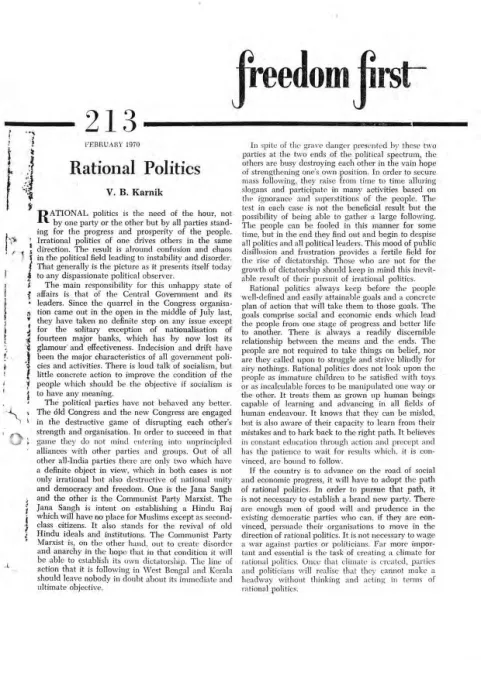
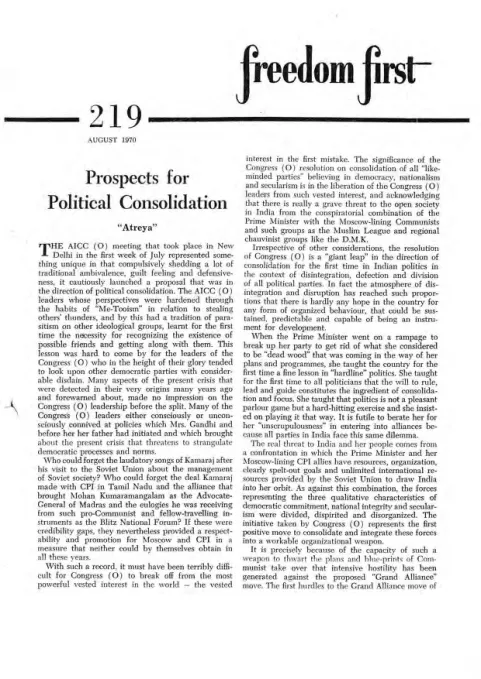
Prospects for Political Consolidation
By “Atreya”
Writing under the pseudonym “Atreya,” the author welcomes the AICC (O)‘s early-July resolution calling for consolidation of “like-minded” democratic, national, and secular parties as a historic break from Congress (O)‘s past habit of ideological free-riding. The essay credits Indira Gandhi’s ruthless intra-party purges with teaching all Indian politicians that governance requires a clear will to lead, and frames the emerging Grand Alliance of Congress (O), Swatantra, Jana Sangh, and B.K.D. as the first serious counterweight to what it calls a conspiratorial alignment between the Prime Minister, Moscow-aligned Communists, the Muslim League, and the DMK. It surveys the Swatantra convention’s endorsement (via Rajaji) and the Jana Sangh convention’s parallel resolution as evidence the alliance is more than an academic proposal, while noting the likely lukewarm response from the PSP and SSP.
- AICC (O)‘s July 1970 resolution proposes consolidating democratic, national, and secular parties against a perceived Congress-CPI-Moscow axis.
- The essay frames past Congress (O) leaders as historically parasitic on other groups’ ideas (“Me-Tooism”) and credits the crisis with forcing a change.
- Indira Gandhi is credited, if backhandedly, with teaching Indian politicians that politics requires hardline resolve rather than parlour-game civility.
- Swatantra (via Rajaji at its Madras convention) and the Jana Sangh have both passed resolutions endorsing the Grand Alliance idea.
- The essay expects the PSP and SSP to respond coolly, since PSP reportedly prefers the Prime Minister to the ‘reactionaries.‘
Notes (Welcome, Madame Binh! / “Land Grab” Movement / Coloured Immigration in U.K. / Marxist Logic / Books Received)
This unsigned “Notes” section covers four short topics. It criticises the Government of India for hosting Madame Binh (representative of South Vietnam’s National Liberation Front) as an official state guest, arguing this improperly involves India in another country’s internal affair and lends unwarranted legitimacy to a rebel movement. It condemns the CPI’s newly launched “land grab” movement as a lawless, unconstructive stunt that ignores the practical machinery needed for real land redistribution, and criticises the SSP-PSP’s parallel civil disobedience campaign in similarly harsh terms. A third item welcomes new British Prime Minister Edward Heath’s assurance of equal treatment for existing Commonwealth immigrants while endorsing continued restriction of new immigration as a legitimate exercise of national sovereignty. A closing item, “Marxist Logic,” mocks Bengal’s Marxist Communists for demanding an early election in West Bengal while opposing one in Kerala, attributing the inconsistency to naked tactical opportunism. A “Books Received” list closes the section.
- Criticises the Government of India for extending official-guest status to Madame Binh of the NLF/North Vietnam government, calling it improper interference in Vietnam’s internal affairs.
- Condemns the CPI’s ‘land grab’ movement as lacking any real plan for land allocation, inputs, or credit, and calls it a naked exploitation of rural unrest.
- Also criticises the SSP-PSP joint civil disobedience movement as an ill-considered, attention-seeking parallel campaign.
- Welcomes UK PM Edward Heath’s pledge of equal treatment for settled immigrants alongside continued restriction on new immigration.
- Accuses Marxist Communists of applying contradictory logic: demanding early elections in West Bengal while blocking them in Kerala.
Social Market Economy
By M. R. Pai
M. R. Pai argues that India’s economic troubles could be addressed by adapting West Germany’s postwar “Social Market Economy” philosophy, associated with Walter Eucken and Ludwig Erhard. He distinguishes it sharply from 19th-century laissez faire, describing it as a system combining individual and collective market activity with state responsibility for anti-cyclical policy, competition enforcement, infrastructure provision, and social justice, while explicitly avoiding central planning or state ownership of enterprises. Drawing on data on Germany’s postwar recovery (falling work-hours-to-purchase ratios for staples, rising per capita income, near-full employment), Pai attributes German success not to Marshall Aid alone but to this policy framework, and closes by arguing the model is flexible enough to be adapted successfully to India.
- Frames West Germany’s post-WWII recovery as attributable to the Social Market Economy philosophy of Walter Eucken and Ludwig Erhard, not primarily to Marshall Aid.
- Defines the Social Market Economy as combining individual, collective and state market participation with a strong emphasis on preserving competition and social justice.
- The state’s role includes anti-cyclical monetary/fiscal policy, anti-monopoly enforcement, and infrastructure provision — but not central planning or nationalisation.
- Cites concrete statistics: work-hours needed to buy bread, sugar, potatoes, and a car fell sharply in West Germany between 1949 and 1968.
- Concludes that with suitable adaptation, the Social Market Economy model can be applied successfully to India.
President’s Rule (Bengal Report)
By Analyst
Writing as “Analyst” in the recurring “Bengal Report” column, the author assesses over four months of President’s Rule in West Bengal following the collapse of the United Front government. The piece credits the administration with modest, concrete gains — improved police assertiveness, CRP reinforcement, and enacted land reform legislation — but argues these are dwarfed by continuing Naxalite violence, arrests running into the thousands, and deepening economic paralysis from strikes in tea, jute, and engineering, including a crippling stoppage at Durgapur. It describes leftist parties as “biding their time” ahead of a wave of coordinated agitation, doubts the viability of a proposed non-CPM ministry, and closes arguing that only a decisive political intervention — not more amorphous leftist compromise — can pull Bengal back from a drift toward disorder.
- West Bengal has been under President’s Rule for over four months after the United Front government’s internal collapse.
- Concrete gains cited: greater police assertiveness, CRP reinforcement, and enactment of new land reform legislation by presidential signature in mid-July.
- The CPI’s aggressive ‘land grab’ movement has involved several murders and is going largely unchecked by the administration.
- Naxalite arrests have reached roughly six thousand in four months, alongside discoveries of arms-manufacturing sites and alleged China/Pakistan/Mizo links.
- Durgapur production is under trade-union (mainly CPM) stranglehold, running at 10% capacity with a loss of Rs. 1 crore per month.
- The column closes questioning whether Indira Gandhi has the resolve to confront the drift toward disorder rather than pursue an ‘amorphous leftist cocktail.‘
National Integration
By G. L. Mathur
G. L. Mathur’s essay argues that genuine national integration in India requires a change in the mind and character of the people, not merely conferences and pamphleteering. He contrasts India’s fragmentation into castes, communities, and rival political and economic factions with the civic solidarity he attributes to Americans (illustrated by a child’s rescue from a well captivating the whole nation), and blames a wrongheaded notion that flag, constitution, and territory are more sacred than the people themselves. In the continuation on page 11, Mathur extends the critique to what he calls India’s static ‘religious philosophy of acceptance,’ whereby caste and communal codes go unchallenged, and proposes encouraging inter-caste, inter-communal, and international marriage — citing the Prime Minister’s son’s marriage to an Italian as a model — supported by state incentives in employment, promotions, and family planning outreach.
- Argues true national integration requires changed character and mindset, not just conferences and speeches.
- Contrasts Indian societal fragmentation (caste, creed, language, political faction) with American civic solidarity, illustrated by the rescue of a child from a well.
- Blames a wrongheaded reverence for flag, constitution, and territory over the actual wellbeing of citizens.
- Describes Indian society as static due to a ‘religious philosophy of acceptance’ that leaves caste/communal codes unchallenged.
- Recommends state-incentivised inter-caste, inter-communal, and international marriage, citing the Prime Minister’s son’s marriage to an Italian woman as an example, with Family Planning Ministry support.
Review: Objectives of Planning in India (Murarji J. Vaidya, Popular Prakashan, Bombay, Rs. 15)
By B. N. Datar
B. N. Datar reviews Objectives of Planning in India (Popular Prakashan), a posthumous collection of writings and lectures by Murarji J. Vaidya, longtime President of the All India Manufacturers’ Organisation. The review characterises Vaidya as an avowed free-enterprise advocate whose recurring argument is that Indian planning has under-delivered relative to what freer private enterprise could have achieved, while acknowledging fair industrial progress since Independence. Datar finds the book’s cross-country comparisons sometimes strained given differing political and social contexts, and notes that Vaidya’s criticisms of taxation policy and small-industry protection, while representative of business opinion, are not always backed by empirical evidence. The review concludes that the book usefully documents the business community’s perspective but presents only one side of the picture of India’s development.
- Reviews Objectives of Planning in India, a posthumous essay/lecture collection by Murarji J. Vaidya, former President of the All India Manufacturers’ Organisation, published by Popular Prakashan.
- Vaidya is described as essentially a free-enterprise advocate whose quarrel with planners was over emphasis and priorities, not planning as such.
- The review notes the book’s cross-country comparisons sometimes introduce incongruities given differing contexts.
- Vaidya’s criticism of taxation policy is described as representative of business interests but lacking firm empirical backing.
- Datar’s overall verdict: the book documents the business community’s view and shows only one side of the development picture.
With Many Voices
“With Many Voices” is Freedom First’s recurring quotations column, compiling short excerpts from Indian and international press and public figures during July-August 1970. The selections cluster around criticism of Indira Gandhi’s governing style and perceived tilt toward Moscow and the CPI, alarm over Naxalite violence (compared to Vietcong tactics), scepticism toward socialism given the Czechoslovakia precedent, and commentary on unemployment, party fragmentation, and Cold War alignment. The page closes with a subscription coupon addressed to the Democratic Research Service and the issue’s registration/imprint details (edited and published by V. B. Karnik, printed at Inland Printers, Bombay).
- Compiles press quotations from July-August 1970 on Indira Gandhi’s governance, Naxalism, and party politics.
- Includes C. Rajagopalachari’s Swarajya remarks on the Communist menace trebling and Naxalite operations mirroring Vietcong tactics.
- Includes D. F. Karaka’s warning that India is ‘virtually becoming a colony controlled from Moscow.’
- Quotes Lenin’s 1917 divide-and-conquer tactical formula as reproduced in Swarajya.
- Closes with the Freedom First subscription form and the masthead: edited/published by V. B. Karnik for the Democratic Research Service, printed at Inland Printers, Bombay.
Generated by the v1.5 extraction pipeline. Awaiting editorial review.
Metadata and summary are AI-extracted from the source PDF and reviewed for editorial accuracy. The original work is available via the Read PDF tab above (where present); paragraph-level citation inside the PDF is deferred to a future engagement.