periodical issue
Freedom First
By V. B. Karnik, Arvind A. Deshpande, (Contributed), (A Participant), V. B. Patankar, N.D.
Edited and published for the Democratic Research Service by V. B. Karnik at 127 Mahatma Gandhi Road, Bombay 1, and printed by him at Inland Printers, 55 Gamdevi Road, Bombay 7. · Bombay · 1971
12 pages
Freedom First
Summary
Freedom First No. 226 (March 1971) is the monthly periodical of the Democratic Research Service, edited and published by V. B. Karnik, appearing in the immediate aftermath of the 1971 Lok Sabha general election. The issue’s centre of gravity is that election: Karnik’s lead editorial reflects on the personality-driven, propaganda-heavy campaign fought around Indira Gandhi and calls for parties to set aside factional struggle and cooperate for the country’s sake, while Arvind A. Deshpande’s essay works through the manifestos of the Congress(R), PSP, Congress(O)-led Democratic Front, Swatantra, Jana Sangh, SSP, CPI and CPM, sorting them into statist, anti-statist, and extreme-left tendencies and finding most of them evasive or unworkable. Beyond the election, the issue carries a contributed geopolitical survey of Chinese foreign policy and subversive activity across Asia, Africa and Latin America; a report on two Bombay/Poona seminars run by the Leslie Sawhny Programme and the Friedrich-Naumann-Stiftung on the ‘widening gap’ between rich and poor nations and on nationalism and the nation-state; three book reviews (on B. B. Misra’s administrative history of India, A. G. Noorani’s collection on foreign policy, and R. A. Gopalaswami’s plea for political reform); a ‘Without Comment’ item reporting the arrest of an Anglican dean in South Africa under the Terrorism Act; and the ‘With Many Voices’ column of press quotations, followed by the statutory ownership statement for the periodical.
Key points
-
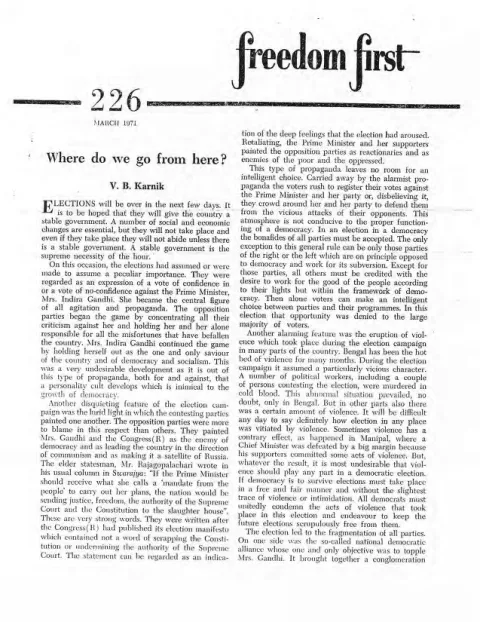
V. B. Karnik’s editorial “Where do we go from here?” argues stable government is the country’s supreme need, criticising both Congress(R) and the opposition for turning the 1971 election into a referendum on Indira Gandhi personally and flagging election violence, especially in Bengal.
-
Arvind A. Deshpande’s “A Farewell To Real Politics?” surveys party manifestos as collectively “unimpressive” and “innocuous,” grouping them into statist, Congress(R) and PSP, anti-statist, the Congress(O)-Swatantra-Jana Sangh alliance, and extreme-left, CPI and CPM, trends, and dismissing the far-left programme as unworkable.
-
A contributed survey of Chinese foreign policy documents Chinese-linked subversive incidents across Africa and Latin America, China’s improving relations with Allende’s Chile, and its continuing rivalry with the Soviet Union for influence in Pakistan, Afghanistan and Nepal.
-
A participant report covers two Leslie Sawhny Programme/Friedrich-Naumann-Stiftung seminars: a Bombay seminar on “The Widening Gap” concluding neither comprehensive planning nor massive foreign aid is necessary or sufficient for development, and a Poona seminar on nationalism concluding no decisive peaceful settlement between the communist and non-communist worlds is likely.
-
Reviews cover B. B. Misra’s The Administrative History of India 1834-1947, A. G. Noorani’s Aspects of India’s Foreign Policy, and R. A. Gopalaswami’s Indian Polity, which proposes a two-party system to end political instability.
-
A “Without Comment” item reports the arrest of Anglican Dean Gonville ffrench-Beytagh in South Africa under the Terrorism Act after his outspoken sermons against apartheid.
-
The closing “With Many Voices” column, alongside the issue’s statutory ownership statement, quotes P. K. Tripathi framing the Golaknath case as a dispute over supremacy between the Supreme Court and Parliament.
Essays
Where do we go from here?
By V. B. Karnik
V. B. Karnik’s editorial, written as the 1971 general election results are awaited, argues that a stable government is the country’s supreme need regardless of which social and economic changes follow. He criticizes both the ruling party and the opposition for turning the election into a referendum on Indira Gandhi personally, warning that this cult-of-personality style of campaigning is corrosive to democracy. He condemns the lurid mutual propaganda between Congress(R) and the opposition alliance (quoting Rajagopalachari’s Swarajya column comparing a Gandhi ‘mandate’ to sending the Constitution and the Supreme Court ‘to the slaughter house’), and singles out election violence, especially in Bengal, as an alarming feature. He closes by urging that whatever the result, all democratic parties must find common ground and work together rather than continue factional struggle.
- A stable government is described as the supreme necessity, prerequisite to any social or economic change taking hold.
- The election became a referendum for-or-against Indira Gandhi personally, which the author sees as fostering an unhealthy personality cult.
- Opposition parties are criticized for painting Congress(R) as pro-Communist and a satellite of Russia; Congress(R) retaliated by branding opposition parties reactionary and anti-poor.
- Rajagopalachari’s Swarajya column is quoted attacking the idea of a Gandhi ‘mandate’ as a threat to the Constitution and Supreme Court.
- Election violence, especially in Bengal (including murders of political workers), is flagged as a serious democratic danger.
- The opposition’s ‘national democratic alliance’ is described as a fragile conglomeration of parties with divergent programmes, united only by the aim of toppling Mrs. Gandhi.
- The piece closes with a call for all democratic parties to cooperate for national progress regardless of election outcome.
A Farewell To Real Politics?
By Arvind A. Deshpande
Arvind A. Deshpande surveys the manifestos of the major parties contesting the 1971 election, calling them collectively ‘unimpressive’, ‘disappointing’ and ‘innocuous’, and argues that most parties avoided real political debate on substantive issues. He groups the manifestos into three strategic trends: statist/socialist moderate-left (Congress(R), PSP), anti-statist/anti-communist partly-liberal partly-Gandhian (Congress(O), Swatantra, Jana Sangh, and to some extent SSP), and extreme-left/Communist (CPI, CPM). He walks through each party’s specific commitments — Congress(R)‘s land ceilings and privy-purse abolition, the PSP’s radical structural reforms, the Congress(O)-Swatantra-Jana Sangh alliance’s commitment to property rights and constitutional defence, the Jana Sangh’s stance on China/Pakistan and a uniform civil code, and the CPI/CPM’s calls for a new Constituent Assembly, nationalization, and a ‘People’s Democratic State’ — concluding that the far-left programme is unworkable in India and quotes Engels on the folly of trying ‘to make people happy by force’.
- All major-party manifestos are judged unimpressive, disappointing and innocuous, seemingly avoiding real political issues in what was treated as a referendum-style poll.
- Manifestos are grouped into three strategic trends: statist/socialist (Congress(R), PSP); anti-statist/anti-communist (Congress(O), Swatantra, Jana Sangh, partly SSP); and extreme-left (CPI, CPM).
- Congress(R)‘s manifesto reaffirms urban property ceilings, land reform, abolition of privy purses, and enlargement of the public sector, while remaining vague on constitutional amendments.
- The PSP manifesto calls for radical structural change, socialization of the ‘commanding heights’ of the economy, and restoring Parliament’s sovereign right to amend the Constitution.
- The Congress(O)-Swatantra-Jana Sangh ‘Democratic Front’ alliance emphasizes property rights, judicial independence, rule of law, and a pragmatic approach to planning; the Jana Sangh separately calls for recovery of Chinese/Pakistani-occupied territory and a uniform civil code.
- The CPI and CPM manifestos call for a new Constituent Assembly, nationalisation of foreign trade and big industry, a wealth ceiling, and a ‘People’s Democratic State’ led by the working class.
- The author dismisses the extreme-left programme as unworkable in India, quoting Engels’s warning against trying to make people happy by force.
China And The World
By (Contributed)
This contributed, unsigned piece surveys Chinese foreign policy and covert activity worldwide as reported by the New China News Agency (NCNA) heading into 1971. It documents Chinese-linked subversive and diplomatic incidents across Africa (Burundi, Congo-Kinshasa, Central African Republic, Tunisia) and Latin America (Brazil, Mexico, Ecuador, Venezuela, Cuba, Chile), arguing that even as China expands formal diplomatic and trade ties, it continues to support ‘people’s wars’ and pro-Chinese splinter movements, though with reduced ambition after Guevara’s death and general guerrilla setbacks. It then turns to Asia, describing China’s continuing rivalry with the Soviet Union for influence in Pakistan, Afghanistan, and Nepal, its cultivation of Maoist student sympathizers in Nepal, and its cautious but improving relations with Chile under Allende and with Cuba.
- NCNA’s 1971 New Year messaging emphasized ‘anti-imperialist struggle’ across Africa, Latin America, and Oceania, though much of Asia coverage focused narrowly on Philippine Communist guerrillas.
- Multiple African states (Burundi in 1965, the Central African Republic in 1966, Tunisia) expelled Chinese diplomats or NCNA staff over alleged subversion and arms smuggling.
- Chinese-linked subversive activity in Latin America included arrests of pro-Chinese ‘Marxist-Leninist’ movement members in Brazil and Mexico and NCNA office closures in Ecuador and Venezuela.
- By 1970 only two of five Peking-staffed NCNA bureaus in Latin America (Cuba and Chile) remained functioning, with China’s support for ‘people’s wars’ reduced but not abandoned after Guevara’s death.
- China’s relations with Chile improved after Allende’s election, with Chou En-lai congratulating Chile on its ‘just struggle against imperialist aggression’ and both countries agreeing to exchange ambassadors.
- In Nepal, China is reported exploiting strains in Indo-Nepali relations, cultivating Maoist sympathies among students, and providing roughly one-sixth of Nepal’s foreign aid, including road-building projects.
- Pakistan and Afghanistan continue to receive significant Chinese aid and diplomatic attention as China and the Soviet Union compete for influence in the region.
Two Seminars - A Report
By (A Participant)
An unnamed participant reports on two seminars organized in late 1970 and early 1971 by the Leslie Sawhny Programme of Training for Democracy together with the Friedrich-Naumann-Stiftung. The first, held in Bombay in December on ‘The Widening Gap’, brought together economists, journalists and public figures including Prof. P. T. Bauer, M. R. Masani, G. L. Mehta, B. R. Shenoy and G. G. Gadgil to debate development planning, foreign aid, and foreign equity investment, concluding that neither comprehensive planning nor massive international aid is either necessary or sufficient for rapid economic progress, and that properly utilised foreign capital has a positive role that has been undervalued. The second, held in Poona from January 31 to February 2 on ‘The Role of the Nation-State in the emerging one world’, discussed nationalism’s complex, double-edged character and debated whether communism remains compatible with peaceful coexistence, concluding pessimistically that no decisive peaceful settlement is likely between the communist and non-communist worlds short of a stalemate.
- The Bombay seminar on ‘The Widening Gap’ (December 1970) included Prof. P. T. Bauer, M. R. Masani, G. L. Mehta, F. A. Mehta, A. D. Moddie, B. R. Shenoy, and other economists and public figures.
- Participants agreed that poverty alone does not represent a fundamental barrier to economic progress, and that the ‘vicious circle of poverty’ thesis does not by itself justify massive planning or aid.
- There was broad agreement that neither comprehensive planning nor international aid is strictly necessary or sufficient for rapid economic progress; specific national performance (India, Indonesia, Burma, Brazil) matters more than aggregate ‘widening gap’ framing.
- Discussion of foreign equity capital balanced concerns about foreign control against the benefits of technology transfer and managerial skills, urging a ‘more mature view’ by developing countries.
- The Poona seminar (Jan 31-Feb 2, 1971) on nation-states discussed nationalism as complex and double-edged — a unifying, constructive force that could also curdle into aggression, suppression, and isolationism.
- The Poona seminar concluded that communism’s stated aim of international brotherhood has, in some countries, taken on ‘imperialist adventure’ characteristics, and that no decisive peaceful settlement between communist and non-communist worlds is likely, only an uneasy stalemate.
Reviews: The Administrative History of India 1834-1947 (Dr. B. B. Misra)
By V. B. Patankar
The Reviews section covers three books. V. B. Patankar reviews Dr. B. B. Misra’s ‘The Administrative History of India 1834-1947’ (Oxford University Press), praising its erudition and readability while noting the author’s own admission that, given the vastness of the subject, ‘no study in depth was possible’; the review summarizes the book’s account of centralising administrative power after 1834, the dominance of the executive, and the uneven effects of imperial educational policy on Indian society. N.D. reviews A. G. Noorani’s ‘Aspects of India’s Foreign Policy’ (Jaico), an eleven-chapter collection of the author’s articles on India-Pakistan relations, Sino-Indian and Indo-Pak wars, and non-alignment, describing Noorani as a fearless, US-aligned commentator whose views often cut against official Indian opinion. V.B.K. reviews R. A. Gopalaswami’s ‘Indian Polity — A Plea for Reform’ (Nachiketa Publications), which proposes a two-party system and constitutional/electoral reforms to end political instability and also addresses graduate unemployment, but the reviewer finds the proposals under-thought given how entrenched party fragmentation already is.
- Misra’s ‘Administrative History of India 1834-1947’ is praised for erudite scholarship and readability but criticized (by the author’s own admission) for lacking depth given its vast scope across 650-plus pages.
- The Misra review highlights the book’s treatment of the 1834 abolition of East India Company trading rights, the centralisation of administrative power, and the role of imperial educational policy in producing a loyal middle class.
- Noorani’s ‘Aspects of India’s Foreign Policy’ is an eleven-chapter, roughly 400-page collection of articles from the prior nine years priced at Rs. 10, covering India-Pakistan and Sino-Indian relations, Nehru and non-alignment, and territorial disputes.
- The reviewer (N.D.) describes Noorani as firmly aligned with the democratic U.S. and opposed to communist Russia, and notes his views often diverge from official Indian opinion.
- Gopalaswami’s ‘Indian Polity’ proposes constitutional and electoral changes to establish a stable two-party system and separately proposes manpower planning to address graduate unemployment.
- The reviewer (V.B.K.) judges Gopalaswami’s proposals as under-developed given how far party fragmentation has already progressed and how weak the political incentive is to adopt them.
Reviews: Aspects of India’s Foreign Policy (A. G. Noorani)
This ‘Without Comment’ item reprints a report from the Swiss Press Review and News Report on the arrest of the Very Reverend Gonville ffrench-Beytagh, Anglican Dean of Johannesburg, under South Africa’s Terrorism Act, which allows indefinite detention without judicial guarantee. The piece frames the Dean’s arrest as retaliation for his outspoken sermons against apartheid, notes his likely deportation as a British citizen, and connects the timing to the recent visit to South Africa by the Archbishop of Canterbury, Dr. Michael Ramsey, who had also spoken out against apartheid and reported being spied upon during his stay.
- The Very Reverend Gonville ffrench-Beytagh, Anglican Dean of Johannesburg, was arrested under South Africa’s Terrorism Act, permitting indefinite detention without judicial procedure.
- The report argues his arrest, framed by police as related to his private life, actually followed sustained security-police surveillance of his anti-apartheid sermons.
- As a British citizen, the Dean is expected to receive consular access and likely eventual deportation rather than prosecution.
- The arrest’s timing is linked to the recent visit of Archbishop of Canterbury Dr. Michael Ramsey, who also criticized apartheid and reported being spied upon in South Africa.
Indian Polity - A Plea for Reform (R. A. Gopalaswami)
By N.D.
‘With Many Voices’ is Freedom First’s regular column of short press quotations on current affairs, opening with a Tennyson epigraph and drawing on sources including M. R. Masani, David Lawrence, British PM Edward Heath, Inder Jit, and P. K. Tripathi, touching on the CPI’s political character, the Vietnam war, faulty Indian economic planning, unrest in West Bengal’s education system, India-Pakistan relations, and the constitutional stakes of the Golaknath case. The page also carries the statutory ‘Statement about Ownership and Other Particulars of Freedom First’, naming V. B. Karnik as printer, publisher and editor, and the Democratic Research Service as owner, dated 1 March 1971.
- The column collects short press quotations from figures including M. R. Masani, U.S. commentator David Lawrence, British PM Edward Heath, journalist Inder Jit, and Dean P. K. Tripathi of Delhi University’s Faculty of Law.
- Quoted items touch on the CPI’s political alignment, the Vietnam war’s domestic political toll on the US Congress, faulty economic planning in India, the breakdown of West Bengal’s educational system, and India-Pakistan tensions.
- P. K. Tripathi’s quote on the Golaknath case frames the constitutional dispute as one of supremacy between the Supreme Court and Parliament rather than over the Constitution’s supremacy itself.
- The issue’s statutory ownership statement names V. B. Karnik as printer, publisher and editor, based at 127 Mahatma Gandhi Road, Bombay 1, with the Democratic Research Service as owner, signed 1 March 1971.
Generated by the v1.5 extraction pipeline. Awaiting editorial review.
Metadata and summary are AI-extracted from the source PDF and reviewed for editorial accuracy. The original work is available via the Read PDF tab above (where present); paragraph-level citation inside the PDF is deferred to a future engagement.